
 Your current location >> Press Release
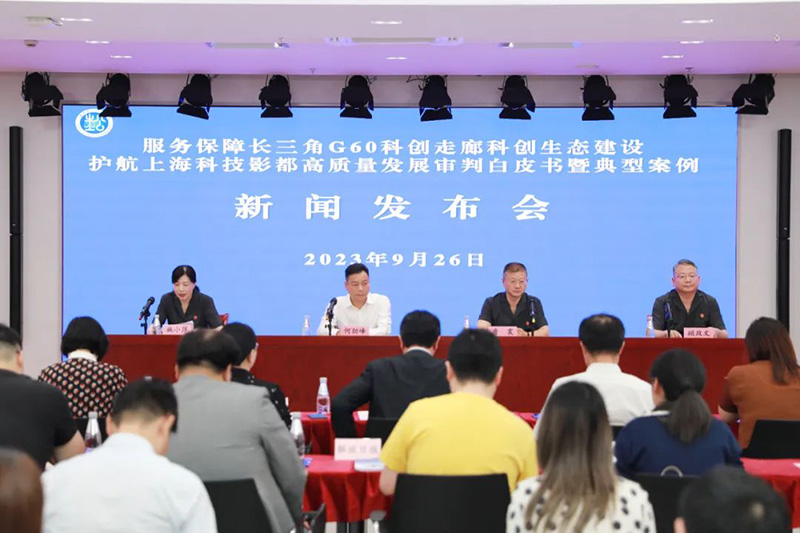
An important platform to show a country’s cultural soft power, the film and television industry is of great significance for staying culturally confident, increasing regional cohesion, gathering new drivers for economic growth, and meeting people’s expectations for a better life. In order to play an active judicial role, on September 26, 2023, the Shanghai Songjiang District People’s Court (hereinafter referred to as “Songjiang Court”) held a press conference to release the Guaranteeing the Development of the Yangtze River Delta G60 Science and Technology Innovation Valley and Promoting the Shanghai S&T Film and Television Capital: A White Paper on the Trial of Cases (2021-2023) (hereinafter referred to as “White Paper”), along with ten typical cases.
It was the 20th session in a series of press conferences aimed at promoting the modernization of work in Shanghai courts.
He Jinfeng, deputy director of the Publicity Department of the CPC Songjiang District Committee and secretary of the Party Leadership Group of the Songjiang District Culture and Tourism Bureau, attended the meeting. Tang Zhen, member of the Party Leadership Group and vice president of the Songjiang Court, briefed the attendees on relevant situation. More than 60 people were invited, including Cao Chengli, deputy to the Shanghai Municipal People’s Congress, Zhuang Lingling, member of the CPPCC Songjiang District Committee, Cong Lixian, dean of Intellectual Property School of East China University of Political Science and Law (ECUPL), Yu Zhiqing, secretary-general of the Shanghai Broadcasting Film & Television Producers Association (SFTPA), reporters, representatives from film and television companies and actors’ and actresses’ studios, and some teachers and students from ECUPL, Shanghai University of Political Science and Law (SHUPL), and Shanghai University of International Business and Economics (SUIBE). Film and television companies from film and television industry bases in the Yangtze River Delta region participated via a video link. Shi Xiaoping, member of the Party Leadership Group, director of the Political Department, and spokesperson of the Songjiang Court, hosted the press conference.
According to the White Paper, from January 2021 to June 2023, the Songjiang Court accepted 468 cases related to the film and television industry. The disputes are mainly over copyright, service contracts, right of personality, investment and financing in film and television projects, unfair competition, and film and television drama co-creation contracts. And copyright disputes are the most, accounting for 52.77% of the total. 329 cases are settled through mediation or withdrawal, accounting for 73.43% of the closed, which suggests a high likelihood to resolve in multiple ways disputes in the film and television industry.
The White Paper summarizes the characteristics of cases concerning the film and television industry from 2021 to 2023: 1. A long intellectual property infringement chain, which involves such industry links as creative planning, script writing, adaptation of works, audio-visual production, commercial application of animation images, copyright trading, and digital application, and there is a diversity of infringement; 2. Increasing disputes over service contracts in new business forms, such as short video production, live stream sales, and live stream platform operation; 3. Increasing cyber-infringement upon personality rights: The violation of film and television celebrities’ personality rights, such as the right of name and the right of portrait, has shifted from traditional ways involving physical stores and billboards to the Internet-based ways; 4. Multiple purposes of film and television investment and financing: In addition to the elements of general investment and financing contracts, film and television investment and financing contracts often include commercial development of films and TV dramas, such as using them for exhibition, business training, and derivative work, which shows mixed purposes.
The White Paper then digs into the outstanding problems existing in the disputes involving the film and television industry and the causes lying behind them: 1. The easy reproduction of intellectual property leads to an increase in infringement; 2. Commercial approach to rights protection causes a higher cost; 3. Too principled contract makes it difficult to ascertain the facts; 4. Poor corporate governance leads to errors in decision-making.
In order to guarantee and promote the high-quality development of the film and television industry, the Songjiang Court proposes the four suggestions below. First, increasing efforts to protect intellectual property rights in the film and television industry: A sound intellectual property management system should be established. People should properly manage and protect their intellectual property rights in accordance with relevant laws and regulations, and improve evidence awareness and litigation ability against infringement. Second, working together to create a mechanism to resolve in multiple ways disputes in the film and television industry: The court and relevant functional departments should strengthen communication to establish a professional linkage mechanism and consultation system, unify the ideas and standards of law enforcement, and promote the universal protection of the film and television industry. It should also learn from the “Fengqiao Experience”, adhere to the principle of “mediation first, mediation and judgment combined”, and promote the substantive resolution of disputes. Third, reviewing the film and television contracts to ensure compliance: Film and television companies should pay more attention to contracts and review the normative elements, clauses and terms of contracts, so as to avoid disputes caused by ambiguity in contract clauses. Fourth, improving internal governance in a company: Film and television companies should notify or vote in strict accordance with the provisions of the company law and the articles of association when it comes to a capital increase or reduction, and collectively study investment and financing risks, arrange for share payment, and decide contract text through standardized resolutions of the shareholders’ meeting and the board of directors.
Songjiang District is home to the Shanghai S&T Film & Television Capital. In recent years, focusing on the bigger picture of regional economic development, the Songjiang Court has practiced active justice and engaged itself in protecting the whole film and television industry chain in its jurisdiction, fully performed its judicial function and tried in a fair and efficient manner all kinds of cases related to the industry, thus providing powerful judicial services and guarantees for the high-quality development of the film and television industry in Songjiang. First, it has worked on litigation source management and built a mechanism to resolve disputes in a substantive and coordinated manner; promoted the protection of intellectual property rights in the film and television industry and the coordinated protection of the industry needs and enterprises’ development; and played a leading role in front-end governance. Second, it has revolved around the central task of case trial and established a professional trial mechanism to increase judicial protection of the film and television industry. Third, it has established, through regional collaborative protection, a mechanism to serve and guarantee the film and television industry. Relying on the regional intellectual property collaborative protection center, the court and the Publicity Department of the CPC Songjiang District Committee, the Songjiang District Culture and Tourism Bureau, ECUPL Intellectual Property School, and the SFTPA co-established the Film and Television Industry Intellectual Property Application and Protection (Songjiang) Base to deeply combine production, study, research, and application, and stimulate the enthusiasm of market entities for greater innovation and development.
Cao Chengli, deputy to the Shanghai People’s Congress and secretary of the Party General Branch and director of the committee of Huguang Village, Maogang Town, Songjiang District, said that the White Paper uses data, cases, and suggestions to show how the judicial organs help promote high-quality economic and social development by practicing active justice with solid measures. Not only does the White Paper sort out and analyze the characteristics and causes of disputes involving the film and television industry, but also it proposes reasonable and targeted countermeasures and suggestions according to the needs of enterprises. With its preventive measures in the preliminary stage, the court has contributed to the formation of a new pattern of litigation source management. With the support and protection of the judicial organs, Cao believed that the “Shanghai S&T Film & Television Capital” would go big and the film and television industry would be brought to a new stage of higher-quality and higher-level development.
Zhuang Lingling, a member of the CPPCC Songjiang District Committee and a full-time lawyer of Guantao Law Firm Shanghai, said that the film and television industry has a large commercial value, involves a wide range of people, and produces highly original results. Therefore, the rapid development of the industry is accompanied by many challenges such as a high occurrence of disputes, various forms of infringement, and blockage in rights protection. Based on the overall situation of regional development, the Songjiang Court has given full play to its judicial functions. In response to the new situation, new forms, and new problems in the film and television industry, it has sought to resolve the disputes substantively in a coordinated manner, created a professional trial mechanism, and established a system to serve and guarantee the development of the industry, thereby providing a strong judicial guarantee for the high-quality development of the industry. The cases released at the conference are quintessential and can serve as examples to help relevant market entities in the film and television industry improve corporate governance, avoid risks, and safeguard their legitimate rights and interests. With an enhanced political stance, the conference launched targeted and practical measures to help strongly promote the high-quality development of the film and television industry.
>> Chinese Version
