
 Your current location >> Press Release
How can voluntary guardianship be
supervised to protect the personal and property rights of the ward? How can
elderly individuals safeguard their right of residence after transferring
property ownership? Can a personal safety protection order be sought in cases
of domestic violence following a divorce?
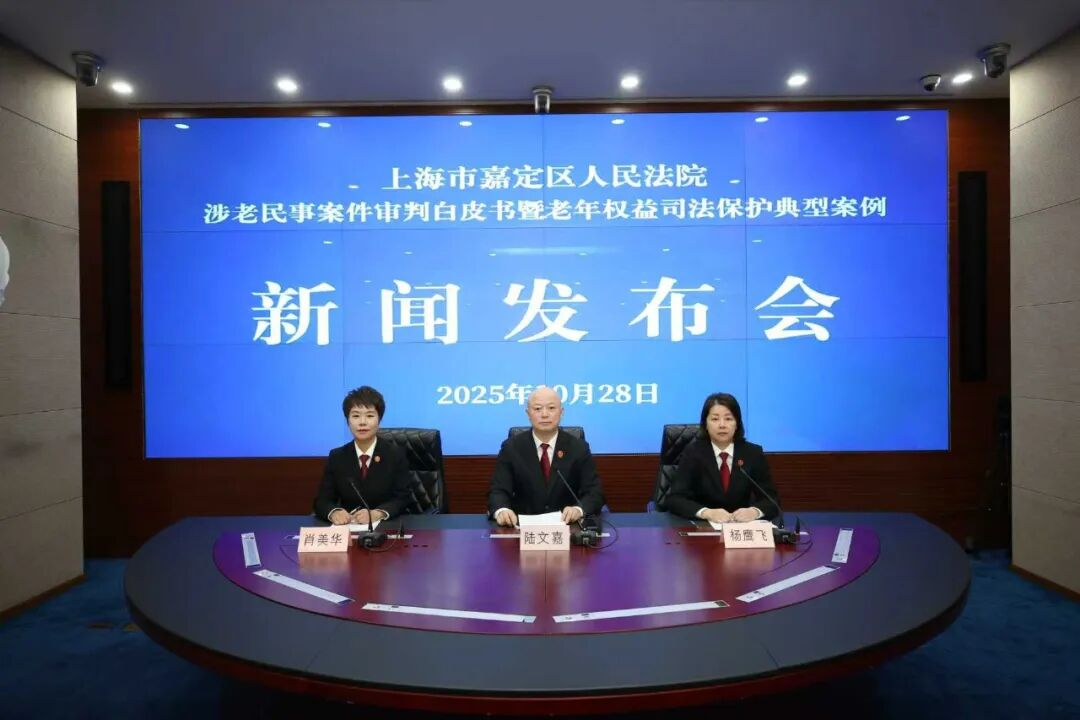
On the morning of October 28, ahead of
the traditional Double Ninth Festival, the Jiading District People's Court of
Shanghai (hereinafter referred to as Jiading District People's Court) held a
press conference. The court released the White Paper on the Trial of
Elderly-Related Civil Cases and a set of typical cases concerning judicial
protection of seniors' rights, reporting on elderly-related civil case trials
from 2022 to September 2025 and presented 10 representative cases illustrating
judicial protection for the elderly. This move aimed to implement a national
strategy of proactively responding to population aging, showcase the practical
achievements of courts in elderly-related trials, accurately address societal
concerns about the protection of elderly rights, and foster a favorable
atmosphere of caring for and supports the elderly in building a senior-friendly
society. Lu Wenjia, Vice President of Jiading District People's Court, and Xiao
Meihua, Chief Judge of the Civil Division of Jiading District People's Court,
attended the press conference and answered questions from journalists. Deputies
to the Shanghai Municipal People's Congress and some news media were invited to
attend the press conference. The conference was chaired by Yang Yingfei, Head
of the Political Department and Spokesperson of Jiading District People's
Court.
According to the White Paper, between
2022 and September 2025, the Jiading District People's Court accepted a total
of 13,408 elderly-related civil cases, showing a steady year-on-year rise.
In terms of case types, contract
disputes and tort (personality rights) disputes accounted for the majority,
with family, property rights, and special procedure cases also representing a
significant proportion. These trends reflect the diverse legal needs of the
elderly, whose primary concerns focus on personal and property safety as well
as family relationships.
Key characteristics of elderly-related
civil cases include:
Contract disputes: A high incidence of
disputes involving property security and daily-life services. Private lending
cases account for nearly one-third. Disputes related to property management,
leasing, and housing sales rank second to fourth, underscoring the central
importance of housing as an essential asset for elderly individuals.
Tort (personality rights) disputes:
Tort risks are becoming increasingly diversified. Motor vehicle traffic
accident liability disputes and non-motor vehicle accident liability disputes
rank first and second, respectively. Special tort cases—including medical malpractice
liability and liability for harm caused by domestic animals—occur with notable
frequency.
Family disputes: These disputes are
highly inheritance-driven and deeply intertwined with family dynamics.
Inheritance matters account for more than 55% of all family cases, with the
absence of a will being the primary reason for the high incidence of
statutory-inheritance conflicts. Divorce cases involving elderly individuals
and post-divorce property disputes often center on asset management and
interference by adult children. Support disputes directly relate to ensuring
adequate care for the elderly, with the attitude of "no share of the
property, no obligation to support" becoming a common source of conflict.
Property rights disputes: New
categories of cases—such as those involving home renovation projects and noise
pollution—are on the rise. A considerable number of disputes involve
neighboring relations, partition of co-owned property, confirmation of
ownership, and removal of obstructions.
Special procedure cases: Applications
for declaring a natural person as having no or limited civil capacity, together
with related special guardianship procedures, account for nearly 90% of such
cases. While traditional family-based guardianship remains dominant, emerging
needs have led to the development of new guardianship models, including
voluntary (appointed) guardianship, social guardianship, and testamentary
guardianship. A number of applications for personal safety protection orders
are also present among elderly-related special procedure cases.
The White Paper concludes that the
trial of elderly-related civil cases faces the following issues:
(i) intertwined legal relationships and
difficulty in ascertaining facts; (ii) insufficient evidence-providing capacity
and inadequate response to litigation procedures; and (iii) weakened family
autonomy and prominent non-property claims.
To effectively address the challenges
brought by population aging, shift the handling of elderly-related disputes
from "post-incident resolution" to "early-stage prevention plus
diversified resolution," and enhance seniors' sense of security and
well-being, the White Paper proposes countermeasures in four aspects: First,
move the service front line forward by enhancing seniors' awareness of risk
prevention through targeted legal education. Conduct special lectures in
elderly care institutions and universities for seniors; establish "Rule of
Law Service Stations" to provide regular legal consultation; and develop a
"legal risk early warning mechanism for the elderly". Second, fully
integrate the concept of "senior-friendly" services throughout the
creation of comprehensive litigation service channels for the elderly. Provide
dedicated staff to guide seniors in using tools such as "micro-litigation";
expand circuit trials and on-site mediation for elderly-related cases; and
jointly build a litigation service platform tailored to seniors. Third, combine
specialized adjudication with flexible dispute-resolution mechanisms to ensure
stable and effective conflict resolution. Establish specialized collegial
benches or judge teams for elderly-related cases; build a coordinated
"judiciary + grassroots" mechanism for dispute resolution; and
implement post-judgment follow-up and assistance mechanisms. Fourth, upgrade
the supporting guardianship system to protect the legitimate rights and
interests of the special elderly groups. Promote voluntary guardianship for
seniors; implement the "Three-Way Separation of Property Rights"
model; establish a full-process supervision mechanism; and build a diversified,
collaborative guardianship system that ensures comprehensive protection.
Briefing on 10 typical cases to set
exemplary precedents
At the press conference, the Jiading
District People's Court also released and interpreted the Typical Cases of
Judicial Protection of Elderly Rights. These 10 typical cases cover a range
of key areas, including property rights, personal safety, consumer protection,
elderly care services, and guardianship procedures. Through fair and efficient
adjudication, the court safeguards the lawful rights and interests of seniors
and promotes core socialist values.
For example, in the case of Zhu A v.
Zhu B (Guardianship Liability Dispute), the court confirmed that the core duty
of a guardian is to safeguard the ward's personal, property, and other lawful
rights and interests, and that the guardian may not dispose of the ward's
property except for the ward's benefit. This ruling demonstrates the
judiciary's robust protection of the property rights of elderly persons with
disabilities under guardianship.
In the case of Yan v. Chen (support
payment dispute), the court clarified the boundaries of support obligations,
holding that children may not evade their duty to support their parents due to
family conflicts, while also requiring that parents may not impose unreasonable
or disproportionate burdens on specific children.
In the case of Zhao et al. v. Tao
(Nuisance Removal Dispute) and the Application for Change of Guardian by a
Guardianship Center, the court offered innovative solutions to protect the
rights of special elderly groups. By applying mechanisms such as
"conditional gifting to safeguard residence rights" and the
"Three-Way Separation of Property Rights" guardianship model, the
court explored new approaches to ensuring the well-being of vulnerable seniors.
It is reported that the 4 dispatched
tribunals covering the district's 12 subdistricts and towns organized local
residents to watch the press conference online and presented books to resident
representatives.
Launching respect-for-the-elderly
activities to empower elderly-oriented social governance
On the afternoon of the press
conference, officials from the Jiading District People's Court, the Jiading
District Civil Affairs Bureau, the Jiading District Welfare Institute, and
others attended a symposium themed "Warmth for the Golden Years, Justice
to Help the Elderly" at the Qiaoqiao Social Welfare Institute in the
Jiading Industrial Zone.
At the event, the Jiading District
People's Court presented the White Paper on the Trial of Elderly-Related Civil
Cases and the Typical Cases of Judicial Protection of Elderly Rights
to the participating welfare institutions. Two judges from the court also
carried out elderly-focused legal education activities through case-based
explanations, addressing key topics such as support obligations, the right of
residence, and guardianship rights.
[Representative Comments]
Chen Dong
Deputy to the Shanghai Municipal
People's Congress and On-board Mechanic at the Shanghai South EMU Depot of
Shanghai EMU Depot, China Railway Shanghai Group Co., Ltd.
Based on a comprehensive analysis of
the unique trial difficulties in elderly-related cases, Jiading District
People's Court effectively addressed the urgent concerns, difficulties,
worries, and expectations of the elderly. This demonstrates the warmth of
justice for the people in the details. This is achieved by building a targeted
elderly-related law popularization education system, improving a specialized
trial and diversified dispute resolution system, and strengthening an elderly-related
framework for litigation service assurance. It is hoped that the court will
continue exploring new measures and methods for elderly-related trials,
providing high-quality judicial services and safeguards to comprehensively
protect seniors' rights and interests, so that the elderly may enjoy support,
companionship, fulfillment, and peace in their later years.
Ju Xiaofang
Deputy to the Shanghai Municipal
People's Congress and Director of the Jiading District Agricultural Technology
Extension and Service Center
The 10 typical cases released by the
court today are truly impressive. Whether it is the grave plot usage rights case
or the family dispute over support obligations, the court fully considered the
special role of public order and good morals in protecting the rights of the
elderly. Cases such as the elderly care institution tort compensation case and
the excessive health supplement refund case reflect the court's unremitting
efforts to safeguard the personal and property safety of the elderly.
Particularly, the case involving testamentary designated guardianship showcases
the court's innovative approach. The "Three-Way Separation of Property
Rights" mechanism can play a vital role in special scenarios,
including—though not limited to—families where elderly individuals care for
disabled dependents. These typical cases cover a wide range of issues faced by
seniors in daily life, enhancing their sense of security and well-being.
>> Chinese Version
