
 Your current location >> Press Release
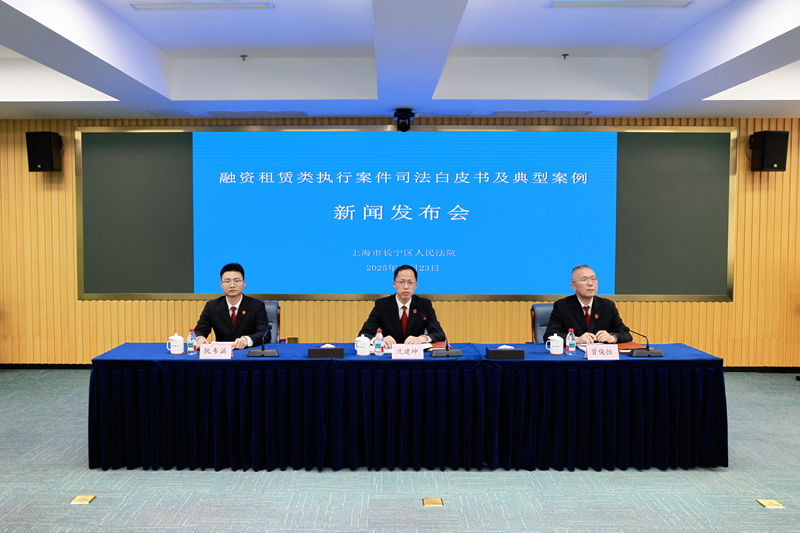
The financial leasing industry connects finance and the real economy and has the dual attributes of "financing" and "asset leasing". This industry is of great significance for improving the modern industrial system and enhancing the capabilities of global resource allocation. How to safeguard and realize the financial leasing companies' rights and interests affirmed by people's courts, and provide more comprehensive higher-quality judicial services and protection for this industry's development? On December 23, the Changning District People's Court of Shanghai (hereinafter referred to as the Changning District People's Court) held a press conference to release the Judicial White Paper on Financial Leasing Enforcement Cases (July 2020—June 2025) (hereinafter referred to as the white paper) and typical cases. The white paper focuses on the financial leasing enforcement cases over the past five years, deeply analyzes the characteristics of such cases, and summarizes the enforcement experiences so as to promote the sound and normalized development of financial leasing companies.
At the conference, Shen Jiankun, Vice President of the Changning District People's Court, released the white paper, while Zeng Junyi, Director of the Enforcement Department of the Court, introduced six typical cases. The press conference was hosted by Ruan Weihan, Deputy Director of the Office and Spokesperson of the Court. The participants included some deputies to the People's Congresses of Shanghai and Changning District, members of the People's Political Consultative Conferences of Shanghai and Changning District, representatives from the Commission of Commerce and the Investment Promotion Office of Changning District, representatives of financial leasing companies, and media reporters.
The white paper shows that from July 2020 to June 2025, the Changning District People's Court accepted 1,388 financial leasing enforcement cases and concluded 1,342 of them.
In terms of the types of leased assets, traditional leased assets such as vehicles, engineering machinery and equipment, and medical instruments and equipment accounted for nearly 60%. With the development of the digital economy and digital technologies, new leased assets such as intelligent manufacturing equipment and intelligent terminal equipment are emerging. Although these new leased assets accounted for a small proportion, their types were diversified.
In terms of enforcement quality and efficiency, the average enforcement recovery rate of financial leasing enforcement cases was only about 30%, indicating great difficulties in the enforcement of such cases. Many cases were closed by terminating the enforcement or terminating the current enforcement procedure, resulting in significant pressure on subsequent management.
In terms of asset disposal measures, a total of 20 financial leasing enforcement cases initiated judicial auction procedures, while only 11 of the cases finally entered the auction stage resulting in a low auction listing rate of 0.82%. Despite the existence of leased assets, it is difficult to realize the rights and interests affirmed by people's courts.
The Changning District People's Court analyzed the difficulties in the enforcement of financial leasing cases and the underlying reasons: insufficient risk management within the financial leasing industry itself leads to poor repayment performance; leased assets are scattered across different regions, making the seizure and disposal of them difficult; the pre-enforcement collaborative governance for financial leasing disputes needs improvement.
Accordingly, the Court proposed three countermeasures.
The first one is to intensify source control and improve industry standards: intensify control over leased financial assets from rights registration to dynamic monitoring; intensify the review of guarantee qualifications, from the review in form to substantive examination; carry out practical and refined supervision and management of the financial leasing industry to effectively prevent financial risks.
The second countermeasure is enhancing innovative explorations to comprehensively improve the quality and efficiency of leased assets disposal: explore diverse models of leased assets disposal, such as leaseback, debt settlement with assets, and compulsory management; improve the multi-dimensional and networked enforcement collaboration system to address the difficulty in cross-regional enforcement; realize intelligent enforcement by comprehensively utilizing modern technologies such as the BeiDou Navigation System; further explore the "living seizure and living detention" of financial leasing equipment to achieve a win-win situation of safeguarding creditors' rights and revitalizing enterprises.
The third countermeasure is enhancing collaboration to improve the quality and efficiency of case handling throughout the entire process: fix claims through element-based case filing, and clarify key information such as details of leased assets and purchase contract numbers; strengthen the guidance and examination of pre-litigation preservation, and open a green channel for the preservation of leased assets; enhance the status quo examination of leased assets and secure evidence during the trial stage; establish an information sharing mechanism connecting adjudication and enforcement to ensure rapid and accurate enforcement.
The six typical cases released this time focus on the effective resolution of financial leasing disputes. The Changning District People's Court has innovatively adopted a cross-regional cooperation mechanism, explored a joint auction method, and advanced the measures of "encumbering title without seizing assets" and "promoting settlement through auction." The Court has put great efforts into addressing the enforcement difficulties in financial leasing disputes and provided valuable experience for the lawful disposal of leased assets and for safeguarding the financial leasing companies' rights and interests affirmed by people's courts.
In a financial leasing contract dispute involving hundreds of vehicles, the Court first seized 671 vehicles under the name of the party subject to enforcement. However, the large number and wide distribution of these vehicles brought high seizure costs and great difficulties to their disposal. The Court innovatively adopted a joint auction mechanism, took into account the interests of all parties and achieved win-win cooperation, resulting in a successful enforcement of the case. At the same time, the Court streamlined the delivery process, realized the enforcement of the subject matter by involving the actual controller in the judicial auction, and avoided auction disruptions and mitigated risks through the deposit system.
In another dispute of financial leasing contract involving mechanical engineering equipment, the equipment was essential to the production and operation of the party subject to enforcement, and putting up the equipment involved for auction directly would have an adverse impact on the party's subsequent normal operation. The Court accurately grasped the importance of the leased equipment to the company's operation, and used the disposal of the equipment as a deterrent to prompt the party subject to enforcement to actively seek solutions, thus maintaining the enforcement power while creating conditions for the company to continue operating. The two parties eventually reached a settlement and the party subject to enforcement actively fulfilled its obligations, which were completed in the end according to the settlement agreement.
The "15th Five-Year Plan" proposes to "build a modern industrial system with advanced manufacturing as the backbone," and the financial leasing industry that connects the financial industry and the real economy is at a critical stage of transformation and upgrading. The Changning District People's Court will continuously optimize and innovate enforcement measures, improve the quality and efficiency of the enforcement work, and further enhance the level of judicial services, building a solid judicial protection line for the sound and orderly development of the financial leasing industry.
Comments of Deputies and Members
Sun Yin, a deputy to the Shanghai Municipal People's Congress, Party Secretary and Chairman of Donghongqiao Group, and Party Secretary of the Linkong Business Park
This press conference provides clear legal guidance for the collaborative governance and integrated resolution of financial leasing disputes. It will help promote the lawful and compliant, sound and orderly development of the financial leasing industry, and better assist relevant companies in shifting from high-speed growth to high-quality development. The financial leasing industry is an important link between finance and the real economy, with multi-dimensional and deep-level significance to the overall economic development. The relevant explorations and practices of the Changning District People's Court are a vivid example of how the judiciary empowers Shanghai in advancing its "five-center" development, enhancing its global resource allocation capabilities, and improving the city's core competitiveness. They effectively demonstrate the working principle of safeguarding high-quality economic and social development with strict impartial justice.
Yu Xiaoyu, a deputy to the Changning District People's Congress of Shanghai, and the Party Branch Secretary and General Manager Assistant of ShanghaiMart Co., Ltd.
Against the strategic backdrop of comprehensively deepening reforms and developing new quality productive forces, the financial leasing industry is an important component of high-quality economic development. The Changning District People's Court focuses on the characteristics and difficulties of financial leasing dispute enforcement cases and follows the new trends and new problems in the industry's development. The judicial white paper on financial leasing enforcement cases released by the Court summarizes the characteristics of such cases and the best practices in handling them. It will not only help improve the quality and efficiency of enforcement cases but also enhance the level of judicial services. The Changning District People's Court has provided typical cases and working experience for the enforcement of financial leasing dispute cases. It fully demonstrates the judicial philosophy of the people's courts in maintaining financial order and serving financial innovation, and injects strong judicial momentum into the sound development of the financial leasing industry.
Lin Lijuan, a member of the CPPCC Changning District Committee of Shanghai, Vice President of the Shanghai Women Lawyers Association, and Vice Chairperson of the Changning District Federation of Industry and Commerce
The release of this judicial white paper and typical cases is a practical action of the Changning District People's Court to actively serve the overall interests and optimize business environment. It reflects an initiative change from "adjudication" to "governance" and demonstrates the foresight and responsibility of judicial work. From "individual case reviews" to "industry guidance", the white paper makes an insightful extraction and a systematic analysis of the common problems, provides clear risk alerts and operation guidelines for the industry, achieving the deeper effect of "regulating an industry by the adjudication of relevant cases." It will also help to build a solid legal shield that extends from "resolving disputes" to "safeguarding development," ensure the steady and long-term development of the financial leasing industry, provide solid legal protection for high-quality economic development, and enhance the confidence and sense of gain of business operators.
>> Chinese Version
