
 Your current location >> Press Release
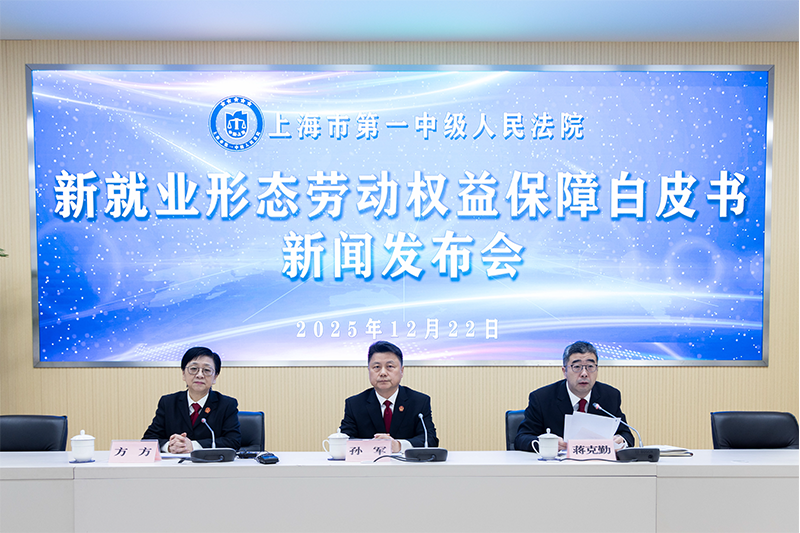
In recent years, new forms of employment arising from Internet platforms have been expanding in scale and have become an important part of the workforce. While creating substantial jobs, they have also brought new challenges to the traditional labor-related legal relations identification and the rights and interests protection system due to their flexible employment forms, digital management and other characteristics. What are the features of this type of case? How should judicial practice respond? Are there any typical cases to be learnt from? On December 22, the First Intermediate People's Court of Shanghai Municipality held a press conference to release a white paper on safeguarding labor rights and interests in new forms of employment, giving a general report on the Court's adjudication of labor dispute cases involving new business forms over the past four years and releasing six typical cases.
Sun Jun, Vice President of the First Intermediate People's Court of Shanghai Municipality, and Fang Fang, Chief Judge of the Civil Division of the Court, attended the press conference and gave a report. The conference was chaired by Jiang Keqin, Spokesperson and Research Office Director of the Court. The participants included some deputies to the Shanghai Municipal People's Congress, members of the CPPCC Shanghai Committee, relevant personnel from the Labor Relations Department of the Shanghai Federation of Trade Unions, and some reporters from the central and Shanghai media outlets.
Data analysis: The cases show four features, revealing the difficulties in safeguarding the workers' rights and interests.
The white paper shows that from January 1, 2022 to October 31, 2025, the First Intermediate People's Court of Shanghai Municipality concluded 79 second-instance labor dispute cases involving new business forms, with the number of cases in each year showing a slight upward trend.
In terms of the forms of closure, 78% of the second-instance cases affirmed the original judgment, 9% were revised, and 13% were settled through mediation or withdrawal.
In terms of the occupations of the parties involved in the lawsuits, delivery riders accounted for the largest proportion, with 25 people, accounting for 32%. Apart from delivery riders, there were also parcel deliverers, e-commerce operators such as customer service staff, live streamers, bloggers, and online car-hailing drivers.
In terms of workers' income, 55 cases showed specific income. Among them, the largest number of cases, totaling 16, involved monthly salaries below 5,000 yuan; the second largest number was 14, with monthly salaries between 5,000 and 8,000 yuan; 8 cases involved monthly salaries between 8,000 and 10,000 yuan; 13 cases involved monthly salaries of over 10,000 yuan; in 4 other cases, the monthly salaries were not fixed but directly related to the number of orders received.
In terms of the workers' claims, more than half of the cases involved claims for confirming labor relations, the payment of wage differences, overtime wages, and the conversion payment for unused annual leave. A small number of cases involved claims for compensation for wrongful termination of employment contracts and economic compensation for termination of employment contracts. There were another 3 competitive restriction disputes.
A total of 69 cases were closed by ruling. In 40% of them, the Court fully affirmed the workers' claims; in 30%, some of the workers' claims were affirmed; in the other 30%, the Court did not affirm the workers' claims.
The press conference introduced four characteristics of the labor dispute cases in new business forms and the problems to be solved:
First, the evidence structures are increasingly digital, and platform companies use digital technologies to manage employment and provide services. Second, the parties involved are diverse, mixed with platforms and multi-level outsourcing companies. Third, the legal relations are more complicated, with multiple employment models coexisting, such as direct operation, crowd sourcing, and outsourcing. Fourth, the claims are becoming more complex, as workers often make multiple claims and require multiple parties to jointly assume liability. Behind the cases are systemic problems facing the industry: It is difficult to identify legal relations; algorithm management lacks transparency and the supervision mechanism is inadequate; workers face weak protection of their basic rights and interests, such as social security, rest and vacations; the market is dominated by leading platforms and their management rules are similar, which further squeezes workers' bargaining power and channels for safeguarding their rights.
Safeguarding measures: Follow three paths to build a judicial protection system systematically
At the press conference, Sun Jun introduced a series of measures taken by the First Intermediate People's Court of Shanghai Municipality to support and regulate the sound development of new business forms.
The first measure is to "identify changes" precisely and perceive trends and problems from multiple channels. By taking root in adjudication practices, the Court analyzed case data from recent years and extracted the characteristics and underlying difficulties of these cases. By listening to the voices of the people, the Court collected opinions and suggestions from NPC deputies and CPPCC members, and communicated with the people through multiple channels, which helped it keenly grasp the urgent needs and concerns of workers. By making field research, the Court visited relevant enterprises and workers to gain an understanding of the dilemma of balancing business models and rights and interests protection, which laid a solid practical foundation for judicial decisions.
The second measure is to "respond to changes" scientifically and build rules and standards in judicial practice. To address the difficulties encountered in hearings, the Court held Judges Conferences to make professional studies and analyses and improve the quality and efficiency of adjudication. The Court cultivated typical cases to leverage their demonstrative and guiding roles. To address the difficulty in obtaining electronic evidence, the Court formed a set of effective methods to examine electronic evidence and reasonably allocated the burden of proof, truly lowering the threshold for workers to safeguard their rights and interests.
The third measure is to "seek changes" proactively and contribute to and promote social governance through the extension of adjudication. By publishing typical cases and adjudication guidelines, and by sending judicial recommendations to enterprises and regulatory authorities, the Court guided enterprises to improve compliance and regulatory practice. The Court intensified litigation mediation, improved the mediation-litigation coordination mechanism, and continued to promote circuit courts and other work, while communicating and cooperating with various departments, such as human resources and social security, market supervision, and trade unions. By creating columns such as Legal Knowledge, the Court aimed to enhance the legal awareness of workers and enterprises, and achieve the goal of "addressing problems before they arise."
At the press conference, Sun Jun stated that the First Intermediate People's Court of Shanghai Municipality would contribute a stronger judicial force, with high-quality judicial practice, to safeguarding the legitimate rights and interests of workers in new employment forms, promoting the normalized, sound and sustainable development of the platform economy, and serving the social governance of Shanghai as a megacity.
Comments of Deputies, Members and Experts
Zhu Xueqin, a deputy to the Shanghai Municipal People's Congress and part-time Vice Chairperson of the Shanghai Federation of Trade Unions, said that the white paper, with its detailed judicial data and cases, clearly reveals the common difficulties faced now by workers in new business forms in safeguarding their legitimate rights and interests, and it demonstrates the necessity of building an institutionalized consultation and coordination mechanism from the perspective of judicial practice.
Liu Huaxin, a deputy to the Shanghai Municipal People's Congress and Vice Chairperson of the Pudong New Area Federation of Trade Unions, said that the white paper is a vivid reflection of the First Intermediate People's Court of Shanghai Municipality proactively serving the overall economic and social development and earnestly responding to the people's livelihood concerns. It demonstrates the Court's efforts and commitment to balancing the protection of workers' legitimate rights and interests with the facilitation of the normalized sound development of new business forms.
Tong Lin, a member of the CPPCC Shanghai Committee and Vice President of the Shanghai New Social Stratum Association, said that the white paper released by the First Intermediate People's Court of Shanghai Municipality is timely and of profound significance. It is not only a summary of adjudication experiences, but also an important reference for promoting social consensus-building and facilitating multi-party collaborative governance.
Chen Rong, Director of the Labor Relations Department of the Shanghai Municipal Federation of Trade Unions, stated that the release of the white paper is based on judicial practice, responds to social concerns, and focuses on rule guidance and future planning. With solid data and professional analyses, it precisely reveals the real difficulties faced by workers in today's new business forms in various aspects, such as labor relations identification, algorithm management, and rights and interests protection.
