
 Your current location >> Press Release
Since
the Several Provisions of Shanghai Pudong New Area on Improving the
Market-Based and Law-Based Enterprise Bankruptcy System (hereinafter
referred to as the Pudong Bankruptcy Regulations) went into force, what
key explorations and institutional innovations have the people’s courts
undertaken in the field of bankruptcy adjudication? And how can bankruptcy
adjudication better play the role of market clearing and corporate rescue, and
continue to provide judicial support for optimizing the business environment
and promoting high-quality development?
This
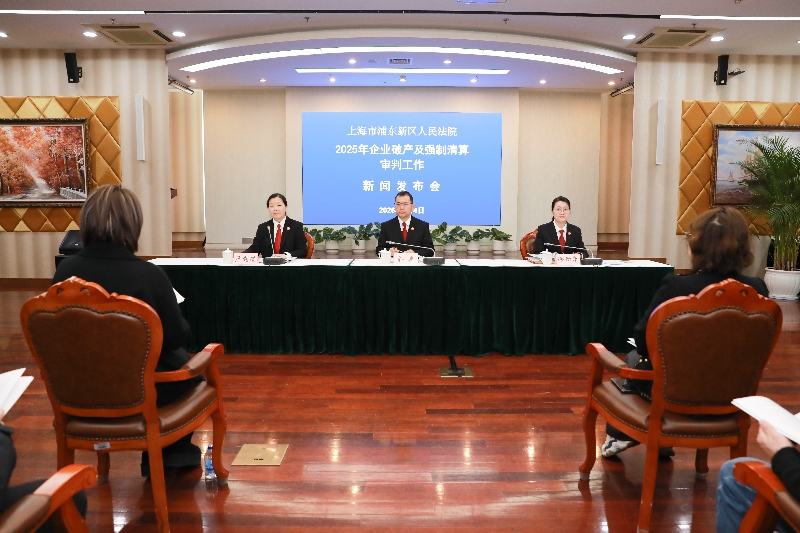
morning (March 4), the Shanghai Pudong New Area People’s Court (hereinafter
referred to as the “Pudong Court”) held a press conference on enterprise
bankruptcy and compulsory liquidation adjudication for 2025, summarizing new
trends, new characteristics, and new measures taken in bankruptcy adjudication,
addressing key issues and problems encountered in practice, and injecting
stronger judicial momentum into building a world-class business environment.
This
press conference was the fifth in the series “Anchoring the 15th Five-Year
Plan and Advancing Shanghai Courts to Take the Lead and Set the Example.”
At the press conference,
Yu Wei, Vice President of the Pudong Court, reported on the adjudication of
enterprise bankruptcy and compulsory liquidation cases. Xu Jingcao, Head of the
Bankruptcy Adjudication Division of the Pudong Court, introduced eight typical
cases. The press conference was hosted by Yan Jianyi, Deputy Director of the
Political Department and Spokesperson of the Pudong Court. Participants
included Deputies to the Shanghai Municipal and Pudong New Area People’s
Congresses, members of the Pudong New Area Committee of the Chinese People’s
Political Consultative Conference (CPPCC), representatives of the Shanghai
Association of Bankruptcy Administrators, and journalists from central and
Shanghai media outlets.
1,897 cases accepted in
2025, with 61.95bn yuan in debts cleared
According to the white
paper, in 2025, the Pudong Court accepted a total of 1,897 bankruptcy,
compulsory liquidation, and related derivative litigation cases, and concluded
1,647 of them. Among the concluded cases, bankruptcy accounts for 33.4%,
compulsory liquidation 36.4%, and derivative litigation 30.2%.
By case type, there were
eight bankruptcy reorganization cases concluded in 2025, attracting six
strategic investors—including five upstream and downstream industry chain
enterprises and one enterprise that is an existing shareholder of the
reorganized enterprise—and one financial investor. One enterprise, without resorting
to external investment, repaid its debts through a combination of methods. In
bankruptcy reorganizations, the court utilized flexible approaches such as cash
repayment, debt-to-equity swaps, and trust plans, revitalizing assets valued at
12.57bn yuan and clearing 43.4bn yuan in debts, significantly improving the
creditor repayment rate while rescuing enterprises.
In terms of the amount
disposed of, 61.95bn yuan in bankruptcy debts were cleared in accordance with
the law over the year, involving 3,388 creditors, and 4.64mn yuan in wage
guarantee funds were disbursed for 220 employees. In bankruptcy liquidation
cases, assets totaling 539mn yuan were collected and 18.44bn yuan in debts were
cleared. Four bankruptcy settlement cases were concluded, revitalizing 10.56mn yuan
in assets and clearing 110mn yuan in debts.
Faced
with diverse forms of assets, the court has enhanced the professionalism of
asset realization and refined disposal procedures to improve asset realization
efficiency, effectively protecting creditors’ rights while providing
opportunities for regeneration for enterprises with operational value.
By enterprise scale,
small and micro enterprises account for 72.8% of bankrupt enterprises and 51.4%
of enterprises subject to compulsory liquidation. To further strengthen
judicial protection for small and micro enterprises and improve the quality and
efficiency of bankruptcy adjudication, the Pudong Court has fully applied
expedited procedures to eligible simple cases, facilitating efficient market
clearing for enterprises. In 2025, nearly 30% of bankruptcy cases were subject
to summary procedures, with an average adjudication period of 120 days and the
shortest taking only 48 days.
Implementing
the Pudong Regulations to foster a first-class business environment
The
press conference reported on a series of measures taken by the Pudong Court to
deepen the implementation of the Pudong Bankruptcy Regulations,
continuously integrate institutional innovation with bankruptcy adjudication
practices, and leverage high-quality bankruptcy adjudication to support the
high-quality development of the Pudong Leading Area.
First,
focusing on serving reform and development and strengthening leadership in
legal innovation. The Court has actively promoted the revision and improvement
of the Pudong Bankruptcy Regulations, strengthened theoretical research
on personal bankruptcy systems, explored the steady advancement of coordinated
personal debt resolution mechanisms, and enhanced the judicial application of
innovative institutions.
Second,
improving bankruptcy mechanisms to enhance adjudication quality and efficiency.
The Court has optimized the differentiation between complex and simple cases,
fully applying expedited procedures to eligible simple cases. It has
strengthened the connection between filing, adjudication, enforcement, and
bankruptcy proceedings, resolving related enforcement cases through the
“enforcement-to-bankruptcy” mechanism. It has also established a comprehensive
supervision and evaluation system for administrator performance and
standardized risk prevention across the entire case process.
Third,
strengthening the corporate rescue function to protect the vitality of market
entities. The Court has intensified efforts to rescue distressed enterprises,
deepened the practice of pre-packaged reorganization, and begun developing
guidelines for bankruptcy protection tailored to small and micro enterprises,
providing them with low-cost, high-efficiency pathways to bankruptcy
protection.
Fourth,
advancing the development of the business environment and building a
coordinated service system. In collaboration with multiple departments, the
Court has promoted the integrated handling of bankruptcy affairs, worked to
enhance mechanisms for business environment optimization, explored the
establishment of early warning systems for corporate debt distress and
pre-packaged reorganization identification mechanisms, strengthened digital
empowerment by providing online inquiry services through the “Government
Online-Offline Shanghai” platform, and improved information disclosure
mechanisms.
Fifth, continuously
strengthening team building to solidify the foundation of judicial protection.
One case was selected for inclusion in the People’s Court Case Database, and
multiple Q&As on Fada, an internal information-sharing platform, were rated
as excellent. The Court has conducted research on several topics and published
papers that received awards. Its working mechanisms and related cases have been
covered by mainstream media. It has held multiple seminars, invited experts to
exchange ideas, and actively engaged in teaching and lecturing at universities.
Eight
typical cases demonstrating judicial wisdom
The
eight typical cases released at the press conference cover different types
including bankruptcy reorganization, settlement, and liquidation, and focus on
sectors such as chip manufacturing, real estate development, and e-commerce.
They fully demonstrate the judicial wisdom of the Court in actively exercising
bankruptcy adjudication functions, facilitating the orderly exit of market
entities, and helping distressed enterprises overcome difficulties and achieve
rebirth.
For
example, in one bankruptcy reorganization case, a real estate company faced a
capital chain break during the development of a residential project, resulting
in nearly 300 pre-sold homes being unable to be delivered on time. With a view
to “stabilizing people’s livelihoods,” the Pudong Court helped resume the
construction through a combination of mechanisms involving emergency DIP
(debtor-in-possession) financing, introduction of market-based investment, and
specialized construction management. Meanwhile, leveraging the government-court
coordination mechanism, it worked with multiple departments to address key
issues such as acceptance inspection and filing, ultimately ensuring the
successful completion and delivery of the project. By doing so, it has not only
protected people’s livelihoods and safeguarded the public’s aspiration for
secure housing, but also provided a reference for rescuing real estate
enterprises and restoring asset value.
In
a case involving the conversion from pre-packaged reorganization to formal
reorganization, a commercial center developed by a property company had been
stalled for five years. The Pudong Court, for the first time, applied the
pre-packaged reorganization system—appointing an interim administrator,
convening a creditors’ meeting, and securing an investor—to formulate a
reorganization plan in advance, gaining a critical time window. Subsequently,
the Court tailored its approach to the case, flexibly adopting an “asset sale
restructuring” strategy, which involved divesting the core assets of the
bankrupt enterprise and injecting them into a subsidiary, followed by the
investor acquiring the subsidiary’s equity. This ring-fenced risks, balanced
the interests of all parties, resolved the challenge of assets being frozen due
to criminal cases, and facilitated the resumption of construction, helping the
enterprise achieve a “rebirth.”
In
a bankruptcy derivative litigation case, the Pudong Court, for the first time,
applied the provisions of the Pudong Bankruptcy Regulations concerning
the special duties of the management when the enterprise is nearing bankruptcy,
ruling that a corporate executive should bear liability for tortious
compensation. This case established clear boundaries for management conduct
during a company’s near-bankruptcy phase, filled a blank in judicial practice,
and was selected as a typical case in the development of a law-based business
environment by Shanghai courts.
Journalists also asked
questions on topics such as measures for bankruptcy protection tailored to
small and micro enterprises, how to improve the success rate of bankruptcy
reorganization and rescue distressed enterprises, and the guiding significance
of judgments on the special duties of the management in the zone of insolvency.
The responsible officials answered each question.
Comments
from Deputies and Members
Shen
Yi: Deputy
to the Shanghai Municipal People’s Congress
With
the release of the bankruptcy adjudication white paper and typical cases, the Pudong
Court demonstrates its commitment to the overall development of the Leading
Area. By actively applying and refining the Pudong Bankruptcy Regulations,
it has responded to market development needs through legal practice. Through
detailed data, it showcases the critical role of bankruptcy adjudication in
optimizing resource allocation and facilitating the survival of the fittest. By
advancing institutional innovation and enhancing adjudication efficiency
through typical cases, it highlights the Court’s commitment to serving
high-quality development and provides high-quality examples for market-based
and law-based bankruptcy practices.
Chu
Jiayu: Deputy
to the Shanghai Pudong New Area People’s Congress
The
white paper comprehensively reviews the Pudong Court’s adjudication of cases
over bankruptcy and compulsory liquidation in 2025, clearly presenting the
judicial practice of market entity exit and rescue and outlining a picture of
bankruptcy judicial governance through systematic adjudication practices. The
typical cases precisely address difficulties and obstacles in bankruptcy
adjudication, transforming the institutional advantages of the Pudong
Bankruptcy Regulations into adjudication effectiveness and driving
institutional innovation and practical exploration. Through corporate rescue,
rights protection, and mechanism improvement, they strengthen legal safeguards
and inject judicial momentum into regional high-quality development.
Feng
Xiaojun:
Standing Committee Member of the CPPCC Shanghai Pudong New Area Committee
With comprehensive data
and typical cases, the white paper presents a panoramic view of the Pudong
Court’s bankruptcy adjudication achievements in 2025. The eight typical
bankruptcy cases highlight the Court’s core values of seeking judicial
innovation, rescuing bankrupt enterprises, and providing bankruptcy protection
for small and micro enterprises. Through deepened government-court
coordination, improved pre-packaged reorganization mechanisms, and accelerated
summary procedures, the Court has continuously optimized the law-based business
environment, serving the development of the Leading Area with high-quality
bankruptcy adjudication. This provides solid judicial support for Pudong’s
accelerated efforts to become a benchmark for a market-based, law-based, and
internationalized business environment, reflecting the Court’s commitment to and
responsibility in ensuring the high-quality development of private enterprises.
Shanghai Pudong New Area People’s
Court: Typical Cases on Enterprise Bankruptcy (2025).pdf
