
 Your current location >> Press Release
Mirroring
an increasing demand for a better quality of life, the medical aesthetics
industry has become a new growth driver in the consumer market. However, the
rapid development of the industry has led to a rise in consumer disputes, raising
the question of how court rulings can protect consumers’ legitimate rights and
interests, and how judicial work can further contribute to the high-quality
development of the medical aesthetics industry.
On
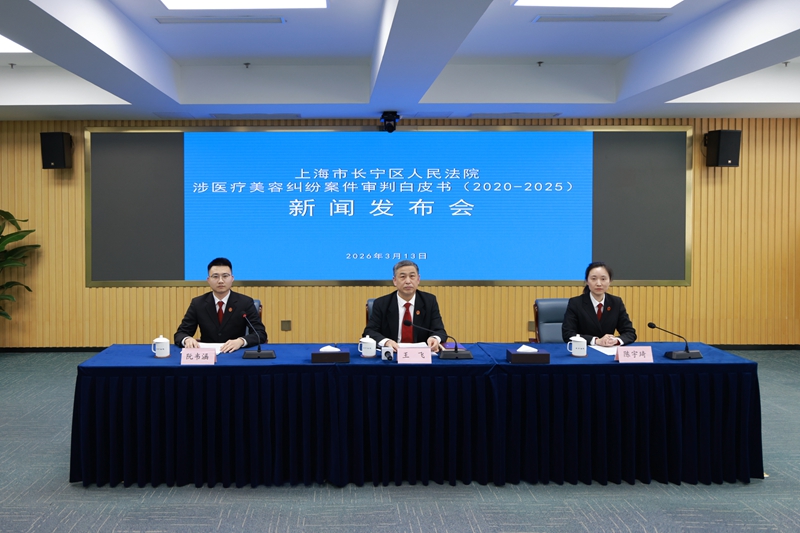
March 13, the Shanghai Changning District People’s Court (hereinafter referred
to as “Changning Court”) held a press conference to release the White Paper
on Adjudication of Cases Involving Medical Aesthetics Disputes (2020-2025)
(the “White Paper”). The White Paper systematically reviews data on such cases
concluded over the past six years, provides an in-depth analysis of industry
malpractices, and summarizes key points of adjudicative rules. It serves both
as judicial guidance for the high-quality development of the medical aesthetics
industry and as a warning to consumers against irrational choices.
At
the press conference, Wang Fei, Vice President of the Changning Court, released
the White Paper, and Chen Yuqi, Chief Judge of the Changning Court Civil
Division, presented five typical cases. The press conference was hosted by Ruan
Weihan, Deputy Director of the Office and Spokesperson of the Changning Court.
Attendees included representatives from the Changning District Committee of
Political and Legal Affairs, the Changning District Consumer Rights Protection
Committee, the Changning District Medical Mediation Committee, as well as some
deputies to the Changning District People’s Congress, members of the Changning
District Committee of the Chinese People’s Political Consultative Conference
(CPPCC), and media reporters.
Five core characteristics of
medical aesthetics disputes
Based
on a comprehensive analysis of 215 cases of medical aesthetics disputes over
the past six years, the White Paper outlines the following characteristics of
such disputes, which reflect a deeper link between industry development and
consumer demand.
First,
there is a high concentration of involved entities, with private institutions
as the focal point of risks. The medical aesthetics institutions involved are
primarily private providers. Among them, the top five institutions account for
nearly 35% of the total number of cases, indicating that leading institutions,
due to their large business scale and high service frequency, have more
concentrated risk exposure. Some institutions have notable shortcomings in
medical quality control and internal management.
Second,
the consumer base is diversifying, with significant gender and age
stratification. Women remain the core group of medical aesthetics consumers,
accounting for 93.49% of the total; whereas male consumer demand is steadily
rising, up 3.17% compared to the previous statistical period, indicating
continued growth potential in the male medical aesthetics segment. In terms of
age distribution, the primary group aged 20–40 accounts for over half of the
total, while consumers aged 50 and above account for 22.79%, forming a
diversified consumption pattern where the younger seek beauty enhancement, the
middle-aged seek anti-aging treatments, and the elderly seek restorative
procedures.
Third,
treatments show a complex nature, with a surge in disputes over light medical
aesthetics. As light medical aesthetics grows more popular, minimally invasive
procedures such as injections and Thermage have become mainstream. Over 20% of
cases involve two or more combined procedures. Since 2023, disputes over light
medical aesthetics have become a high-incidence area of disputes, increasing by
42% year-on-year.
Fourth,
consumers often pursue unreasonable claims, leading to a significant gap
between claimed and awarded compensation. Across the 215 cases, the total
amount claimed by plaintiffs was 37.44 million yuan, while the amount
ultimately awarded by the court was 8.99 million yuan, accounting for less than
25%. Many consumers do not know enough about the legal provisions governing
compensation for medical aesthetics damages, hence a noticeable gap between
their expectations and judicial standards. Among the 67 cases in which
consumers sought punitive damages and claimed “a refund plus treble
compensation,” only three received such awards.
Fifth,
consumers tend to pursue contractual remedies, with contract disputes being the
most prominent type. Contract disputes account for more than 60% of the cases,
with core disputes focusing on issues such as false advertising, failure to
meet service standards, and prepaid card refunds. This highlights the prominent
problems of non-compliant contracts and unfulfilled promises in the medical
aesthetics industry.
Eight
pain points underlying medical aesthetics disputes
Drawing
on judicial practice, the White Paper accurately identifies eight pain points
that make medical aesthetics disputes prone to occur, pointing directly to the “hidden
risks” in industry development.
-
Unregulated marketing and promotion: Some institutions create appearance
anxiety through tactics such as “low-price baiting and upselling upon arrival,”
exaggerate treatment outcomes, downplay risks, and induce consumers to
overspend or spend blindly.
-
Chaotic pricing models: Issues include mismatches between the payment recipient
and the contracting party, failure to issue formal invoices after payment, and
unclear fee structures, making it difficult for consumers to prove the nature
of the fees and the transaction parties involved when seeking legal remedies.
-
Lack of qualification compliance: Frequent violations include non-medical
institutions (e.g., beauty salons) illegally offering medical aesthetics
procedures, licensed institutions performing high-risk procedures beyond their
authorized scope, and unqualified doctors practicing, all of which pose
significant medical safety risks.
-
Failure to fulfill informed consent obligations: Some institutions use standard
terms in place of detailed disclosure, have consumers sign blank consent forms,
fail to provide supplementary notification when treatment plans are changed
during procedures, and maintain insufficient medical records, which infringe on
consumers’ right to be informed and to give informed consent.
-
Improper use of drugs and devices: A small number of institutions use
counterfeit or substandard drugs and medical devices of unknown origin, or even
pass off ordinary products as high-end medical aesthetics products, directly
harming consumers’ right to physical health.
-
Insufficient awareness of evidence preservation: Many consumers fail to retain
records of institutional promises before treatment or to document diagnoses and
evidence of injuries after treatment, making it difficult to prove their
claims. Some institutions fail to retain patients’ medical histories,
particularly pre- and post-treatment photos, leading to disputes.
-
Differences in evaluating treatment outcomes: Disputes over “unsatisfactory
results” not caused by medical malpractice are increasing, due to differences
between consumers’ subjective expectations and the objective medical standards,
making dispute resolution more difficult.
-
Involvement of professional bad-faith claimants: Some professional claimants
exploit gray areas in the industry to file frequent claims based on grounds
such as “false advertising” or “qualification deficiencies,” disrupting
industry order and driving up the total number of medical aesthetics disputes.
Guidance
for both medical aesthetics consumers and operators
From
a judicial perspective, the White Paper provides clear compliance guidance for
both medical aesthetics consumers and operators, aiming to foster an ecosystem
characterized by “judicial protection, industry self-discipline, and rational
consumption.”
For
consumers, four points should be kept in mind to avoid risks: 1) Distinguish
the nature of services, verify the Medical Institution Practicing License and
doctors’ qualifications through official channels of the Health Commission, and
stay away from medical aesthetics procedures offered by beauty salons. 2) Sign
contracts properly, specifying key terms such as treatment content, price,
product brands, outcome commitments, and liability for breach of contract, and
retain records of the institution’s promotional promises. 3) Choose treatments
prudently based on individual health conditions, and be wary of “low-price
baiting” traps, carefully read the risk disclosure statement, and fully
understand the risks before signing. 4) Preserve medical records properly,
including pre- and post-treatment photos, medical records, payment receipts,
and chat logs. In the event of adverse reactions, seek prompt treatment at a qualified
medical institution and obtain and preserve diagnostic documentation.
For
operators, strict compliance with laws and regulations is required, along with
adherence to four bottom-line requirements: 1) Regulate marketing practices,
eliminate false advertising and inducement of consumption, strengthen
professional and legal training for staff, and implement a system for
documenting consultation records. 2) Fully fulfill informed consent obligations
by providing comprehensive disclosure of treatment risks, indications, and
contraindications in both written and oral forms. When treatment plans are
changed during procedures, provide supplementary notification and complete the
necessary formalities promptly. 3) Ensure the compliance and completeness of
medical records, manage pharmaceuticals and medical devices in accordance with
regulations, create and maintain records in line with medical standards, retain
consumers’ pre- and post-treatment photos, and safeguard consumers’ right to
access their medical records. 4) Resolve disputes through good-faith
negotiation, using platforms such as the medical mediation committee for
amicable discussions, and, after reaching an agreement, apply for judicial
confirmation to render it enforceable, thus achieving finality through
mediation.
Typical
cases demonstrating judicial humanity and wisdom
The
five typical cases released at the press conference cover different types of
disputes in the medical aesthetics field. Grounded in both the protection of
consumer rights and the high-quality development of the industry, the court has
fully leveraged its judicial function to safeguard the “bottom line for beauty
treatments.”
For
example, in the case of Fan v. X Beauty Salon in a service contract dispute,
Fan, at the recommendation of the salon’s manager, underwent procedures at the
salon including oxygen bubble-based facial and Radiesse injection to the nose,
and was also taken to other shops for procedures such as Ultherapy and
picosecond laser. Fan filed a request with the Changning Court to verify the
relevant qualifications of the salon. By clarifying the nature of the
procedures involved and verifying the qualifications of the salon, the
Changning Court found that all procedures Fan underwent were medical aesthetics procedures,
and that the salon did not possess the corresponding qualifications.
Accordingly, the court granted the plaintiff’s request for a refund and ordered
the salon to pay punitive damages. This case has fully protected the consumer’s
legitimate rights and interests and has demonstrated the court’s firm stance on
cracking down on unlicensed medical aesthetics practices and building a strong
safety defense for medical aesthetics consumption.
In
the case of Zhang v. X Clinic in a medical service contract dispute, Zhang, a
woman in her seventies, was repeatedly solicited by the clinic’s sales staff
and purchased medical aesthetics procedures such as “Peach Blossom Face” and “Peach
Blossom Back.” She made multiple top-ups, with individual payments ranging from
50,000 to 300,000 yuan, accumulating a total of over 1.3 million yuan. However,
after undergoing the procedures, she not only saw no improvement but also her
appearance was worse than before. When her family learned of the situation and
sought a refund, they were turned down. Through investigation and analysis of
the sales process, services provided, and market prices, the Changning Court
organized multiple mediation sessions between the parties, ultimately reaching
a settlement under which the elderly woman received a refund of one million
yuan. Due to physiological and cognitive characteristics, elderly consumers
often have weaker judgment, insufficient ability to access and evaluate information,
and a tendency to readily believe verbal promises. Faced with active
solicitation and exaggerated claims from the sales staff, they find it
difficult to rationally assess the compliance, suitability, and price
reasonableness of medical aesthetics procedures, making them highly vulnerable
to falling into consumption traps. This case has protected the rights and
interests of elderly medical aesthetics consumers and provided clear guidance
for regulating business practices targeting this demographic and promoting
rational consumption among the elderly in this area.
Moving
forward, the Changning Court will continue to focus on emerging issues and
developments in the medical aesthetics industry, refine adjudicative rules for
similar cases, strengthen diversified dispute resolution mechanisms, and
enhance coordination with regulatory authorities and industry associations. At
the same time, it will continue to carry out targeted legal awareness campaigns
on medical aesthetics, promote the widespread adoption of compliant business
practices, and work toward a new governance framework for the medical
aesthetics market characterized by “judicial protection, robust regulation,
industry self-discipline, and reassuring consumption.” The goal is to make
medical aesthetics a truly “reassuring medical aesthetics” industry that meets
the public’s aspiration for a better life, providing solid judicial support for
the high-quality development of the industry.
Comments
from Deputies and Members
Tang
Longying, Deputy to the Changning District People’s Congress and Director of
the Obstetrics Department at Changning District Maternal and Child Health
Hospital
The
White Paper released by the Changning Court represents a systematic review and
in-depth distillation of six years’ judicial practice, supported by detailed
data and incisive identification of key issues. By outlining case
characteristics, it accurately portrays the consumption pattern of the medical
aesthetics market. By identifying the eight pain points, it directly targets
the irregularities in the industry development. The White Paper serves as a
reference for adjudicating similar cases and shows the direction for industry
regulation. It also offers practical and instructive guidance for both
consumers and operators, helping the former safeguard their rights rationally
and avoid risks and encouraging the latter to return to the medical nature of
their practice and operate in compliance. The White Paper injects judicial
momentum into the high-quality development of the medical aesthetics industry
and offers a replicable judicial model for governing the regional medical
aesthetics market.
Zheng
Yu, Member of the CPPCC Changning District Committee and Chairman of Shanghai
Shenzhou Hospital
The
White Paper provides an important judicial reference for the high-quality
development of the medical aesthetics industry and also sounds a note of
caution for compliant operations of medical aesthetics institutions. It
presents the characteristics of the industry-related disputes through detailed
data and objectively identifies shortcomings of some institutions in areas such
as qualification management, risk prevention, and service fulfillment. The
development of the medical aesthetics industry must be built on compliance and
medical safety. We hope that medical aesthetics institutions will benchmark
against the findings to identify issues in their management and operations,
strengthen professional and legal training for employees, act in good faith, provide
compliant services, and fulfill their responsibilities and obligations as
medical institutions.
