
 Your current location >> Press Release
The
Outline for Building China into a Leading Sports Power explicitly calls
for strengthened intellectual property (IP) protection in the sports industry. The
World Intellectual Property Organization (WIPO) has designated the theme of the
World Intellectual Property Day 2026 as “IP and Sports: Ready, Set, Innovate!”
Sports
are more than just competitions; they are closely intertwined with fashion,
entertainment, media, health, gaming, and consumer goods. From cutting‑edge
equipment and game‑changing technologies to inspiring brands and designs, IP
protection powers a vibrant sports culture.
On
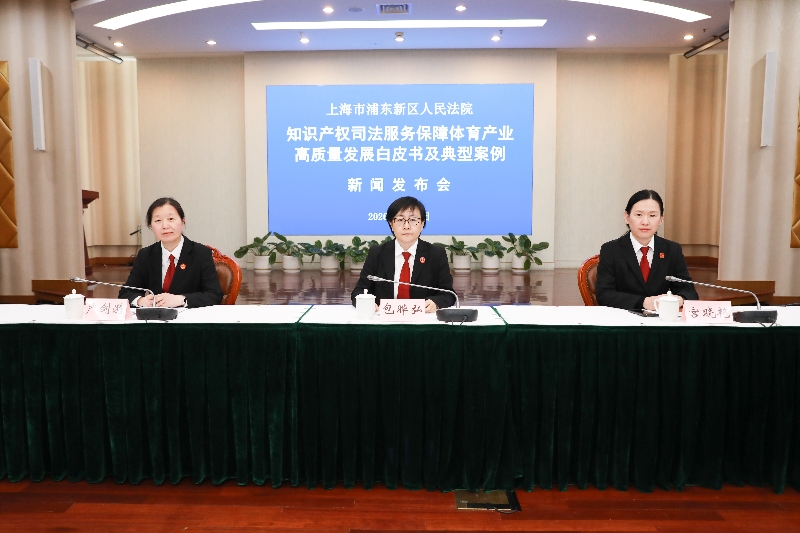
April 22, the Shanghai Pudong New Area People’s Court (hereinafter “Pudong
Court”) held a press conference to release a white paper and typical cases on
judicial IP protection for the high‑quality development of the sports industry.
The court summarized the new trends, characteristics, and measures in the
adjudication of sports‑industry‑related IP cases over the past five years,
injecting legal momentum into the high‑quality development of the sports
industry.
At the press conference, Bao
Yehong, Vice President of the Pudong Court, presented the white paper, and Gong
Xiaoyan, Chief Judge of the Intellectual Property Tribunal, introduced ten
typical cases. The press conference was hosted by Yan Jianyi, Deputy Director
of the Political Department and Spokesperson of the Pudong Court. Attendees
included municipal and district deputies to the People’s Congress and municipal
and district committee members of the CPPCC and the Pudong New Area Committee
of the CPPCC, as well as journalists from central and Shanghai media outlets.
1,727
cases concluded in five years with a total disputed amount of 1.012 billion
yuan
The
white paper shows that from 2021 to 2025, the Pudong Court accepted 1,658
sports‑industry‑related IP cases, with a total disputed amount of 963 million
yuan. It concluded 1,727 cases in total, with a total disputed amount of 1.012
billion yuan.
By
cause of action, among the civil cases accepted, there were 924 copyright
infringement disputes, 384 over trademark infringement, 130 over unfair
competition, and 120 over IP contracts. Criminal cases mainly involved crimes
such as the crime of selling goods bearing counterfeited registered trademarks
and the crime of counterfeiting registered trademarks.
By
industry segment, the concluded cases covered various categories of the sports
industry, including sports services (1,072 disputes), sports goods and related
product manufacturing (653 disputes), and sports venue facilities construction
(2 disputes). Cross‑border disputes also drew significant attention: over the
five years, 102 such cases were concluded, involving 72 million yuan, with parties
concerned from multiple countries and regions.
By
method of conclusion, most sports‑industry‑related IP cases were resolved by
judgment. The focal points of disputes involved the legal characterization of
nested broadcasting and companion live streaming of sports events, the
copyrightability of e‑sports game footage, and conflicts between registered
trademarks and prior rights. These factors made adjudication significantly more
challenging.
According
to the white paper, sports‑industry‑related IP cases are characterized by a
high proportion of copyright disputes, diverse types of trademark disputes,
frequent novel competition disputes, and a concentration of international
event‑related disputes.
Six
measures to safeguard the high‑quality development of the sports industry
In
the face of these new trends and characteristics, how can the judiciary respond
precisely and effectively? The press conference announced a series of measures
taken by the Pudong Court to provide judicial IP protection for the
high‑quality development of the sports industry.
One,
the court clarifies copyright protection rules to incentivize creation. The
court has made clear that original continuous live broadcasts of sports events
can be protected under the copyright law; online platforms, without
authorization, may not access live broadcast channels to retransmit sports
events; and the copying of e‑sports games is strictly prohibited.
Two,
the court strengthens trademark infringement governance to clean up the
environment for brand operation. The court has severely punished trademark
infringement, reasonably determined compensatory damages, and applied punitive
damages in accordance with the law. As of the end of 2025, it had rendered 46
punitive damages judgments in IP cases, with a total award of 62.78 million
yuan, the highest single award being 9.95 million yuan, and the highest
multiplier being five times.
Three,
the court clarifies the boundaries of competitive conduct to regulate market
order. The court has fully protected the prior rights of well‑known sports
brands and accurately defined the boundaries of competitive interests in
sports‑derived industries.
Four,
the court implements the principle of equal protection to safeguard the
legitimate rights and interests of both Chinese and foreign enterprises. The
court has equally protected the rights and interests of domestic and foreign
sports‑industry entities, lawfully protected the rights of right holders such
as “AION,” “Call of Duty,” and “New Balance,” and properly handled IP disputes
in the import and export of sports goods.
Notably,
the Pudong Court also took the lead in establishing a working relationship with
the WIPO Arbitration and Mediation Shanghai Service, the first international
arbitration and mediation organization to be based in China, entrusting it with
the mediation of foreign‑related IP cases and actively building a diversified
mechanism for resolving foreign‑related IP disputes.
Five,
the court improves diversified dispute resolution pathways and promptly
applying preservation measures. The court has explored “partial pre‑mediation,”
made full use of behavioral preservation measures, and built a diversified IP
dispute resolution mechanism. As of the end of 2025, it had entrusted mediation
organizations with mediating 518 sports‑industry‑related IP disputes.
Six,
the court conducts in‑depth industry exchanges and seminars to promote the
building of a leading sports power. The court has carried out legal awareness
campaigns targeting the sports industry, established the “Model Law Zone” IP
Judge Studio, strengthened IP protection education and publicity, and responded
to the IP protection needs of sports enterprises.
Ten
typical cases released to set an example and provide guidance
The
ten typical cases released at the press conference focus on areas such as sports
events, e‑sports, sports brands, sports variety shows. Several of them are the
first of their kind in the country or in Shanghai, setting boundaries and
clarifying rules for the orderly development of the industry, and providing
strong judicial guidance.
In
one pre‑litigation behavioral preservation application concerning a major
sports event, during the Winter Olympics, the respondent used its mobile app to
broadcast CCTV‑5+ and other TV channels, providing the public with online
access to event coverage. The Pudong Court, after review, found that the event
coverage was highly time‑sensitive and had significant economic value, and
promptly issued an order requiring the respondent to immediately stop providing
coverage of the Beijing Winter Olympics. This case created a judicial model for
expedited review of major international sports events and efficient, full‑cycle
protection of event IP, and was cited in the Supreme People’s Court’s work
report.
In
the country’s first unfair competition dispute involving commercial e‑sports
boosting, the defendant operated Dailianbang, a game boosting app, to provide
commercial boosting services to users, including minors. The Pudong Court held
that this conduct constituted unfair competition for undermining the fair
competition mechanism and interfering with the real‑name registration policy and
the anti‑addiction system for minors. It thus ordered the defendant to cease
the infringement and pay damages. The case clarified the legal boundary between
personal recreational boosting and platform‑based commercial boosting, provided
a judicial basis for cracking down on match‑fixing in professional
competitions, and was selected as a typical case on antitrust and unfair
competition by the People’s Court Case Database.
In
a criminal case involving the sale of goods bearing counterfeited registered
trademarks, the defendants sold counterfeit golf clubs bearing well‑known
brands such as “HONMA,” “XXIO,” and “PING” both domestically and overseas
through online platforms, with sales amounting to over six million yuan. The Pudong
Court imposed custodial sentences on all principals, ranging from two years and
four months to four years, and fines ranging from 300,000 to three million yuan,
severely punishing sports‑industry‑related IP crimes and effectively
maintaining order in the sports goods market.
After
the press conference, a seminar on cutting‑edge issues in judicial IP
protection for the sports industry was held, with representatives from legal practice,
academia, and the industry discussing topics such as the dissemination of
sports events and IP protection, new digital sports business forms, and new
judicial responses to IP protection.
Comments
from Deputies and Committee Members
Hong
Chengdong, Deputy to the Shanghai Municipal People’s Congress
By
aligning with the theme of World Intellectual Property Day 2026 and releasing a
white paper and typical cases on judicial IP protection for the high‑quality
development of the sports industry, the Pudong Court has demonstrated its
proactive role in serving national strategies and promoting the construction of
Shanghai as a world‑renowned sports city, fully showcasing the international
vision and sense of responsibility of a court in a leading area. We look
forward to seeing more efficient judicial adjudication and cutting‑edge
rule‑setting that inject new momentum into the innovative development of the
sports industry.
Chen
Yin, Deputy to the Pudong New Area People’s Congress
By
focusing on the sports industry and releasing a white paper and typical cases
on judicial IP protection for its high‑quality development, the Pudong Court
has accurately responded to the needs of the times and helped drive industry
innovation. Whether it is copyright protection for event broadcasts or
resolution of trademark disputes in international events, the court has made
rulings in accordance with the law while striking a balance between industry
development and the public interest, thereby building a solid legal foundation
for the high‑quality development of the sports industry. We hope the court will
continue to deepen its judicial IP adjudication, refine its judgment standards,
and extend its judicial functions, providing even stronger judicial protection
to help the sports industry achieve steady and long‑term development.
Zhu
Xiaoqing, Member of the CPPCC Pudong New Area Committee
The
white paper released today by the Pudong Court systematically summarizes the
adjudication of sports‑industry‑related IP cases, with solid data, precisely
identified issues, and practical measures. The typical cases cover core areas
such as event broadcasting, sports trademarks, and digital sports, with clear
adjudicative rules and a strong orientation, responding to the urgent need for
the rule of law in the high‑quality development of the sports industry and
providing clear judicial guidance for event operations, brand protection, and
digital sports innovation. We expect to see more forward‑looking research,
strengthened collaborative governance, and extended judicial services in the
court to provide even stronger judicial protection for the high‑quality
development of the sports industry.
>> Chinese Version
