
 Your current location >> Press Release
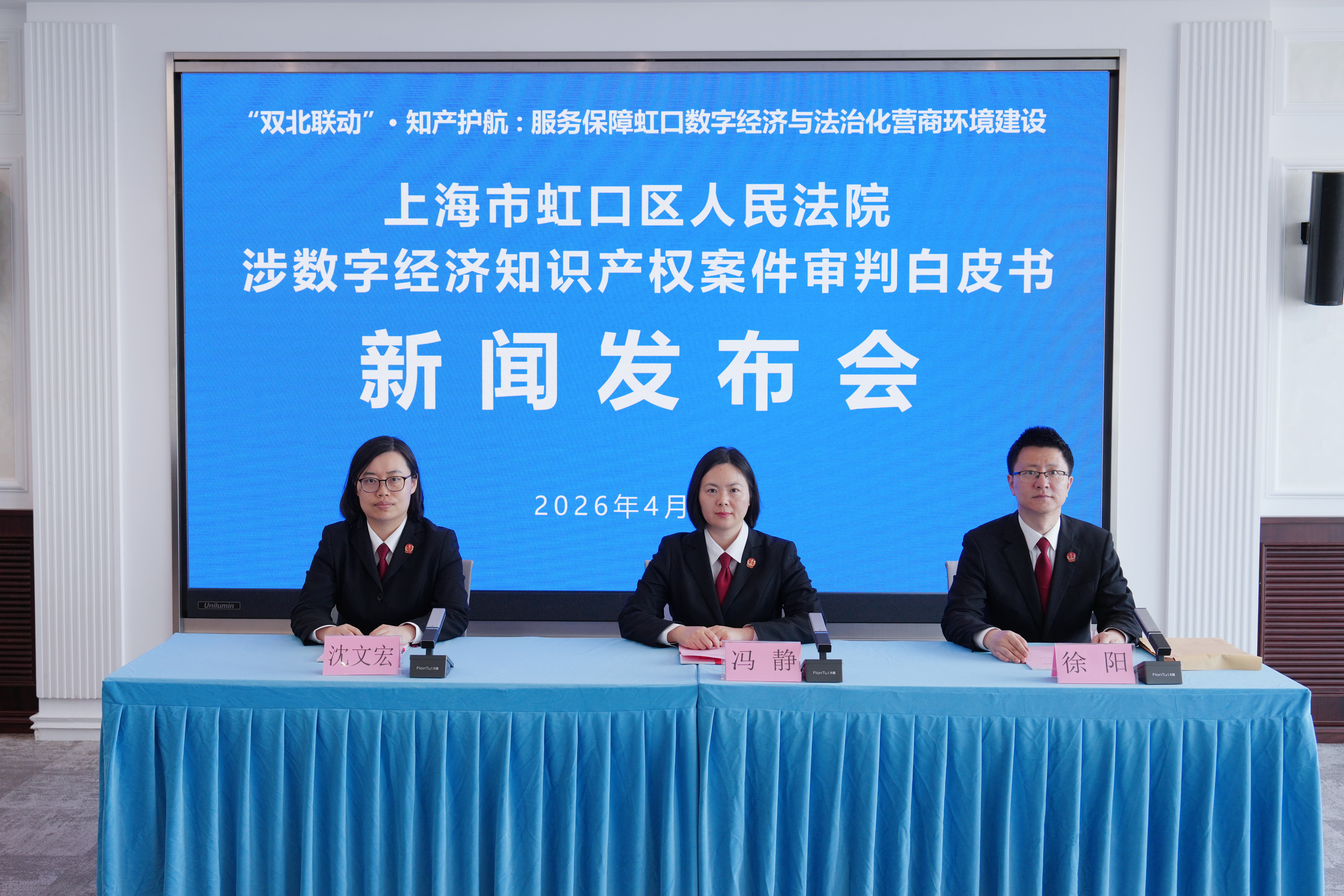
On
April 9, the Shanghai Hongkou District People’s Court (hereinafter “Hongkou
Court”) held a press conference at The North Bund International Legal Service
Hub to release the “Dual-North Linkage” & Intellectual Property
Protection: Serving and Safeguarding the Digital Economy and Law‑Based Business
Environment in Hongkou District – Shanghai Hongkou District People’s Court White
Paper on Adjudication of Digital Economy‑Related Intellectual Property Cases
(hereinafter “White Paper”) and typical cases, which focus on the judicial
needs arising from the industrial upgrading of the “North Bund” and the “North
Sci-Tech Innovation Zone” in the district, identify the characteristics of
digital economy‑related intellectual property (IP) disputes involving local
enterprises, summarize judicial experience, and provide robust legal safeguards
for the high‑quality development of the digital economy under the district’s “Dual-North
Linkage” strategy.
At
the press conference, Feng Jing, Vice President of the Hongkou Court, presented
the White Paper, and Shen Wenhong, Chief Judge of the Commercial Adjudication
Tribunal of the Hongkou Court, introduced eight typical cases. The press
conference was hosted by Xu Yang, Director of the Political Department and
Spokesperson of the Hongkou Court. Attendees included municipal and district deputies
to the People’s Congress and municipal and district committee members of the
CPPCC, representatives of digital economy enterprises, and journalists.
A
rising share of disputes related to industrial upgrading
The
White Paper shows that from July 2022 to December 2025, the Hongkou Court
accepted a total of 2,908 IP cases, of which 2,668 involved the digital
economy, accounting for over 90%.
By
case type, disputes related to the cultural and creative industries in the
digital economy had the highest share, exceeding 80%; disputes over trademark
ownership and infringement accounted for 11.99%. At the same time, with the
development of new technologies and new business forms such as artificial
intelligence, disputes over technology contracts, software development
contracts, online unfair competition, and trade secret infringement continued
to grow, now covering multiple areas including contract performance, market
competition, and rights protection.
According
to the White Paper, digital economy‑related IP disputes exhibit four main
characteristics:
One,
platform‑related digital infringement cases account for a relatively high
proportion, placing significant pressure on internet platform governance. IP
infringements aimed at gaining web traffic—such as brand free‑riding, image
theft, and copying of promotional content—are common, and the platform rules
for protecting intellectual property still have room for improvement.
Two,
new types of digital‑related cases continue to emerge, and the forms of
protection for cutting‑edge technology are becoming more diverse. New
technologies, new business forms, and new models are constantly evolving,
giving rise to disputes over cutting‑edge technology development contracts,
unfair competition involving “tech-enabled illicit activities,” and IP
infringement in digital cultural creations, all of which demand diverse forms
of judicial protection.
Three,
abusive enforcement is not uncommon in the digital environment, seriously
eroding the innovation ecosystem. “Litigation for profit” is something that
cannot be ignored under the framework of strict IP protection. Acts such as
preemptive registration of IP rights, induced enforcement, and fishing
expeditions negatively interfere with the innovation ecosystem of the digital
economy.
Four,
the digital economy is becoming increasingly
globalized, leading to a notable increase in related foreign-related disputes. In addition to
foreign trademark infringement and foreign‑related IP contract disputes,
Chinese enterprises going global are also facing challenges such as preemptive
trademark registrations abroad. The determination of jurisdiction and
applicable law directly affects case outcomes.
Targeted
measures in three dimensions to strengthen judicial protection
In
response to the urgent demand driven by digital industrial upgrading for a
law‑based environment, the Hongkou Court has launched a series of judicial
protection measures by creating an IP judicial protection brand called “Xiao
Hong Mao.”
First,
the court reinforces the rigidity of judicial protection for the digital
economy through enhanced deterrence. The court adheres to the principle of
strict IP protection, increases the application of punitive damages, raises the
cost of infringement, and fully leverages the deterrent effect of punitive
damages against malicious infringements. It has introduced a “Legal Aid
Package” for local businesses and developed model cases to establish clear
judicial guidance through fair judgments.
Second,
the court improves the litigation ecosystem in the digital economy through
in‑depth governance. The court has issued comprehensive platform governance
recommendations to improve the efficiency of resolving platform‑related
disputes and promote the healthy development of the platform economy. It has
enhanced the collaborative governance mechanism against malicious litigation,
clarified the boundaries of judicial protection, and resolutely protects
genuine innovation while punishing malicious litigation in accordance with the
law.
Third,
the court expands the scope of judicial services and coordination. The court
has strengthened the guiding role of Party building by establishing this “Knowledge-Action
Alliance (Zhixing Lianmeng)” platform to deeply integrate Party building
with adjudication. It has deepened court‑university collaboration and
court‑government coordination, built a systematic and integrated one‑stop legal
service platform, and pooled multi‑party efforts to resolve disputes at their
source.
Typical
cases released to provide judicial guidance
At
the press conference, the Hongkou Court released and interpreted several
typical cases concerning digital economy‑related IP disputes, providing clear
behavioral guidance for relevant market entities through concrete judgments.
In
one case involving unfair competition through overseas trademark squatting, the
defendant, through a cooperative relationship, learned that the product
identifier used by the plaintiff had not yet been registered. After failing to
become the exclusive distributor of that product in the EU, the defendant
preemptively registered an EU trademark similar to the plaintiff’s and filed
malicious complaints against the plaintiff’s store on an international
e‑commerce platform, causing the plaintiff’s products to be taken down and its
export business to suffer serious damage. The court found that although the
defendant had successfully registered the trademark abroad, its conduct
effectively misappropriated the goodwill of its cooperation counterpart.
Subjectively, the defendant violated business ethics; objectively, actual harm
had been caused. The court thus held that the conduct constituted unfair
competition and ordered the defendant to pay 500,000 yuan in damages to the
plaintiff. This case reflects the close link between strengthening IP
protection and enhancing export competitiveness. The defendant’s conduct
hindered the plaintiff’s exports to its main sales market, causing serious harm
to the plaintiff’s domestic export-related interests. Therefore, although
the EU trademark involved remained valid, it did not prevent Chinese judicial
authorities from finding unfair competition conduct connected to China. The
ruling strengthens judicial protection for the rights and interests of
enterprises going global.
In
another case involving unfair competition through “fake transactions and fake
reviews” (brushing), the defendant set up a website to direct platform sellers
to register on its own website, recharge accounts, and post product promotions.
It attracted buyers to post positive reviews in exchange for cashback or
commissions on products, and provided paid services to sellers such as
soliciting reviews and persuading buyers to change negative reviews to positive
ones. The court held that the services provided by the defendant caused the
reviews displayed on the platform for products sold by others to be
inconsistent with consumers’ genuine evaluations. This was sufficient to help
other operators engage in false publicity, was likely to mislead consumers’
judgments, distorted the authenticity of platform product reviews and sales
volumes, and harmed the platform’s market reputation. The court therefore
ordered the defendant to pay the plaintiff a total of one million yuan in
economic damages and reasonable costs of enforcement. This case was the first
unfair competition dispute involving brushing practices brought before a
Shanghai court by an internationally renowned e‑commerce platform. The court explicitly
made a negative legal evaluation of brushing practices, effectively
safeguarding the platform’s operational order and the market environment of
fair competition, and demonstrated Shanghai courts’ strong sense of
responsibility in equally protecting the competitive interests of foreign
enterprises and in safeguarding global consumers’ right to know.
Comments
from Deputies and Committee Members
Chen
Liguang, Deputy to the Shanghai Municipal People’s Congress, Co‑founder of
Shanghai Anlogic Infotech Co., Ltd.
The
White Paper on adjudication of digital economy‑related IP cases released by the
Hongkou Court is rich in data and accurately identifies the pressing challenges
in IP protection in the digital economy. The typical cases released alongside
it provide clear and stable behavioral expectations for market entities,
demonstrating the proactive role of the judiciary in serving the broader
economy and helping establish a fair and orderly market environment for the
digital economy. We look forward to the court further enhancing the
effectiveness of judicial protection to promote the high‑quality development of
new quality productive forces.
Lin
Yongsheng, Deputy to the Hongkou District People’s Congress, Secretary of the
Party Committee and President of Xiamen International Bank Shanghai Branch
The
White Paper systematically outlines the characteristics of digital
economy‑related IP cases, directly confronting prominent issues such as the
high incidence of platform‑related infringement and the emergence of new types
of cases. It showcases the effective outcomes the court has achieved in the
digital economy while responding to actual judicial needs arising from that
area, fully demonstrating the judiciary’s strong protection for the
innovation‑driven development of the digital economy. We expect the court to
further leverage the exemplary role of typical cases to provide even stronger
judicial guarantees for building an innovation‑driven, fair, safe, and orderly
environment for the digital economy.
Zhang
Mingmin, Member of the Hongkou District Committee of the CPPCC, Senior Partner
at Landing Law Offices
The
White Paper, grounded in the overall development of the district, proposes a
systematic framework for building a full‑chain IP protection system, providing
clear guidance for enterprises to operate in compliance and mitigate risks. The
court’s active efforts to promote multi‑party coordination involving the
government, enterprises, and industry associations will help raise the overall
level of IP protection in the district and inject legal impetus into the
sustained and healthy development of the digital economy. We hope that
enterprises, on their part, can enhance awareness of IP protection and help
build a law‑based business environment that respects innovation.
>> Chinese Version
