
 Your current location >> Press Release
In
recent years, as industrial structures have accelerated their transformation
and forms of employment have continued to innovate, new situations and new
problems in the field of labor relations have kept emerging. Labor disputes
have taken on characteristics such as diverse types, compound claims, high
correlation between cases, involvement of multiple parties, and high demands
for enforcement, posing new challenges and new requirements for judicial
adjudication and enforcement work affecting people’s livelihoods.
To
actively implement the CPC Central Committee’s directives on safeguarding and
improving people’s wellbeing and strengthening the protection of workers’
rights and interests, effectively serve the national employment-first strategy,
build harmonious labor relations, and continuously optimize the law-based
business environment, the Shanghai Jiading District People’s Court (hereinafter
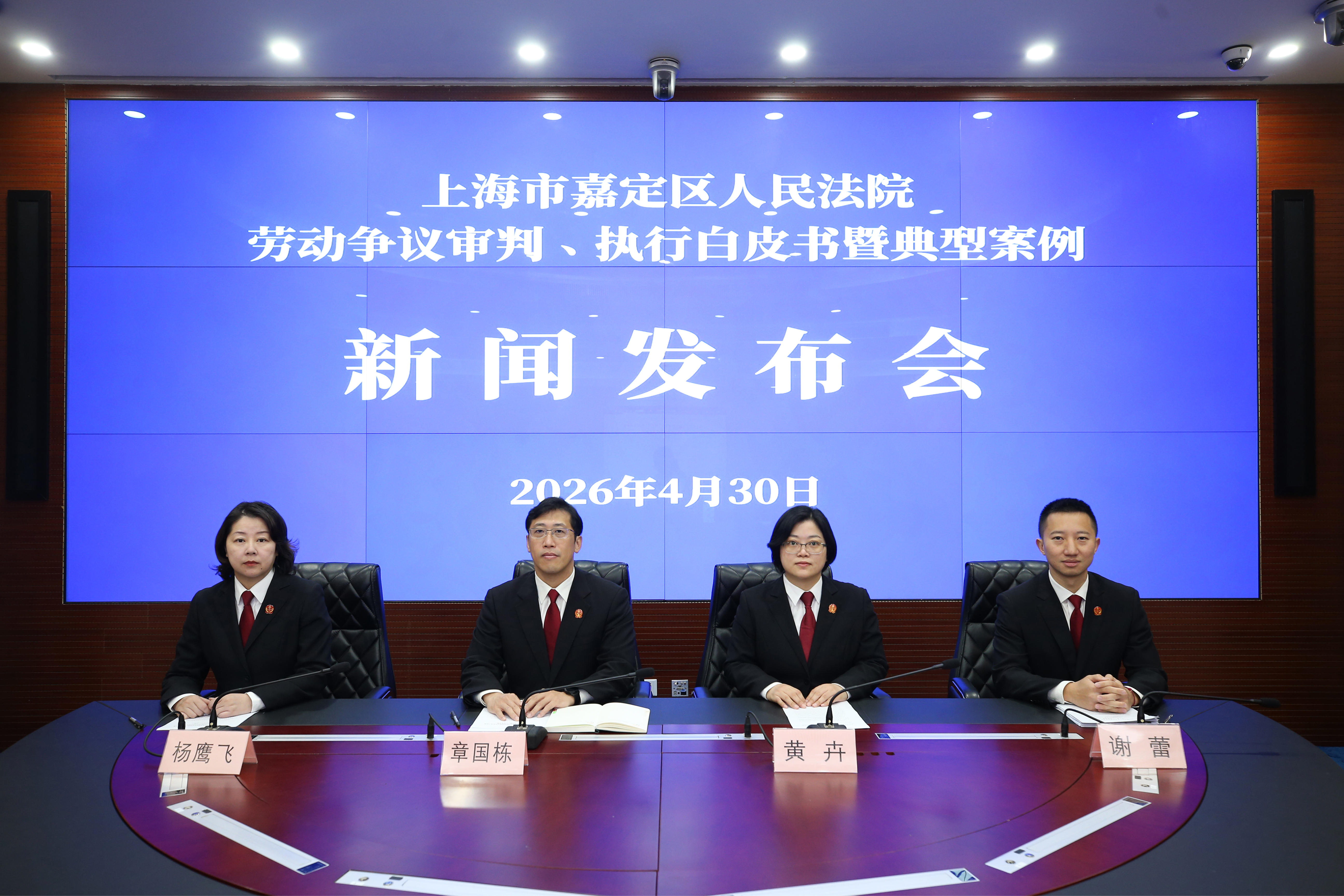
“Jiading Court”) held a press conference on April 30 to release the White
Paper on Labor Disputes (Adjudication) and the White
Paper on Labor Disputes (Enforcement) and present the Typical
Judicial Cases on Labor Disputes (Adjudication) and the Typical
Judicial Cases on Labor Disputes (Enforcement).
Zhang
Guodong, Vice President of the Jiading Court, Huang Hui, Chief Judge of the Enforcement
Disputes Division of the Jiading Court, and Xie Lei, Deputy Section Chief of
the Second Enforcement Section of the Enforcement Department of the Jiading
Court, attended the press conference and answered questions from reporters.
Deputies to the Shanghai Municipal People’s Congress, members of the Shanghai
Municipal Committee of the Chinese People’s Political Consultative Conference
(CPPCC), deputies to the Jiading District People’s Congress, and
representatives from the press were invited to attend the event. The press
conference was moderated by Yang Yingfei, Director of the Political Department
and spokesperson of the Jiading Court.
Labor
Disputes Adjudicated: Overview
The White
Paper on Labor Disputes (Adjudication) shows that from 2023 to 2025,
alongside the deep advancement of regional economic development and industrial
transformation, the Jiading Court saw a steady increase in the number of labor dispute
cases accepted. In 2023, 951 cases were accepted; in 2024, 1,331 cases were accepted
(a 40% year-on-year increase); and in 2025, 1,829 cases were accepted (a 37.40%
year-on-year increase). The number of cases accepted in 2025 was nearly twice
that of 2023. The number of cases concluded in 2025 increased by more than 70%
compared with 2023.
In
terms of cause of action, over the three years, labor contract disputes remained the primary
cause of action, accounting for 56.40% to 63.60% of the total. Disputes over
confirmation of labor relations increased from 12.90% to 17.40%, while those
over recovery of labor remuneration decreased from 7.4% to 5.90%. The number of
disputes over economic compensation (damages) remained low.
In
terms of case outcomes, the proportion of cases resolved by judgment remained
between 55.70% and 66.50%, increasing from 530 to 1,068 over the three years.
The mediation-withdrawal rate fluctuated from 32.5% in 2023 to 24.10% in 2025.
The foundational role of rigid adjudication in settling disputes has continued
to be strengthened, and more refined and specialized dispute resolution
mechanisms are needed.
Dispute
Hotspots Identified
to
Highlight Challenges in Labor Dispute Adjudication
The
White Paper on Labor Disputes (Adjudication) summarizes that the
difficulties and hotspots in the adjudication of labor dispute cases are
primarily reflected in the following three aspects:
1.
The complexity of establishing labor relations is increasingly
prominent. Under new forms of employment, disguised forms of affiliation
or cooperation, as well as arrangements where work is performed under the guise
of independent contracting, are common. The attribution of subordination in
such working relationships has become ambiguous, making it difficult to
delineate the boundary between labor relations and other types of civil legal
relationships.
2.
Disputes arising from the performance of labor contracts run through the entire
process and are concentrated in certain types of claims. Non-compliant corporate
management practices throughout the employment process—such as unlawful
termination, job and salary adjustments, overtime pay, and employment involving
affiliated or mixed entities—are frequent and can easily trigger mass labor
disputes.
3.
The handling of disputes over work-related injury insurance benefits presents
challenges in the application of law. The circumstances for work injury
compensation often overlap in complex ways, relevant legal provisions are
scattered across multiple sources, and standards for determining compensation
in scenarios involving competing claims are inconsistent, making it difficult
to achieve uniform adjudication standards.
Governance
Recommendations Proposed
to
Foster Harmonious Labor Relations
The
White Paper on Labor Disputes (Adjudication), taking a full-process
approach encompassing “front-end prevention, mid-stream resolution, and
end-stage adjudication,” proposes recommendations across three dimensions: standardized
employment practices, workers’ rational assertion of rights, and collaborative
social governance.
(I)
Strengthening principal responsibilities of enterprises to fortify the
frontline defense for dispute source control
1.
Standardizing full-process employment management to achieve closed-loop
compliance in employment practices.
2.
Improving internal systems and operating mechanisms to consolidate the
foundation for compliance management.
3.
Perfecting the labor-management consultation and resolution mechanism to
promote on-site resolution of disputes at an early stage.
(II)
Guiding workers to assert their rights in accordance with the law and enhancing
awareness of the balance between rights and obligations
1.
Cultivating a rational concept of rights assertion while rejecting irrational
misconceptions.
2.
Strengthening the awareness of evidence preservation and documentation to
solidify the factual basis for rights protection.
3.
Participating in dispute resolution in accordance with laws and regulations to
uphold the order of dispute settlement.
(III)
Improving the social collaborative governance system to empower the quality and
efficiency of labor dispute adjudication
1.
Deepening multi-party coordination and the connection between arbitration and
litigation to achieve layered filtering of conflicts.
2.
Implementing circuit trials and frontline judicial services to extend the reach
of judicial functions.
3.
Enhancing targeted legal publicity and risk warning to build a source-level
prevention system.
4.
Optimizing the adjudication mechanism to improve professional quality and
efficiency, thereby strengthening the function of judicial protection.
Enforcement
of Labor Dispute Cases
The
White Paper on Labor Disputes (Enforcement) shows that from 2023 to
2025, the Jiading Court accepted a total of 3,690 enforcement cases involving
labor disputes, representing a 13.87% increase over the three-year period
compared to the previous three years. Over the three years, a total of 3,651
labor dispute cases were enforced, with an overall enforcement-conclusion rate
of 98.9%.
Enforcement
cases involving labor disputes exhibit the following basic characteristics:
1.
Enforcement is primarily based on arbitration awards.
2.
Small-claim cases account for a significant proportion.
3.
Cases concerning multi-claimant wage arrears have increased year by year.
4.
Wage arrears are concentrated in specific industries.
5.
Workers have a distinct advantage in providing property leads.
Innovative
Enforcement Mechanisms Built
to
Help Secure Winning Parties’ Rights and Interests
The
White Paper on Labor Disputes (Enforcement) details six innovative
measures adopted by the Jiading Court in the enforcement of labor dispute cases:
The
first is tapping internal potential. For the first time, the court applied
enforcement settlement in non-litigation enforcement proceedings, and explored
a grace period for defaulters and credit repair mechanisms. It improved the
“prioritized case filing, prioritized enforcement, prioritized release of
proceeds” mechanism for labor dispute cases and established a dual oversight
mechanism integrating “Party affairs and professional business” to enhance
enforcement efficiency.
The
second is strengthening pre-enforcement governance. The court deepened the
coordination between arbitration and preservation measures, and between
administrative processes and preservation measures. It enhanced pre-enforcement
risk screening and promoted model enforcement of multi-claimant labor cases.
Through an initial-case model combining “controlling shareholder performance
and enterprise survival protection,” it provided solutions for similar cases
concerning wage arrears.
The
third is intensifying enforcement efforts. The court actively pursued hidden
assets of asset-light enterprises and built online and offline property
investigation and control systems. It conducted regular special enforcement
actions targeting wage arrears and strengthened credit penalties and
punishments for non-compliance with enforcement orders. One case was selected
as a model case in the Supreme People’s Court’s special enforcement action.
The
fourth is facilitating procedural coordination. The court systematically
advanced the “enforcement-to-bankruptcy” referral mechanism to clear out zombie
enterprises. It established a dual safety-net mechanism combining judicial
assistance and wage arrears protection to maximize protection for workers in
difficult circumstances.
The
fifth is expanding enforcement coordination. The court promoted
cross-enforcement within the judiciary and deepened cooperation with public
security, prosecutorial, health and other authorities. It implemented
coordinated enforcement mechanisms in the Yangtze River Delta region and the
Jiading-Kunshan-Taicang area to enhance cross-regional enforcement synergy.
The
sixth is enhancing digital empowerment. The court leveraged digital tools such
as intelligent identification, risk alerts, and full-process supervision to
achieve intelligent early warning in the management of labor dispute cases, using
technology to drive quality and efficiency improvements in enforcement.
Strategic
Paths and Measures Taken
to
Enhance the Service Effectiveness of Enforcement of Labor Dispute Cases
To
further address pain points and bottlenecks in enforcement of labor dispute
cases, strengthen judicial protection of prevailing parties’ rights and
interests among workers, and continuously improve the quality and efficiency of
enforcement work involving labor disputes as well as the level of judicial
services, the White Paper on Labor Disputes (Enforcement) proposes the
following countermeasures and recommendations:
(1)
Refining the adaptation of enforcement rules to solidify the normative
foundation for enforcement of labor dispute cases
A.
Establishing specialized rules prioritizing the satisfaction of labor claims.
B.
Improving supporting mechanisms for asset tracing and accountability.
C.
Innovating methods for asset disposition to broaden the scope of rights and
interests protection.
(2)
Improving the collaborative governance framework to enhance the overall effectiveness
of comprehensive governance
A.
Strengthening the coordination mechanism between arbitration, adjudication, and
enforcement.
B.
Enhancing cross-regional and cross-sectoral collaborative operational
mechanisms.
C.
Improving the translation of case pattern analysis and governance outcomes in
labor dispute cases.
(3)
Strengthening credit constraint mechanisms to reinforce positive guidance
toward compliance and performance
A.
Improving the deep integration of credit punishment and credit governance.
B.
Establishing scientific and standardized systems for credit reward and credit
repair.
(4)
Strengthening front-end dispute prevention to facilitate substantive resolution
at an early stage
A.
Enhancing comprehensive employment compliance guidance and regular legal
awareness campaigns.
B.
Deepening the development of diversified dispute resolution mechanisms.
Typical
Adjudication and Enforcement Cases Released
to
Demonstrate Precedential Value
At
the press conference, the Jiading Court released the Typical Judicial Cases
on Labor Disputes (Adjudication) and the Typical Judicial Cases on Labor
Disputes (Enforcement). These typical cases span multiple key areas,
including employment characterization in new forms of work, work injury
protection, wage payment, non-competition restrictions, resolution of
multi-claimant wage arrears, enforcement of digital assets, and enforcement in good
faith and with civility. By illustrating legal principles through concrete
cases and promoting governance through case handling, the court guides workers
to assert their rights lawfully and in good faith, while urging employers to stick
to the baseline of employment and regulate their management practices.
For
example, in the case of “Wang X v. Shanghai X Media Co., Ltd. over confirmation
of labor relations,” the court, applying the standard of subordination review,
clarified the rules for determining labor relations for online streamers under
new forms of employment, piercing the contractual appearance to find an actual
labor relationship, and demonstrating the judiciary’s strong protection of
labor rights and interests for workers in new forms of employment.
In
the case of “Sun XX v. Shanghai X Automotive Parts Co., Ltd. over a labor
contract,” the court held that labor contracts cannot be unilaterally
terminated for workers exposed to occupational hazards before they complete
pre-departure health examinations. Through this ruling, it reinforces
employers’ statutory duty to protect workers’ occupational health and
demonstrates the judiciary’s robust protection of workers’ occupational health
rights and interests.
In
the case of “Wang XX v. Shanghai X Network Technology Co., Ltd. over enforcement,”
the court innovated the enforcement path for digital assets by lawfully seizing
and disposing of virtual assets with commercial value, such as WeChat public
accounts, effectively solving the difficulty in enforcing wage arrears against
asset-light enterprises and truly turning workers’ “rights on paper” into “real
money.”
Comments
from Deputies and Committee Members
Chen
Dong, Deputy to the Shanghai Municipal People’s Congress, On-board EMU Technician
of Shanghai South EMU Maintenance Depot, Shanghai EMU Depot, China Railway
Shanghai Group Co., Ltd.
As
new forms of employment are booming, new types of labor disputes are emerging
frequently, making labor rights protection a major livelihood issue of broad
public concern. The white papers and typical cases released by the Jiading
Court, which concern the adjudication and enforcement of labor dispute cases,
are supported by detailed data and vivid cases and closely aligned with the
real needs of the people. Through fair adjudication, the court has clarified
the legal boundaries of employment; through efficient enforcement, it has delivered
prevailing parties’ rights and interests to workers, effectively protecting their
“wallets.” It has also taken into account corporate compliance, thereby
achieving “dual protection for both employees and employers.” We hope that the
court will continue to focus on emerging issues in the labor disputes, step up
efforts to raise legal awareness, and use judicial power to resolve labor
conflicts and safeguard people’s livelihoods.
Hong
Liang, Member of the CPPCC Shanghai Municipal Committee, Director of Zhihe Partners
As
a legal practitioner, I see the Jiading Court’s release of dual white papers on
adjudication and enforcement as a professional and systematic judicial response
to regional labor dispute governance. Supported by three years of adjudication
and enforcement data, the white papers clearly present the growth trends of
cases and the focal points of disputes, providing precise guidance on problems
such as employment characterization in new forms of work, non-competition
restrictions, and wage arrears enforcement, effectively unifying judicial
standards. Through innovative mechanisms such as digital asset enforcement,
pre-enforcement governance, and cross-regional coordination, the court has
truly cleared the “last mile” to workers’ rights and interests. This
achievement provides a practical model for legal practitioners handling similar
cases and advancing the coordination of arbitration, adjudication, and
enforcement, while also being of great significance for optimizing the
law-based business environment.
He
Yi, Deputy to the Jiading District People’s Congress, Deputy Director of Anting
Town Regional Work Office
The
press conference focuses on the actual employment situation and corporate
employment governance practices in the jurisdiction, with practical content and
strong relevance, offering substantial practical guidance. The increase in new
forms of employment and the diversification and complication of labor disputes
pose challenges to grassroots governance. The Jiading Court, leveraging its
functions, has systematically examined case trends, distilled adjudication and
enforcement experience, and released typical cases, providing strong legal
support for resolving labor disputes at the grassroots level. We hope that the
court would continue to deepen government-court coordination and multi-party
collaborative governance, strengthen guidance on employment compliance and
labor rights protection, promote front-end dispute resolution, jointly solidify
the foundation of grassroots governance, and support the steady and orderly
development of the regional economy.
Shanghai
Jiading District People’s Court: Typical Judicial Cases on Labor Disputes
(Enforcement).pdf
