
 Your current location >> Press Release
Minors represent the nation’s future
and the hope of its people. Safeguarding minors bears on the well-being of numerous
households as well as social harmony and stability.
To comprehensively sum up
achievements in judicial protection of minors’ civil rights and interests, pool
joint forces for minor protection, and build a sound
environment conducive to minors’ healthy development, on May 26 ahead of International
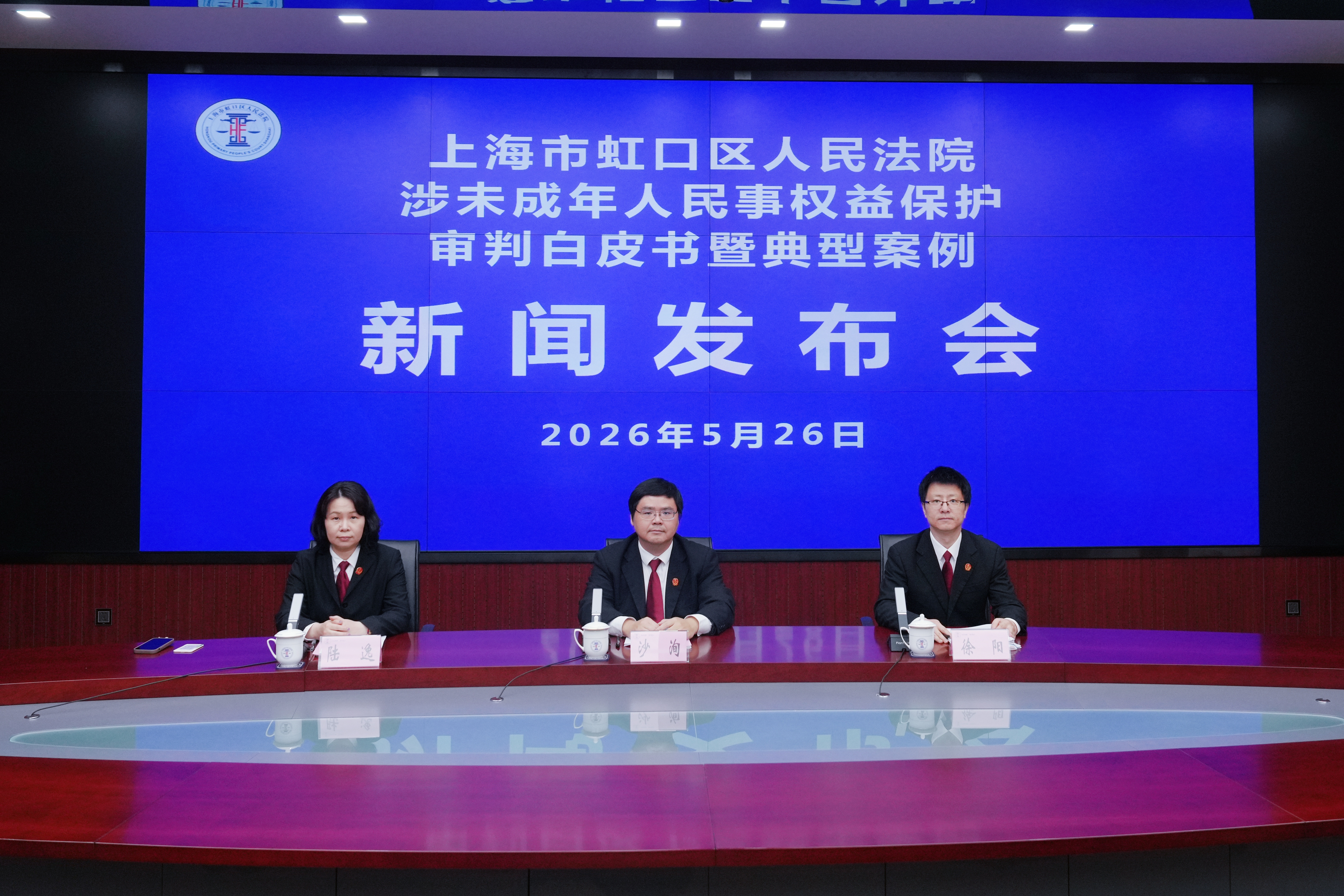
Children’s Day, the Shanghai Hongkou District People’s Court (hereinafter the
“Hongkou Court”) held a press conference to release its White Paper on Trials
Concerning Protection of Minors’ Civil Rights and Interests alongside typical
cases and fielded questions from reporters. The court systematically sorted out
trial practices over the past six years, analyzed root-cause problems, and offered
practical suggestions.
At the press conference, Sha
Xun, Vice President of the Hongkou Court, reported on the court’s adjudication
of such cases from 2020 to 2025. Lu Yi, Chief Judge of the Civil Division,
presented eight typical cases. Both then answered reporters’ questions on
matters such as how the court has implemented the principle of “in the best
interests of the minor” and extended judicial services for minor-related
disputes. The press conference was moderated by Xu Yang, Director of the
Political Department and Spokesperson of the Hongkou Court. Attendees included:
some municipal and district-level People's Congress deputies and Chinese
People’s Political Consultative Conference (CPPCC) members, representatives
from the Hongkou District Education Bureau, the Hongkou District Women’s
Federation, the Hongkou District School–Family Education Research and Guidance
Center, the Hongkou Workstation of the Shanghai Sunshine Community Youth
Service Center, and various schools, and some journalists.
Fluctuating Growth of Case
Volume; Family-related Matters Account for Over 70%
According to the White Paper
on the Protection of Minors’ Civil Rights and Interests, the Hongkou Court
concluded 1,436 civil cases involving minors between 2020 and 2025, with the
overall case volume on a fluctuating upward trend.
By cause of action, the cases
were primarily concentrated in traditional family-related matters such as
divorce, inheritance, and child custody, which accounted for over 70% of the
total. Tort disputes involving minors rose markedly from 12 in 2020 to 55 in
2025. Of such tort cases, disputes concerning rights to life, bodily integrity,
and health took up 56.55%, reflecting a rising number of minor injuries arising
from third-party tortious conduct or deficient safety
safeguards at public premises in daily life.
By case disposition, 604 cases
(44.05%) were concluded by judgment; 377 cases (27.49%) by mediation; and 284
cases (20.7%) by withdrawal. The combined proportion of
mediated and withdrawn cases stood at 48.19%, exceeding the percentage of
judgments.
The full-process mediation mechanism clarifies the
scope of rights and obligations via flexible negotiation and legal
interpretation, thereby effectively lifting the mediation rate.
Focusing on Deep-Rooted Pain
Points to Improve the Quality and Effectiveness of Minor Protection
The White Paper points out that
the adjudication of civil cases involving minors reveals multiple deficiencies
in family and social governance, which mainly fall into three categories:
First, parents tend to tie marital emotional disputes to child custody. Some divorced
parents shift marital conflicts to their children, giving
rise to problems including emotional instrumentalization, abuse of procedural
rights (e.g., abducting and hiding children), and obligation bundling (tying
child support to visitation rights). Such conduct seriously violates minors’
statutory right to care and companionship from both parents.
Second, many
guardians fail to duly perform their guardianship obligations. Two types of
dereliction–objective dereliction (long-term abandonment, arrears in child
support, etc.) and functional dereliction of duty (excessive doting,
inappropriate parenting, excessive pressure, unauthorized disposal of minors’
property, etc.) –constitute key triggers for guardianship revocation litigation
and minor-related tort claims.
Third, safety administration at
public premises has notable loopholes. Insufficient risk identification and preventive
management, lax dynamic patrol and intervention, plus unprofessional
post-accident response and handling constitute major hidden hazards leading to
minor injuries on public premises.
Four Practical Measures to Build
a Dense Judicial Safety Net for Minors
In response to the above issues,
the White Paper proposes four practical measures:
First, foster sound
child-rearing philosophies: Disseminate legal knowledge via typical cases,
circuit trials and short videos; collaborate with schools to deliver family
education guidance; make good use of the Family Education Guidance Order
and the Personal Safety Protection Order; and explore a “judicial plus
social work” mechanism for family affairs investigation and mediation to guide
parents to raise children in compliance with the law.
Second, enhance intervention and
supplementary support for family guardianship: Rely on civil affairs authorities
to carry out grid-based screening of guardianship risks; activate the emergency
intervention functions of minor protection stations; give full play to schools’
role in early identification and guidance; and refine the deposit and
supervision regime for minors’ property.
Third, consolidate protection
barriers on public premises: Define the scope of operators’ safety guarantee
obligations; push forward child-friendly upgrading of public premises;
strengthen targeted oversight of emerging business formats including escape
rooms; and encourage operators to upgrade emergency response capabilities on
the premises.
Fourth, improve supporting
mechanisms for long-term protection: Pilot the system of legal representatives
for minors’ legitimate rights and interests; set up a regular follow-up
mechanism; advance the development of public visitation bases; and introduce
referral mechanisms for psychological assessment and counseling.
Typical Cases Clarify
Adjudicatory Rules Through Legal Interpretation
The eight typical cases announced
at the press conference span such fields as visitation rights,
tattooing-related torts, guardianship alteration, and personal safety
protection orders. These cases unpack prevalent legal
disputes from diverse scenarios and dimensions, clarifying relevant
adjudicatory rules and codes of conduct.
In one case, for example, Du X Jia
had never visited his son Du Xiao X for over a decade after his divorce, and
had cut off all contact after paying only a portion of child support. Du Xiao X
sued, requesting that his father visit him and pay the overdue child support.
The court issued a Family Education Guidance Order to Du X Jia on the
spot, ordering him to visit his son on a regular basis and receive family
education guidance, while also entrusting a youth social worker to facilitate
the visits. Eventually, father and son reconnected and developed a harmonious
relationship, and the child’s academic performance steadily improved. This case
clarifies that visitation rights are not only a right of the parent who does
not primarily live with the child, but also an obligation; moreover, a child
has the right to proactively request visitation by a parent.
In another case, Sang Xiao X,
under the age of 18 at the time, located a tattoo parlor via an online platform
and got a tattoo there. Later, as the tattoo hampered his job prospects, Sang
Xiao X filed a lawsuit against the operator, with the
procuratorate supporting the litigation. The court ruled the tattoo parlor
operator was obviously at fault for failing to check Sang Xiao X’s age prior to
offering skin-penetrating tattoo services. Upon mediation, the operator
tendered a verbal apology before the court and reimbursed the tattoo fees plus
partial tattoo removal costs. This case underscores that providing tattoo
services to minors is illegal and that operators must strictly verify clients’
ages and faithfully fulfill their obligations to protect minors.
In a third case, 8-year-old Shi
Xiao X suffered a tooth injury after being hit by a toy gun wielded by adult
player Gu X during a live-action CS game. The court held that Gu X, as an
adult, was grossly negligent in the course of the game; Company A, the venue
operator, failed to eliminate on-site safety hazards and provide safety equipment,
thereby breaching its safety guarantee obligations. Shi Xiao X’s guardian also
failed to fulfill guardianship duties by not equipping the child with
protective gear or providing on-site accompaniment, and shall bear
corresponding liability. This case clarifies that the assumption-of-risk
doctrine does not exempt operators and organizers from their safety guarantee
obligations; likewise, other participants who cause harm to others through
intent or gross negligence are not exempted from liability.
To protect juveniles is to
safeguard the future. Against the new backdrop, efforts to protect minors’
civil rights and interests are confronted with intricate conflicts arising from
conventional family disputes as well as challenges spawned by new business
formats and emerging scenarios. Going forward, the Hongkou Court will
consistently adhere to the principle of “in the best interests of the minor”,
resolve governance bottlenecks with law-based thinking and meet public
expectations via institutional innovation, enabling every child to thrive under
the sunshine of the rule of law and pursue their dreams with confidence.
Comments from Deputies and Committee
Members
Bian Hua, Deputy to the Shanghai
Municipal People’s Congress; Director of the Hongkou Workstation of the Shanghai
Sunshine Community Youth Affairs Center
The White Paper draws on solid
statistics to identify new features and trends of civil cases involving minors.
In particular, its analysis of deep-seated problems—such as parents improperly
tying marital sentiments to child custody and inadequate performance of
guardianship duties—targets existing pain points precisely. Covering multiple
scenarios concerning visitation rights, tattooing-related torts, and personal
safety protection orders, the typical cases set forth explicit adjudicatory
rules and clear behavioral guidelines, establishing a distinct social
orientation for the judicial protection of minors. We hope that the court will
further refine innovative mechanisms including the “judicial plus social work”
model, enabling the sunshine of the rule of law to warm every child.
Yu Qi, Deputy to the Hongkou
District People’s Congress; Secretary of the Party Branch and Principal of
Guangling Road Primary School
Protecting the healthy growth of
minors calls for coordinated efforts under the Six-pronged Protection system
covering family, school, society, government, cyberspace, and judiciary. The
White Paper released by the Hongkou Court systematically sorts out problems
prevailing in minor-related disputes, including deficient guardianship and
loopholes in safety management at public premises, and puts forward practical
proposals such as building up robust protection barriers through concerted
social efforts. The proposals are highly targeted and practicable. Particularly
noteworthy are the fresh ideas featured in the White Paper, such as the system
of legal representatives for minors’ rights and interests and the establishment
of public visitation bases. It is expected that judicial organs will deepen
linkage with women’s federations, education and civil affairs authorities,
embed judicial protection into the broader framework of family, school, and
social protection, and jointly build a solid “firewall” safeguarding minors’
legitimate rights and interests.
Ding Bei, Member of the CPPCC Hongkou
District Committee; Secretary of the Party Branch and Principal of Shanghai Jiangwan
Junior High School
As a member of the CPPCC Hongkou
District Committee and principal of a junior high school, I have deeply
observed in daily school management that family changes and child custody
disputes, even those not escalated to litigation, can directly affect students’
emotional stability and in-school performance. The White Paper delivers a
timely response to such real-world scenarios, featuring accurate judgment on
the trends of minor-related cases and a distinct problem-oriented approach. The
court’s discretionary award of mental damage compensation even in the absence
of minor disability and the adoption of flexible adjustment periods in child
support disputes embody both judicial compassion for minors’ physical and
mental traits and judicial wisdom in balancing legitimate rights and interests,
providing replicable adjudicatory rules for similar cases. We suggest that the
court further extend its judicial functions through judicial suggestions,
circuit trials, and other means to urge managers of public premises to fully perform
their statutory obligations, reduce minor-related disputes at the source, and
jointly consolidate the rule-of-law barrier for minor protection.
