
 Your current location >> Press Release
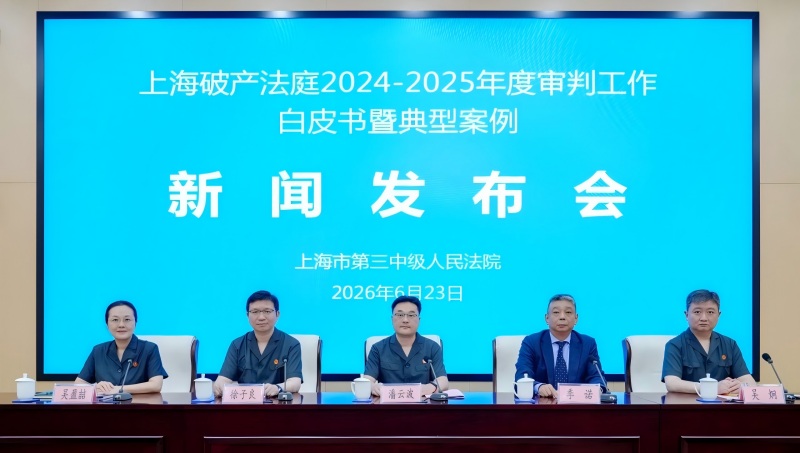
On June 23, the Shanghai Intellectual
Property Court hosted a press conference for the release of “Shanghai
Bankruptcy Court: White Paper on Bankruptcy Adjudication (2024–2025) and Related Typical Cases.”
At the press conference, Pan Yunbo,
Standing Member of the Adjudication Committee of the Shanghai Intellectual
Property Court, briefed attendees on bankruptcy adjudication carried out by the
Shanghai Bankruptcy Court throughout 2024–2025.
Xu Ziliang, Chief Judge of the Bankruptcy Division (Shanghai Bankruptcy Court),
presented twelve typical cases for 2025. Wu Jiong, Director of the Enforcement
Department, and Ji Nuo, President of the Shanghai Bankruptcy Administrators
Association, took part in the event. The press conference was moderated by Wu
Yingzhe, Chief Judge of the Petition Review and Judicial Supervision Division
(Research Office, Adjudication Management Office) and Press Spokesperson of the
Shanghai Intellectual Property Court. Journalists representing several Shanghai
media outlets attended the conference.
Case Volume Consistently Leads All
Bankruptcy Courts Nationwide, Targeting Private Enterprises and MSMEs
Pan Yunbo stated that between 2024 and
2025, the Shanghai Bankruptcy Court received 9,973 cases covering bankruptcy
proceedings, compulsory liquidation matters, and associated derivative
litigation, of which 9,945 were closed. It took in 2,464 bankruptcy cases and
closed 2,318 of them. The court topped the rankings among all bankruptcy courts
nationwide in both aggregate case intake and closures, as well as intake and
closures of bankruptcy cases specifically.
When viewed by debtor entities, private
enterprises made up 91.45% of closed bankruptcy cases, and micro, small and
medium-sized enterprises (MSMEs) accounted for 90.44%. Bankruptcy adjudication
is precisely oriented toward delivering relief to private enterprises and
MSMEs, enabling them to operate free from heavy encumbrances.
“Rescue and Liquidation”: A
Dual-Pronged Approach to Revitalize Assets and Resolve Debts
When it comes to rescuing distressed
enterprises, 49 reorganization cases and 63 composition cases were closed
between 2024 and 2025. These proceedings revitalized assets worth 33.178
billion yuan and resolved various debts totaling 88.961 billion yuan. High-profile
reorganization cases involving enterprises including La X Apparel Company and Wei
X Motor Company were successfully concluded. Meanwhile, the court explored a
market-oriented rescue mechanism featuring “prior out-of-court restructuring
followed by judicial confirmation of reorganization,” and forged cooperative
ties with three local out-of-court restructuring institutions. It closed
Shanghai’s first successful case where market-based out-of-court restructuring
transitioned into judicial reorganization, yielding a replicable and
generalizable practical model. In respect of cross-border bankruptcy, in the
bankruptcy liquidation case of Sheng X Industrial Company, the High Court of
Hong Kong recognized the mainland bankruptcy proceedings and the qualifications
of the bankruptcy administrator.
When it comes to winding up inefficient
enterprises, 2,206 bankruptcy liquidation cases were closed between 2024 and
2025, involving the disposal of assets worth 59.873 billion yuan.
Bankruptcy Adjudication Gathers Speed:
Digital Empowerment Boosts Quality and Efficiency
In terms of boosting adjudication
efficiency, the court has further refined the mechanism for separating complex
and simple cases and adopting fast-track hearing procedures for simple matters.
Around one-third of bankruptcy and compulsory liquidation cases were closed via
the fast-track mechanism, and the average hearing duration for bankruptcy cases
in 2025 was cut by 117 days compared with 2023. The linkage between enforcement
and bankruptcy proceedings has been strengthened. The 2,318 closed bankruptcy cases
facilitated the substantive clearance of roughly 30,000 enforcement cases. The
court has actively explored the reorganization potential of enterprises under
enforcement and has successfully rescued sci-tech enterprises including Zhong X
Electric Vehicle Company through enforcement-to-reorganization conversion.
In terms of digital development, the court
has fully rolled out online creditors’ meetings, online asset auctions, and the
online random selection of administrators, with nearly half of all cases filed
online. It has advanced the effective implementation of the “one-stop
verification” mechanism for information on bankrupt enterprises, endeavored to
break down inter-departmental data barriers, and substituted “data circulation”
for manual legwork. In respect of supporting administrators in performing their
duties, the court has refined whole-process supervision as well as incentive
and guarantee mechanisms for bankruptcy administrators. It has revised the
measures governing case-specific performance evaluation of administrators and
carried out regular oversight on key links including conflict-of-interest
screening, remuneration collection, and administrator account supervision.
Special assistance funds for asset-deficient bankruptcy cases have been put in
place. Such measures enable administrators to discharge their duties in a more
standardized and secure manner and ensure the orderly progress of bankruptcy
proceedings.
Deepening Team Development and
Cultivating a Bankruptcy Rule of Law Culture
In terms of team building, the court
follows the guidance of Party building and strengthens professional capacity
building. It has developed the distinctive Party-building brand “Riding the
Waves of Bankruptcy” to advance integrated development of Party building. This
initiative was named one of the “Top Ten Outstanding Cases” on integrated
Party-building development of Shanghai Courts in 2024.
In terms of professional capacity
building, the court conducts regular university-court cooperation and practical
seminars, and has published Shanghai Bankruptcy Court: Selected Bankruptcy
Adjudication Cases (2019–2024). Eight judges have been named adjudication experts or core
professionals of Shanghai courts.
In terms of advancing the rule-of-law
culture, the court has continued to expand judicial services and built the
legal service brand “Sunward.” It has delivered legal education lectures at
industrial parks and enterprises and conducted regular follow-up visits to
reorganized enterprises to bolster their subsequent development. Committed to
delivering high-quality case adjudication while enhancing judicial publicity,
the court has achieved notable results in case promotion. The bankruptcy
restructuring case of Shanghai X Gang Company, which was converted from
bankruptcy liquidation procedures, has been included in the case database of
the United Nations Environment Programme. In the 2025 selection campaign for
National Classic Bankruptcy Cases hosted by China Trial magazine and
other institutions, four cases from the Shanghai Bankruptcy Court were
shortlisted, accounting for 20% of the total.
12 Typical Cases Released, Covering
Multiple Cutting-edge Areas
At the press conference, the Shanghai
Bankruptcy Court released and interpreted 12 typical bankruptcy adjudication
cases of 2025. The cases span multiple areas: liquidation of large corporate
groups, reorganization of delisted private enterprises, relief for new energy
vehicle manufacturers, out-of-court restructuring, cross-border bankruptcy,
revitalization of sci-tech micro and small enterprises, and linkage between
enforcement and bankruptcy proceedings.
From Liquidation to Rescue:
Illustrating the Functional Value of the Bankruptcy Regime. For instance, in the case of La X Apparel Company, a private
enterprise delisted on both the A-share and H-share markets, the court forged a
path to align mainland bankruptcy proceedings with Hong Kong securities
regulatory requirements. It facilitated investment introduction, delivered
brand rejuvenation for the renowned apparel enterprise via reorganization, and
safeguarded the legitimate rights and interests of more than 7,000 small and
medium-sized shareholders. In another case involving Fu X Payment Company, the
court coordinated the reorganization with financial regulators. By approving
the use of common benefit debts to supplement required regulatory deposits, it
enabled the enterprise holding the scarce third-party payment license to resume
normal business operations. In the reorganization case of Yi X Education
Company, the court arranged for continued performance of the intellectual
property licensing agreement, revitalizing hundreds of patents and copyrights
and facilitating the transformation of the traditional education institution
toward the AI education tool market.
Leveraging a Diverse Toolkit to Pursue
Institutional Innovation. For example, in the
out-of-court restructuring-to-reorganization case of Sheng X Technology
Company, the court sourced strategic investors via the investor pool maintained
by the out-of-court restructuring center. Following multi-party negotiations, a
restructuring agreement was reached, and the outcomes embodied in the agreement
were carried over into judicial reorganization proceedings. This marked
Shanghai’s first successful case featuring seamless connection between
out-of-court restructuring and judicial reorganization. In the reorganization
case of Cheng X Real Estate Company, the court leveraged common benefit debt
financing and facilitated an arrangement whereby investors injected funds for
project continuation in the form of common benefit debt, with secured creditors
agreeing to subordinate their mortgage priorities to such debt, thereby
clearing hurdles to revitalizing a commercial project left unfinished for a
decade. In the reorganization case of Zhong X Real Estate Company, the court
introduced a bankruptcy service trust and adopted the strategy of “trading time
for space” to address problems such as prolonged asset realization cycles,
thereby balancing returns for patient capital and safeguards for short-term
funds. In the enforcement-to-reorganization case of Zhong X Vehicle Company,
the court adopted stalking horse bidding to establish a floor price for public
investor solicitation, ensuring assets were sold at a premium and preventing
fire sales at depressed prices.
Prioritizing Livelihood Protection to
Safeguard Overall Social Stability. In the
reorganization case of Wei X Motor Company, the court coordinated arrangements
to guarantee uninterrupted connected vehicle services and ruled that connected
vehicle service fees advanced during the reorganization period constitute
common benefit debts entitled to priority repayment, preventing more than
100,000 vehicle owners from being disconnected from services. In the
reorganization case of Zhong X Real Estate Company, the proceedings concerned
over 1,000 relocated residents under an urban renewal initiative and more than
100 buyers of pre-sold commercial housing. The court facilitated the government’s
lawful land reclamation and compensation arrangements. Meanwhile, it brought in
investors to honour the developer’s premium finishing commitment made upon
pre-sale, enabling the completion and handover of the stalled real estate
project.
Deepening Judicial Exploration and
Pushing Forward Cross-jurisdictional Collaboration.
In the field of cross-border bankruptcy, for instance, in the bankruptcy
liquidation case of Hao X Water Purification Company, both its mainland
subsidiary and Hong Kong parent company entered insolvency proceedings. The
court set up a collaborative communication platform and guided the mainland
administrator to render substantial support to Hong Kong liquidators in
discharging their duties, further advancing cross-border bankruptcy pilot work
between the two jurisdictions. In respect of overlap between criminal and
bankruptcy proceedings, take the bankruptcy liquidation case of Dong X Film and
Television Company as an example. The court accurately defined the scope of
bankruptcy assets and identified case-related criminal property in accordance
with law. Distributions payable to criminal defendants under the bankruptcy
proceedings were directly utilized for the enforcement of criminal property
orders. Surplus assets entered the bankruptcy estate for fair distribution,
enabling balanced protection of all parties under the law.
