
 Your current location >> Press Release
As the Leading Area marks the fifth
anniversary of its development and we are standing at a new starting point for
the “15th Five-Year Plan” period, how can the judiciary better serve
high-standard opening up and the development of emerging pillar industries?
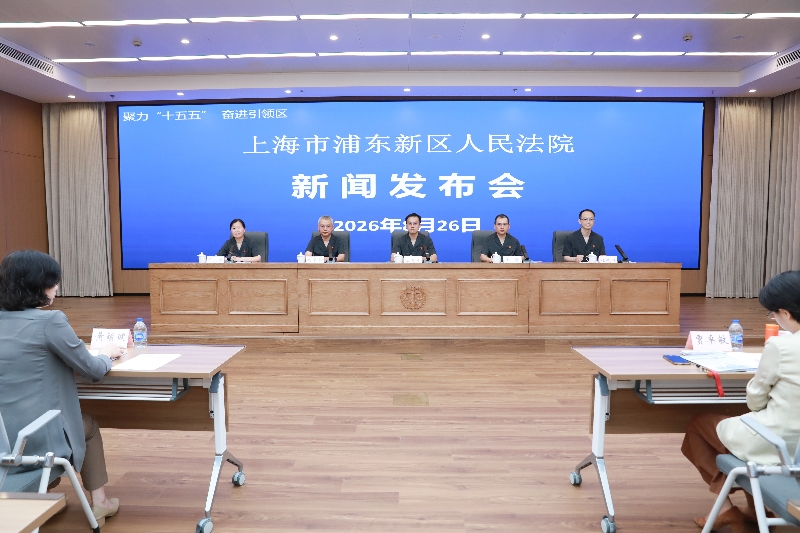
On August 26, the Shanghai Pudong New Area
People’s Court (hereinafter referred to as the Pudong New Area People’s Court)
officially launched its series of press conferences on “Striving Toward the
‘15th Five-Year Plan’ and Advancing the Development of the Leading Area”, aimed
at supporting and safeguarding the high-quality development of the Leading
Area. The first press conference focused on two themes — foreign-related
commercial adjudication and commercial adjudication involving emerging pillar
industries — and separately released adjudication white papers and reported
related typical cases, showcasing in a concentrated manner the results achieved
in adjudication work in these fields over the past five years of the Leading
Area’s development and responding through judicial practice to the new needs of
the Leading Area’s high-quality development during the “15th Five-Year Plan”
period.
Zheng Tianyi, Vice President of the Pudong
New Area People’s Court, Yu Wei, Vice President of the Pudong New Area People’s
Court, Zhang Zhuoyu, Chief Judge of the Free Trade Zone Tribunal, and Du
Xiaochun, Chief Judge of the Commercial Tribunal, attended the press
conference. The press conference was chaired by Yan Jianyi, Deputy Director of
the Party Political Department and spokesperson of the Pudong New Area People’s
Court. Some deputies to the Pudong New Area People’s Congress, as well as
journalists from national and Shanghai-based media outlets, attended.
High-Quality
Foreign-Related Commercial Adjudication Serves High-Standard Opening Up
The white paper shows that from July 2021
to June 2026, the Pudong New Area People’s Court accepted a total of 14,339
commercial cases involving aviation, the Lin-gang Special Area, Hong Kong, Macao
and Taiwan of China, foreign parties, and foreign-invested enterprises, and
concluded 13,965 cases. It also handled 3,419 arbitration-related judicial
review cases, including applications for arbitration preservation.
By case type, contract disputes accounted
for 82.88%, and disputes related to companies accounted for 11.65%. Among
contract disputes, disputes over sales contracts, service contracts, and loan
contracts were the most common. As new forms of business such as offshore
trade, cross-border investment and financing, and digital trade accelerate
their concentration in Pudong, Chinese and foreign business entities have seen
a parallel rise in their demand for both the breadth and precision of
foreign-related commercial judicial services.
In terms of case disposition, over the
past 5 years, 7,464 cases were concluded through mediation, withdrawal of
claims, applications for judicial confirmation, and other means, with the
mediation and withdrawal rate reaching 53.5%; among these, cases involving
applications for judicial confirmation of mediation agreements saw a
particularly significant increase.
In terms of the distribution of countries
and regions, the cases covered 43 countries and regions worldwide, of which
countries and regions participating in the “Belt and Road Initiative” accounted
for approximately 44%, and the number of related cases increased markedly.
Faced with increasingly diverse and
complex foreign-related commercial disputes, the Pudong New Area People’s Court
has proactively benchmarked itself against high-standard international economic
and trade rules and served the overall work of high-standard opening up with
high-quality judicial services.
In terms of rule supply, through the
grassroots legislative contact point of the Free Trade Zone Tribunal, it has
gradually established four working mechanisms covering the sorting of
legislative leads, the conversion of legislative projects, consultation on
legislative argumentation, and the testing of legislative effectiveness,
thereby promoting sound interaction between legislation and the judiciary. In
terms of specialized adjudication, it has improved foreign-related adjudication
mechanisms, established an adjudication mechanism integrating professional
judges, expert jurors, and expert consultation, and promoted the in-depth
application of judicial big data.
To further enhance the effectiveness of
diversified resolution of foreign-related commercial disputes, the Pudong New
Area People’s Court has relied on the “One-Stop Studio for the Resolution of
Foreign-Related Commercial Disputes through Litigation, Mediation, and
Arbitration” to deepen exchanges and cooperation with international commercial
arbitration institutions and, by improving the mechanisms linking litigation
with arbitration and litigation with mediation, has built an efficient path for
dispute resolution. Over the past 5 years, 7,464 cases were concluded through
mediation, withdrawal of claims, applications for judicial confirmation, and
other means, with the mediation and withdrawal rate reaching 53.5%; among
these, cases involving applications for judicial confirmation of mediation
agreements saw a particularly significant increase.
To address practical difficulties in
foreign-related litigation such as the ascertainment of foreign law,
cross-border service of process, and document translation, the Pudong New Area
People’s Court has also continued to reduce litigation costs for overseas
parties and improve the convenience of cross-border judicial services through
mechanisms including multi-channel ascertainment of foreign law, case-specific
litigation guidance, and review and confirmation of general authorizations.
High-Quality
Commercial Adjudication Safeguards the Development of Emerging Pillar
Industries
The white paper shows that from July 2021
to June 2026, the Pudong New Area People’s Court accepted a total of 1,819
commercial disputes involving the six major emerging pillar industries, with a
total amount in dispute reaching RMB 6.477 billion.
In terms of the distribution among the six
industries, the fashion consumer goods industry, the new-generation electronic
information industry, the high-end equipment industry, the intelligent
connected new-energy vehicle industry, the new-energy and green low-carbon
industry, and the advanced materials industry accounted for 29.7%, 28.4%,
18.3%, 15.3%, 6.7%, and 1.6%, respectively.
In terms of the amount in dispute, cases
involving less than RMB 500,000 accounted for the largest share at 46.9%, while
cases involving more than RMB 10 million accounted for 7.1%.
In terms of dispute type, contract
disputes such as disputes over sales contracts and service contracts were the
most numerous, while disputes over partnership contracts, equity transfers, and
damage to company interests were also relatively common.
In response to the judicial needs arising
in the development of emerging pillar industries, the Pudong New Area People’s
Court has fully performed the functions of commercial adjudication and
continuously improved the precision and effectiveness of judicial services and
safeguards.
First, it serves the building of a unified
national market and removes market barriers. It adheres to equal protection for
all types of business entities, strengthens cross-regional and cross-industry
similar-case retrieval mechanisms and promotes the consistent application of
adjudication rules, and focuses on refining adjudication rules for new types of
disputes.
Second, it strengthens the protection of
enterprise property rights and stimulates innovation vitality. Focusing on key
issues in corporate operation and governance, it strengthens the review of
legal facts and the identification of genuine legal relationships, protects the
lawful rights and interests of enterprises and investors in accordance with the
law, and promotes standardized governance and sound operation of enterprises.
Third, it accurately clears bottlenecks in
registration and ensures accountability for commitments related to market exit.
In response to issues such as the exit of enterprises and related personnel,
changes in registration, and simplified deregistration, it strengthens
substantive review, ensures legal accountability in accordance with the law for
acts such as false commitments, and promotes the orderly operation of exit
mechanisms.
Fourth, it improves diversified dispute
resolution mechanisms and builds a judicial service brand. It has continued to
improve the case classification and mediation mechanism and, in cooperation
with the Pudong New Area Federation of Industry and Commerce, established the
“Legal and Business Protection for Enterprises” circuit trial station for
commercial disputes, further extending judicial services to industrial clusters
and the front lines of enterprise operations.
Typical
Cases Provide Judicial Guidance
At the press conference, 6 typical
foreign-related commercial cases and 10 typical cases on commercial
adjudication involving emerging pillar industries were also reported. These
cases not only focused on cutting-edge issues in foreign-related adjudication
such as the application of international commercial rules and the order of
cross-border transactions, but also responded to new needs arising in the
development of emerging industries, including corporate governance, platform
operation, and industrial chain collaboration, thereby providing judicial
guidance for stabilizing expectations and regulating market conduct for Chinese
and foreign business entities.
In a dispute over an international sales
contract for goods, a Shanghai company failed to pay contractual payments as
agreed to a German company, and the German company sued for payment of the
contract price and overdue interest, while also claiming the application of the
interest provisions of the German Civil Code. With reference to Opinion
No. 14 of the CISG Advisory Council on the CISG (United Nations Convention
on Contracts for the International Sale of Goods), the Pudong New Area
People’s Court applied the law of the creditor’s place of business under the
principle of “full compensation” and held that the interest should be
calculated in accordance with the interest rate under German law. The case was
selected for inclusion in the Case Law on UNCITRAL Texts (CLOUT) system,
establishing a Chinese model for the uniform application of the Convention in
global judicial practice.
In a dispute over a sales contract for
lithography machines, the buyer and seller became embroiled in a dispute over
the performance of the contract for four lithography machines. Given the highly
specialized nature of the installation and commissioning of lithography
machines and the fact that they are affected by multiple factors such as equipment
performance and plant conditions, the Pudong New Area People’s Court clarified
the responsibilities item by item, fully considered the company’s subsequent
business plans, and broke the deadlock through a “partial termination +
continued performance” approach, ultimately facilitating mediation between the
parties while preserving their cooperative relationship, thus providing a
useful reference for handling disputes over transactions involving large-scale
specialized equipment in industries such as new-generation electronic
information and high-end equipment.
At the press conference, attending
journalists also raised on-site questions about such issues as how the Pudong
New Area People’s Court helps build a preferred venue for international
commercial dispute resolution, the operation of the one-stop mechanism for
resolving foreign-related commercial disputes, the reasons behind the high
incidence of disputes in related industries, and the next steps in serving and
safeguarding the development of emerging pillar industries, and the relevant
officials responded to them one by one.
Commentary
from a People’s Representative
Jia Zhuomin, deputy to the Pudong New Area
People’s Congress and Deputy Director of the Shanghai Pudong New Area
Investment Promotion Service Center
In the opening year of the “15th Five-Year
Plan”, the white papers and typical cases on foreign-related commercial
adjudication and commercial adjudication involving emerging pillar industries
released by the Pudong New Area People’s Court have injected commercial
judicial certainty into Pudong’s efforts to concentrate on developing a modern
industrial system, building ten hard-core industries, and advancing the
development of the core area of the “Five Centers”. Against the backdrop of
increasingly complex structures in international commercial trade transactions
and increasingly diversified market risks, these achievements provide
forward-looking and practical references for market entities in preventing and
controlling risks and reducing transaction uncertainty. Relying on the
centralized handling of cases in the Pilot Free Trade Zone and the Lin-gang Special
Area, as well as the coordination mechanism between litigation and arbitration,
this internationalized judicial supply has provided strong judicial impetus for
Pudong to build itself into a global hub for resource allocation and improve
its internationalized business environment.
Huang Yingjian, deputy to the Pudong New
Area People’s Congress and General Manager of the Post-Investment Management
Department of Shanghai Pudong Innovation Investment Development (Group) Co.,
Ltd.
The white paper on foreign-related
commercial adjudication released at this event closely follows the requirements
for institutional opening up in the Leading Area and systematically sorts out
and presents innovative measures such as foreign-related adjudication, the
building of arbitration-friendly mechanisms, and the upgrading of the one-stop
platform for resolving disputes through litigation, arbitration, and mediation
through cases and data. It is both grounded in the implementation and
application of Pudong regulations and benchmarked against internationally
accepted rules for commercial dispute resolution, reflecting a strong awareness
of pioneering trial implementation. It is hoped that the People’s Court will
continue to give full play to its exemplary judicial role, continue to produce
replicable judicial experience, and contribute judicial strength to Pudong’s
efforts to build a preferred venue for international commercial dispute
resolution.
>> Chinese Version
