
 Your current location >> Press Release
As asset
management transaction structures grow increasingly complex, how can the
boundaries of rights and liabilities be clarified under multi-layer nesting
structures?
With rapid
iteration and innovation of financial products, how can targeted judicial
adjudication protect investors’ legitimate rights and interests and regulate
the industry ecosystem?
To provide
targeted support for the development of Shanghai as a global asset management
hub, actively respond to the judicial needs of the asset management sector, and
continuously improve the law-based business environment for finance, the
Shanghai Hongkou District People’s Court (hereinafter referred to as Hongkou
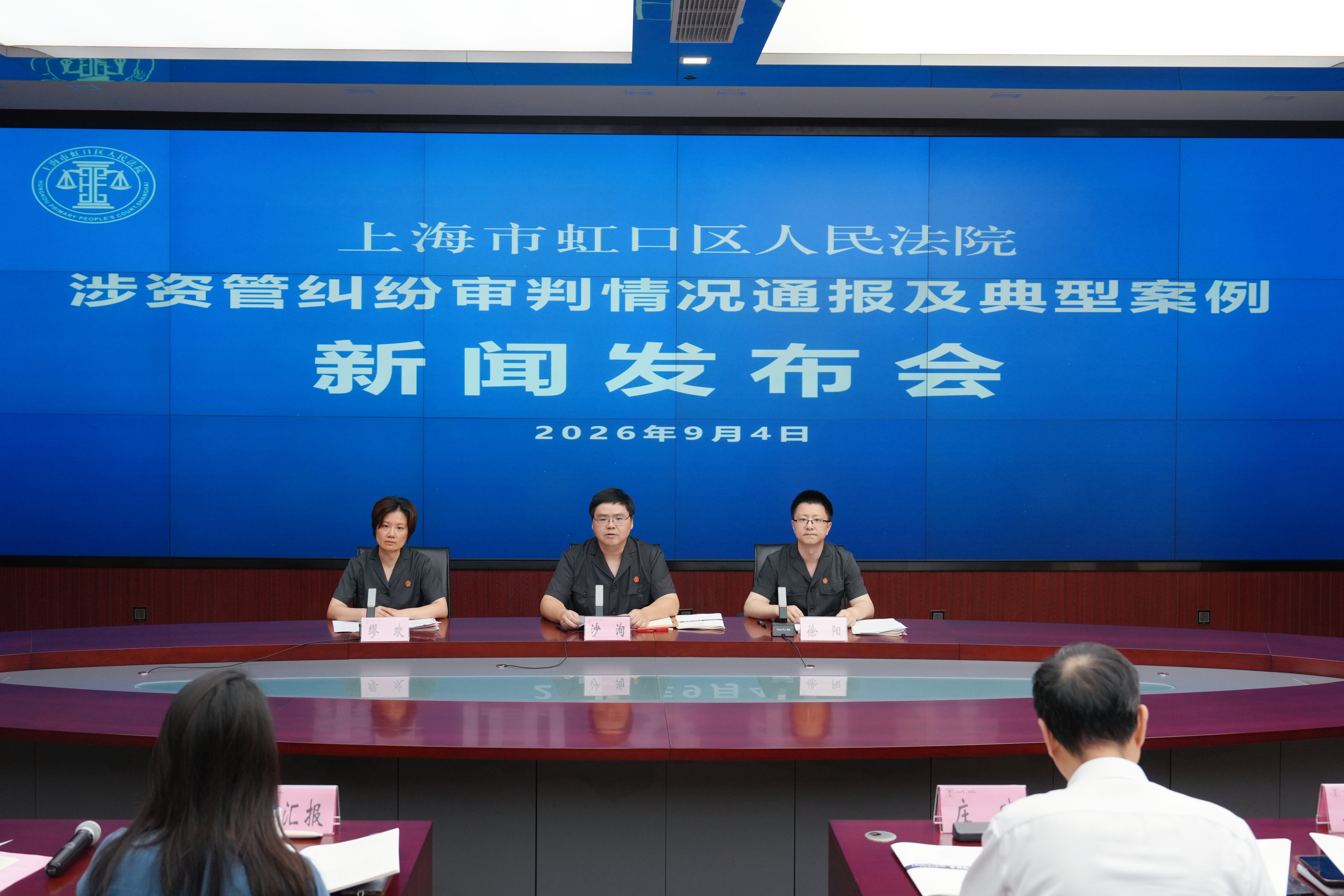
Court) held a press conference on the afternoon of September 4 to release the
trial status and typical cases of disputes on asset management.
At the press
conference, Sha Xun, Vice President of the Hongkou Court, briefed attendees on
the court’s trial of asset-management-related disputes over the past five
years. Miao Huan, Chief Judge of the Financial Trial Division, introduced seven
typical asset-management-related cases. The press conference was hosted by Xu
Yang, Director of the Political Department and Press Spokesperson of the court.
Attendees included deputies to the Shanghai Municipal People’s Congress,
members of the Hongkou District Committee of the Chinese People’s Political
Consultative Conference (CPPCC), representatives of the Shanghai Asset
Management Association (SAMA), the Asset Management Association of Shanghai
(AMAOS), and asset management institutions, as well as journalists.
Review of
Trial Trends and Analysis of Dispute Characteristics
The briefing
shows that the Hongkou Court accepted a total of 223 dispute cases on asset management
from 2021 to the first half of 2026. In terms of case types, the cases cover
multiple categories including tort liability, property damage compensation,
contract, and entrusted wealth management contract. Among them, tort liability
disputes account for the largest share, totaling 113, representing 45% of all
cases. In terms of subject amounts, a vast majority of these cases involve
small and medium-sized claims and a small proportion involve high-value ones,
with a relatively high concentration of cases brought by small and medium-sized
investors seeking remedies.
In terms of case
closing methods, the people’s court has achieved positive results in
diversified dispute resolution relying on working mechanisms such as
coordinated handling of similar cases, multi-channel dispute settlement, and
resolving mass disputes through model judgments.
The briefing
summarizes five major trial characteristics of cases on asset management.
First, multi-party litigation is a prominent feature. Disputes may arise across
the entire process including fundraising, sales, and exit, with intertwined
boundaries of liability among all parties. Second, the bases of claims are
compound and interwoven. Disputes fall under different causes of action and
there exists concurrence of claims. Third, stricter standards apply to the review
of evidence for online contracting. As online promotion and sale of asset
management products have become increasingly prevalent, electronic evidence grows
more important in cases. Fourth, mechanisms for the resolution of mass asset
management disputes continue to be refined. Approaches such as coordinated
handling of similar cases, model judgments and mass mediation have continuously
unified adjudication criteria and reduced investors’ costs for seeking
remedies. Fifth, exit and liquidation status affects loss determination. Facts
concerning exit and liquidation are relatively complicated and constitute the
core controversial issue in the current trial of asset management disputes.
Identification
of Legal Risks to Advance Collaborative Governance
Centered on the
four core links of “fundraising, investment, management, and exit” in the asset
management sector, the briefing systematically sorts out the legal risks facing
the industry at present:
At the
fundraising stage, there are two-way faults including inadequate compliance in the
business conduct of institutions and information concealment by investors. The
boundaries of rights and liabilities under multi-layer distribution models are
ambiguous, making liability identification difficult.
At the
investment operation stage, some institutions illegally exceed investment
scopes, evade supervision through nested structures, and conduct perfunctory
risk assessments. Mismatches between products and investors’ risk tolerance are
prominent.
At the operation
and management stage, the criteria for defining managers’ diligent performance
of duties are vague. The electronic evidence preservation system for online
businesses is incomplete, exposing institutions to the risk of failure to
adduce evidence.
At the
liquidation and exit stage, the contractual provisions governing liquidation
are too general. Some institutions are slack in performing their duties.
Multi-layer structures lead to the shirking of responsibilities and prolong the
period for investors to seek remedies.
In response to
the above issues, the Hongkou Court has put forward tiered collaborative
governance measures from the perspective of multiple stakeholders. For
instance, at the regulatory level, it has recommended that competent industrial
authorities refine industry operational norms, improve the full-process regime
for the liquidation of asset management products, and bridge institutional
gaps. At the asset management institution level, it has held entities accountable
for their primary compliance obligations, improved full-process sales risk
control systems, and clarified the boundaries of rights and liabilities for
multi-layer distribution. At the investor level, it has steadily deepened financial
legal publicity to guide investors to develop rational investment awareness and
seek remedies rationally through legal channels.
Release of
Typical Cases to Provide Judicial Guidance
The seven
typical cases on asset management released at the press conference focus on key
and frequently-occurring issues in the sector, including validity determination
of arbitration clauses, compliance of cross-institutional distribution,
managers’ diligent performance of duties, and protection of investors’ rights
and interests. These vivid precedents clarify legal boundaries and regulate
industry conduct.
In one tort
liability dispute involving an objection to jurisdiction, the investor filed a
lawsuit after suffering losses from subscribing to asset management products. The
investment management company involved raised a jurisdictional objection,
contending that the arbitration clause in the partnership agreement in question
could exclude the jurisdiction of the people’s court. The people’s court held
that arbitration agreements are subject to the principle of relativity. The
investor was not a party to the partnership agreement, and no separate
arbitration consensus had been reached among the parties. Therefore, the
arbitration clause was not binding on the investor, and the jurisdictional
objection was dismissed in accordance with law. This case clarifies the
validity boundary of arbitration clauses under multi-layer asset management
transaction structures and prevents upper-tier transaction parties from
improperly depriving investors of the right to judicial remedies through
contractual arbitration clauses.
In one property
damage compensation dispute concerning trust products distributed by a fund
sales institution, the institution promoted trust products in the name of
providing customer services and completed sales after accepting altered asset
certificates and failing to conduct prudent verification. Default on the
underlying bonds of the trust caused substantial principal losses to investors.
The people’s court held that the institution substantially participated in the
entire sales process and owed suitability obligations. It was at fault for
failing to perform the obligation to verify qualified investors and should
compensate part of the losses. This case makes clear that any entity that
substantially conducts sales activities shall bear corresponding suitability
obligations. It carries cautionary implications for regulating cross-category
sales of financial products and strengthening the review of qualified
investors.
Going forward, the
Hongkou Court will continue to deepen its efforts in asset management
adjudication, strengthen rule supply, effectively respond to the public’s new
expectations for a law-based business environment, and consolidate the legal
foundation for further developing Shanghai as a global asset management hub.
Comments from
Deputies and Members
Zhuang Xiao,
Deputy to the Shanghai Municipal People’s Congress and Chief Technology Officer
of Shanghai Gold Exchange
The Hongkou
Court, based on the practical needs of advancing the development of Shanghai as
a global asset management hub, released the trial status and typical cases of
disputes on asset management, giving full play to the rule-guiding and
policy-guaranteeing roles of judicial adjudication. The press conference not
only provides clear guidance for asset management institutions to standardize
their business operations, but also conducts legal publicity on rational
investment for investors, extending dispute resolution from individual cases to
industry governance. It is expected that courts in Shanghai will further
strengthen coordination and interaction with regulators and industry
associations to consolidate the legal foundation for the sound development of
the asset management sector.
Wang Xiaoming,
Member of the CPPCC Hongkou District Committee and Managing Partner of Shanghai
Jiuyi Yonglin Private Fund Management Co., Ltd.
Asset management
disputes concern the rights and interests of the vast number of investors and
constitute a key issue of financial livelihood. The briefing on trial status
and the released typical cases squarely address issues in trial practice, sort
out the real challenges faced by all participating parties, and deliver thorough
analysis. The sound development of the asset management industry requires joint
efforts of all stakeholders. As market participants, we will take judicial
adjudication as guidance, fulfill our duties of diligent management, and
effectively safeguard investors’ legitimate rights and interests.
>> Chinese Version
