
 Your current location >> Press Release

To thoroughly
implement the decisions and deployments of the Central Committee of the
Communist Party of China on deepening rural land system reform and
comprehensively advancing rural revitalization, to carry out the requirements
set forth in the Plan of Shanghai Municipality for Promoting Comprehensive
Rural Revitalization during the 15th Five-Year Plan Period regarding the “orderly
advancement of marketing rural collective land
for development purposes,” and to fully leverage the
regulatory, guiding, and safeguarding role of judicial adjudication, Shanghai
Qingpu District People’s Court (hereinafter referred to as the Qingpu District
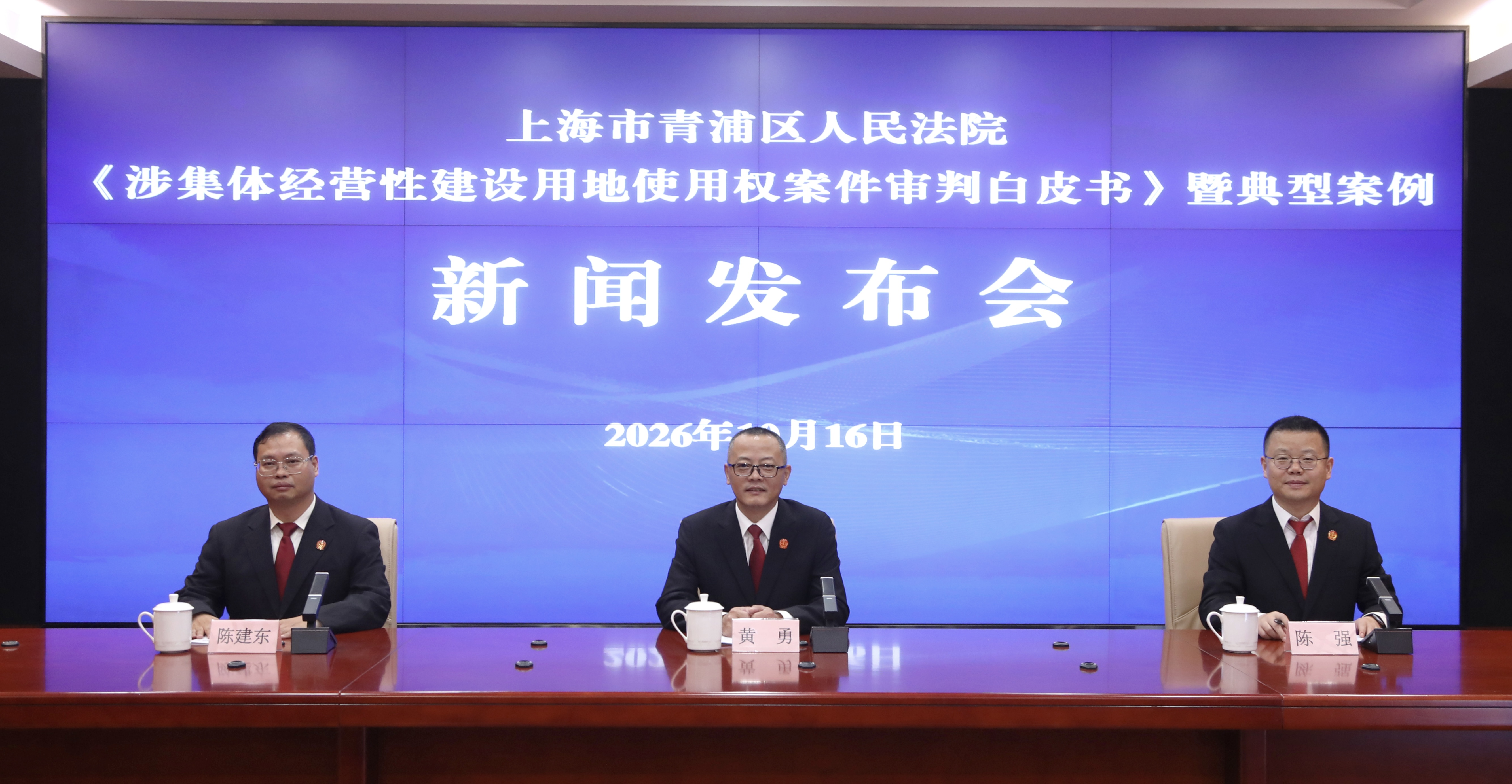
People’s Court) held a press conference on October 16. At the conference, the
court released the White Paper on the Adjudication of Cases Involving Use
Rights of Rural Collective Land for Development Purposes by the Shanghai Qingpu
District People’s Court, 2022–2026 (hereinafter referred to as the White
Paper) along with related typical cases.
At the press
conference, Vice President Huang Yong of the Qingpu District People's Court presented the key findings of the White Paper on
cases involving use rights of rural collective land for development purposes,
while Chief Judge Chen Qiang of the Court’s Civil Division introduced the
related typical cases. The conference was moderated by Chen Jiandong, Deputy
Director of the Political Department and Press Spokesperson of the Court. In
attendance were several members of the Qingpu District Committee of the Chinese
People’s Political Consultative Conference (CPPCC), representatives from the
Construction and Management Commission, the Bureau of Planning and Natural
Resources, and the Commission of Agriculture and Rural Affairs of Qingpu
District, as well as experts and scholars from the School of International Law
at Shanghai University of Political Science and Law and members of the media.
Case Review and
Feature Analysis
The White Paper
systematically reviews cases involving use rights of rural collective land for
development purposes adjudicated by the Qingpu District People’s Court over the
past five years. It comprehensively analyzes case characteristics and causes of
disputes, summarizes adjudication rules, and puts forward targeted governance
recommendations.
According to the
White Paper, from 2022 to 2026, the Qingpu District People’s Court concluded a
total of 110 cases related to use rights of rural collective land for
development purposes. In terms of case types, as
urban renewal and the reduction of inefficiently used
construction land advance, disputes involving
expropriation compensation, removal of nuisance, and transfer of construction
land use rights have gradually emerged, with dispute types evolving from single
to diverse. These cases primarily encompass land lease contract disputes,
building lease contract disputes, and building demolition compensation contract
disputes between civil entities. Among them, land lease contract disputes
accounted for the largest share, totaling 59 cases, or 53.6% of the overall
caseload.
The White Paper
identifies four major characteristics of cases involving use rights of rural collective
land for development purposes. First, causes of action are concentrated, yet
derivative types are diverse. As reforms in marketing
rural collective land for development purposes, the reduction of inefficiently used construction land, and urban renewal
continue to deepen, legacy issues and new-type
transaction disputes have overlapped. Second, dispute resolution remains
highly challenging. Such disputes involve intense
conflicts of interest, with parties typically disagreeing on the nature of
legal relationships, contract validity, and compensation amounts, leaving very
limited room for mediation. Third, trials involve high complexity and
lengthy timelines. Fact-finding is challenging, often
requiring verification of details such as the nature of the land, planning
conditions, and historical evolution, with some cases also involving the
appraisal of above-ground property value and land appreciation. Fourth,
collective economic organizations most often appear as plaintiffs, with core
claims being concentrated. In addition to suing to reclaim collective land due
to the reduction of inefficiently used construction land or urban renewal
needs, collective economic organizations also bring actions to recover
outstanding fees in order to safeguard collective asset rights and interests.
Release of
Typical Cases to Guide Adjudication Rules
At this press
conference, the Qingpu District People’s Court released five typical cases
involving use rights of rural collective land for development purposes,
covering such matters as determination of land use terms, review of contract
validity, binding force of democratic deliberation procedures, allocation of
relocation compensation under inefficiently used construction land reduction,
and resolution of legacy land disputes.
In one land lease
contract dispute case, the court clarified that a lease renewal contract signed
unilaterally by the head of a villagers’ group without going through the
democratic deliberation procedure is not binding on the collective economic
organization. This ruling has effectively urged strict compliance with
democratic deliberation procedures in the leasing of collective assets, preventing
at the source the loss of assets and disputes arising from unauthorized
individual contracting. It not only lawfully safeguards the legitimate rights
and interests of rural collective economic organizations but also further
enhances the level of rule-of-law governance at the grassroots level.
In another contract
dispute case regarding land use right transfer, faced with a legacy dispute
spanning a long period with complex overlapping ownership, the court worked
closely with administrative departments and utilized a multi-channel dispute
resolution mechanism to facilitate a mediation agreement between the parties.
This not only substantively resolved the dispute but also effectively reduced
litigation costs for the parties, providing important practical reference for
the grassroots resolution of similar legacy disputes concerning land
expropriation compensation.
Comments from a CPPCC
member
Xu Chunye, Member
of the CPPCC Qingpu District Committee and Deputy Director of the Social and
Legal Affairs Committee of the CPPCC Qingpu District Committee
The White Paper and
typical cases released this time are closely aligned with the judicial needs
arising from the reform of marketing rural
collective land for development purposes. The issues are
accurately identified, the analysis is in-depth, and the recommendations are
highly practical. In particular, the five typical cases released cover multiple
core difficulties, including term determination, contract validity, relocation
under inefficiently used construction land reduction, and democratic
deliberation procedures. They not only reflect the real challenges in
adjudication practice but also provide clear behavioral guidance for relevant
parties, demonstrating the commitment and wisdom of judicial services in safeguarding
the overall reform agenda. It is hoped that the Qingpu District People’s Court
will continue to deepen government-court coordination, extend the reach of
judicial services, and resolve more disputes at the source and at the
grassroots level.
