
 Your current location >> Press Release
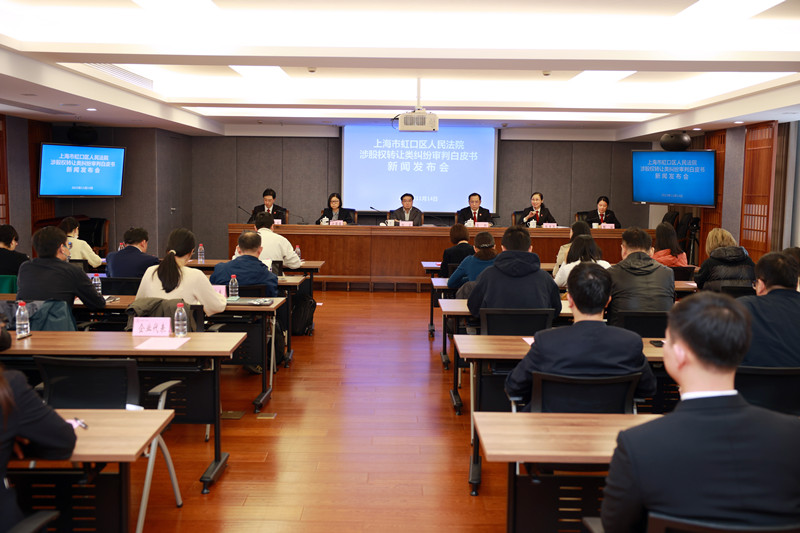
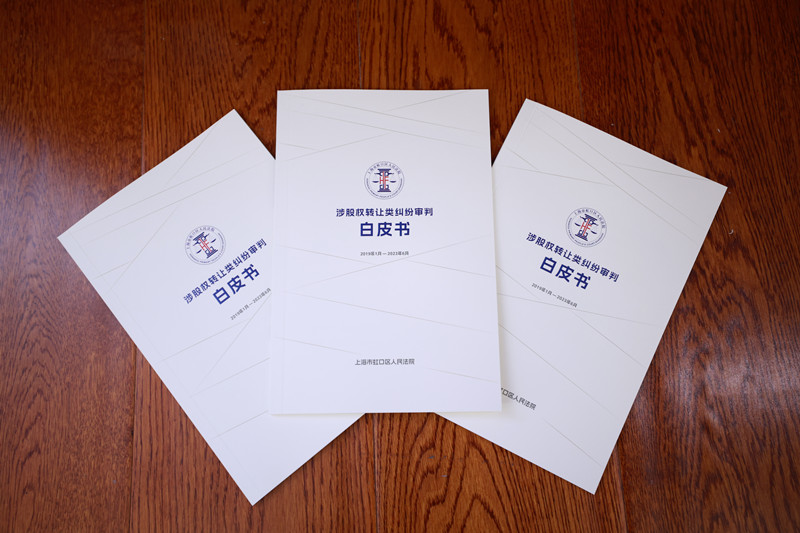
In order to improve the law-based business environment in the district and protect the non-public economy, on November 14, 2023, the Shanghai Hongkou District People’s Court (“Hongkou Court”) held a press conference and issued the Shanghai Hongkou District People’s Court: White Paper on the Trial of Cases Involving Equity Transfers (January 2019 - June 2023) (hereinafter referred to as the “White Paper”), in which the court provides an overview of the trial of cases involving equity transfers in the past five years, outlines the characteristics of such disputes, points out the difficulties in handling such disputes, and gives advice accordingly.
Zheng Hong, member of the Standing Committee of the CPC Hongkou District Committee and minister of the United Front Work Department (UFWD), Xiao Kai, secretary of the Party Leadership Group and president of the Hongkou Court, Fang Weiwei, deputy minister of the UFWD and chairman of the Federation of Industry and Commerce of Hongkou District, and Zhang Hongyi, member of the Party Leadership Group and vice president of the Hongkou Court, attended press conferences to brief relevant situations and answer questions from the reporters. Chen Suqin, member of the Party Leadership Group and spokesperson of the Hongkou Court, presided over the press conference. Other attendees included people from enterprises, the Federation of Industry and Commerce, and media outlets.
Complex case forms and a steady rise in the number of cases concluded
According to the White Paper, from January 2019 to June 2023, the Hongkou Court concluded a total of 330 cases involving equity transfers, accounting for around 4.1% of the total commercial cases concluded during the same period. There has been a steady rise in the number of cases concluded every year before a fall in 2022. In recent years, with the development of the market economy and the diversification of investment methods, the number of cases involving equity transfers has been generally stable. However, the amount of the subject matter in such cases varies significantly; the cases usually take a long time and are difficult to handle; and the appeal rate in such cases is higher than that in ordinary commercial cases.
The White Paper outlines the main characteristics of the cases: involving many stakeholders and many legal relationships; complex case forms; and many related cases.
Five suggestions against the risks and problems and for regulating relevant industries
In order to guide market players to standardize their behavior and enhance the predictability of legal application, the White Paper explains the risks existing in the equity transfer process in the form of cases. These cases, which cover issues like the identification of legal relationships in equity transfers, the conclusion and effectiveness of an equity transfer contract, the performance of an equity transfer contract, and the legal risks after the completion of equity transfer, serve to guide the behavior of the transaction parties.
The White Paper analyzes the risks in the equity transfer process found in trial practice, mentions the points that companies and the parties concerned should pay attention to before and after the equity transfer, and proposes countermeasures and suggestions to standardize and improve related transactions, thereby preventing and reducing the disputes involving equity transfers:
1. The transferor should truthfully disclose the equity and operating conditions of the target company
The equity transferor should follow the principle of good faith and disclose truly, fully, and completely to the transferee its investment information, whether the transfer is restricted, and the operating status of the target company, so that the transferor will not commit contracting fault caused by failure to fulfill the obligation of truthful disclosure in good faith, nor will it be required to cancel the contract for using deceptive means against the other party’s true intentions, nor will it be required to terminate the contract for concealing the target company’s true operating conditions and causing the other party’s failure to achieve the purpose of the contract.
The transferor should also comply with the laws and regulations and the company’s articles of association, consult with the shareholders of the company, protect the shareholders’ right to know and their right of preemption, ensure clear equity ownership and smooth circulation, avoid damaging the shareholders’ right of preemption and making the equity transfer contract invalid.
2. The transferee should conduct due diligence on the equity and the target company
No matter what kind of enterprise they plan to invest in, equity transferees should conduct due diligence on the target company, so they will not make the decision just out of trust in someone they know or in the publicity of the target company and without thinking too much about the transaction itself, and finally make a bad investment after the transfer is completed.
In addition, investors should fully consider the cost when making investments, and include into the cost the personal income tax and stamp duties arising from the equity transfer.
3. Both parties to the transaction should prudently enter into an equity transfer contract
When concluding a transfer agreement, the parties should make it a written contract, sign and seal in a timely manner to make the contract effective, so that it can be a favorable evidence in the event of a dispute.
In addition, after the equity transfer fee is paid, the transferee should ask the transferor to handle the equity change registration as quickly as possible, so as to protect its own rights and interests.
4. A lawsuit should be filed with the people’s court with the right jurisdiction when a dispute occurs
When investors prepare to file a lawsuit over a dispute during the equity transfer process, they should first review the equity transfer contract signed by both parties and their litigation request, and then select the people’s court with the right jurisdiction to avoid wasting time and money.
5. Transaction parties should improve their legal awareness and have a greater sense of integrity
Transaction parties should learn about the laws and regulations about company, property right, contract, and guarantee involved in equity transfers, understand existing limitations and requirements for equity transfers in specific types of enterprises and enterprises in specific industries, and at the same time improve the company’s rules and regulations, standardize the company’s resolution procedures, create a good atmosphere in the company, and prevent internal governance issues from affecting equity transactions.
The people’s court should help boost the non-public economy from three aspects
On how the people’s court should play a part in serving the non-public economy, the Hongkou Court mentioned three points:
One, it should put equal emphasis on justice and efficiency and keep improving the quality and effectiveness of judicial protection. Revolving around the new requirements for improving the business environment, and combining them with the actual situation of trial and execution, the Court should improve its ability to forecast and become more forward-looking and proactive in its work, thus forming an all-round service and guarantee mechanism that covers such areas as resolution of enterprise-related disputes via multiple channels, execution in good faith and with civility, and extension of judicial services.
Two, it should give full play to the multi-channeled dispute resolution mechanism and promote the substantive resolution of enterprise-related disputes. The Court should put the non-litigation dispute resolution mechanism at the forefront, integrate into the social governance system led by the District Committee, and promote the construction of a progressive layered filtering system for dispute resolution; strengthen communication and linkage with the Federation of Industry and Commerce, chambers of commerce, and judicial administrative agencies, improve the “Court +” mediation platform, use various forces to resolve disputes via various channels, thus nipping the conflicts and risks in the bud.
Three, it should come up with new channels to serve enterprises and contribute to the business environment. Aside from the annual rule of law forum, the Court should promote the substantive operation of the legal studio for the private economy, making it an important platform for communication between the Court, the District Federation of Industry and Commerce, and the non-public enterprises, thus achieving the convergence effect of “1+1 >2”.
Private entrepreneurs invited to the Court; Symposium held to help solve problems
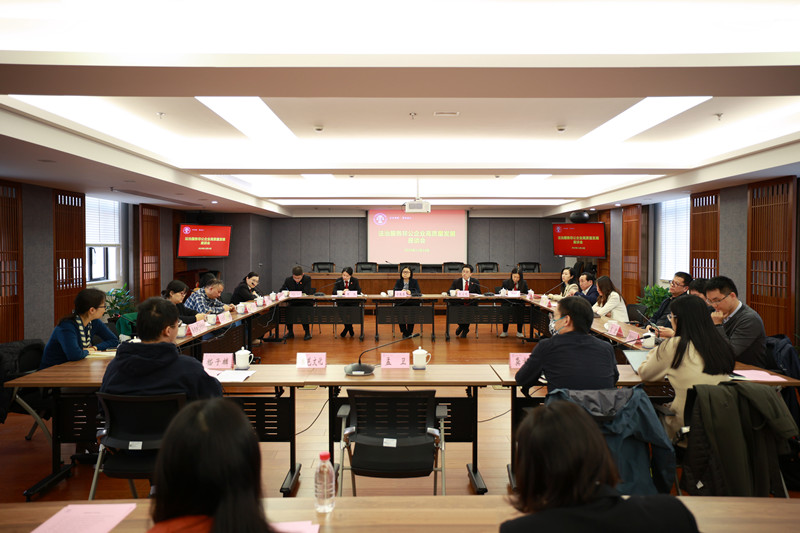
After the press conference, the Hongkou Court held an activity for the private entrepreneurs and a symposium on legally promoting the high-quality development of non-public enterprises.
The entrepreneurs visited the trial places, listening to introduction of the trial process. They felt in person the openness and transparency of judicial procedures and the majesty of the people’s court.
At the symposium, the Hongkou Court introduced to the participants the work it has done in recent years to improve the business environment and protect the legitimate rights and interests of enterprises. Representatives from enterprises also talked about the legal issues and difficulties that they had encountered in operation. The Court gave legal interpretation and analysis of the issues one by one, and provided specific guidance on risk prevention and control in operation.
In the future, the Hongkou Court will strengthen cooperation with the Hongkou District Federation of Industry and Commerce, listen to the representatives from enterprises, provide high-quality judicial services to meet the needs of enterprises, and jointly contribute to the local business environment.
Typical Cases Involving Equity Transfers
>> Chinese Version
