
 Your current location >> Press Release
The
China International Import Expo (hereinafter referred to as "CIIE"),
as a vital platform for international trade and investment cooperation, also
serves as a key window for showcasing China's efforts in intellectual property
(IP) protection and optimizing the global business environment.
As a
judicial authority for the permanent host venue of the CIIE, the Qingpu
District People's Court of Shanghai (hereinafter referred to as the
"Qingpu District People's Court") adheres to its mission of
"serving national strategies and safeguarding the convention
economy". Centering on full-chain IP protection, the court has adjudicated
a series of typical cases involving exhibitions, new quality productive forces,
and people's livelihoods, thus providing a solid rule-of-law guarantee for
high-quality regional industrial development.
On
the afternoon of November 3, as the 8th CIIE commenced, Qingpu District
People's Court held a press conference to release the Working Initiatives
for Advancing Full-Chain Intellectual Property Protection and Providing
Judicial Services and Guarantees for the 8th CIIE (hereinafter referred to
as the "Working Initiatives") and typical cases.
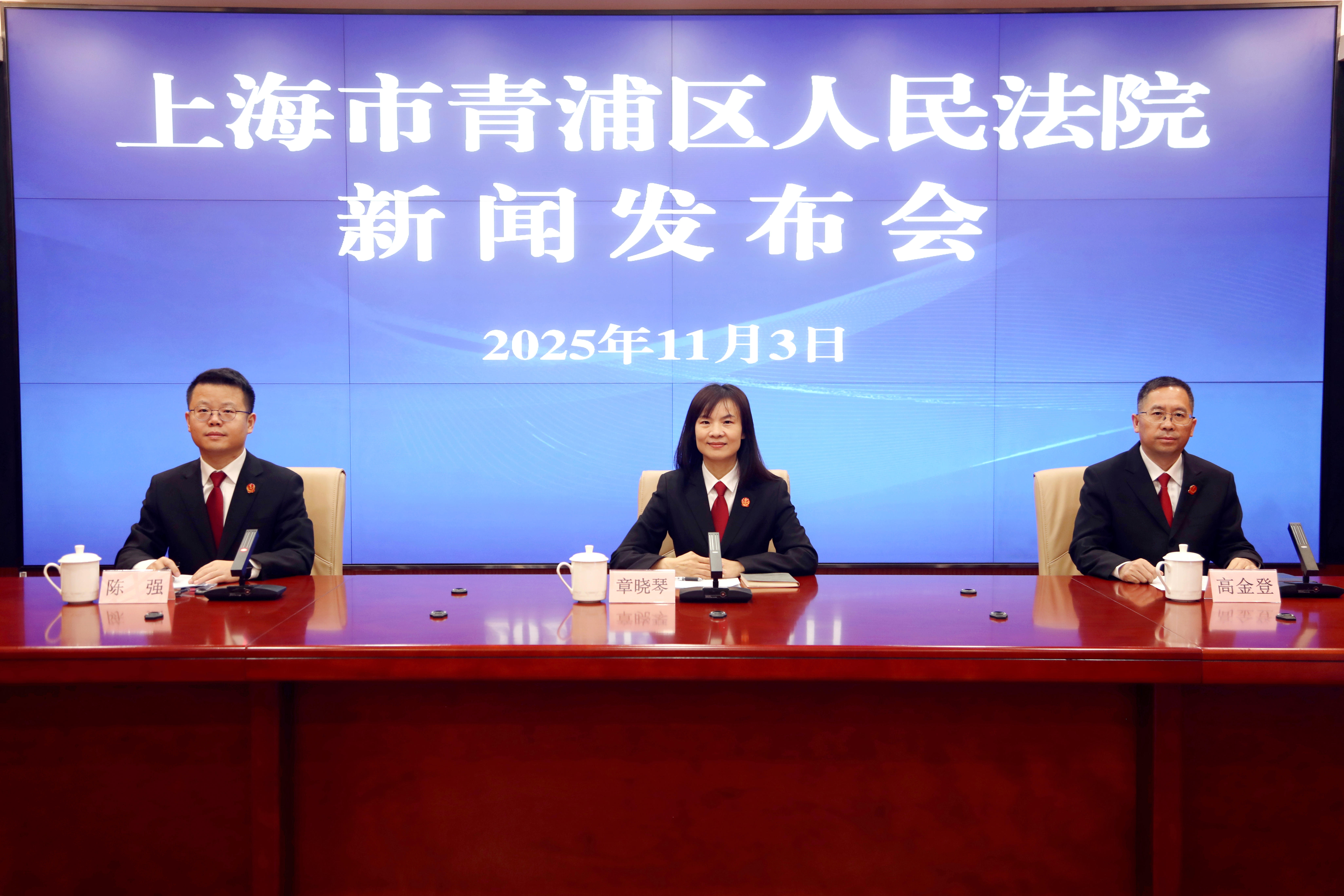
At
the conference, Zhang Xiaoqin, Vice President of Qingpu District People's
Court, reported on the court's achievements in providing services for the CIIE
and explained the details of the Working Initiatives. Chen Qiang, Chief
Judge of the Xihongqiao (CIIE) People's Court, presented the typical cases. The
press conference was chaired by Gao Jindeng, Head of the Political Department
and spokesperson. Attendees included Ning Feng, President of the National
Exhibition and Convention Center (Shanghai); Fang Zhengjie, President of Qingpu
District People's Court; as well as deputies to the Municipal People's Congress,
members of the District CPPCC Committee, experts, scholars, and media
journalists.
As
CIIE's international influence continues to grow, exhibitors have posed higher
demands for the professionalism, timeliness, and coordination of IP protection.
Since the beginning of this year, Qingpu District People's Court has maintained
frequent communication and collaboration with partner institutions through
field visits, research, and symposiums. While formulating the Working
Initiatives to safeguard the 8th CIIE, the court selected typical cases.
This not only provides precise judicial support for the CIIE but also further
deepens and improves full-chain collaborative IP protection across Qingpu
District and the Yangtze River Delta Demonstration Zone, enabling CIIE
exhibitors and key Qingpu industries to experience a more efficient,
convenient, and comprehensive IP protection environment.
At
the conference, Zhang Xiaoqin provided an in-depth explanation of the six
service and safeguard measures introduced for IP protection during the CIIE,
forming a full-chain IP protection system covering "prevention,
resolution, and penalty".
For
basic judicial services, the Qingpu District People's Court, together with the
District Administration for Market Regulation, People's Procuratorate, Judicial
Bureau, and other institutions, promoted the establishment of the Yangtze River
Delta Demonstration Zone Full-Chain Collaborative IP Protection Center within a
one-kilometer radius of the National Exhibition and Convention Center
(Shanghai), innovatively creating a "1-Kilometer Judicial Service
Circle". The Center plans to establish a "Specialized IP Circuit
Courtroom", and conduct circuit trials for typical infringement cases
centering on new quality productive force industries such as artificial
intelligence (AI) and green energy, as well as key exhibition-related sectors
like CIIE. Exhibitors and industry association representatives were invited to
attend hearings, raising legal awareness through intuitive case-based legal education.
Additionally, a collaborative platform known as the "Qingpu Rule-of-Law
Salon" has been established. In regular cooperation with departments of
market regulation, culture and tourism, commerce, and industry associations,
the platform conducts seminars, industry lectures, and field research on
high-frequency issues such as IP protection during exhibition preparation and
the resolution of enterprise-related disputes, building a co-governance
mechanism featuring "judicial leadership, multi-party participation, and
demonstrative guidance".
To
meet the needs of dispute resolution, the Qingpu District People’s Court has
further enhanced the one-stop "litigation-mediation-arbitration"
mechanism, promoting a shift from fragmented and reactive dispute handling to a
systematic and collaborative approach. On one hand, the court—working with
relevant mediation organizations—has selected from their rosters a group of
professional mediators, including technical experts, senior lawyers, retired
judges, and arbitrators who possess multilingual capabilities and are
experienced in international exhibition rules, international trade norms,
international IP protection frameworks, foreign-related laws, and technology.
Together, they have formed the "International IP Mediation Expert Database
for CIIE-Related Cases" to provide multilingual and precise mediation
services for cross-border, highly complex IP disputes arising from exhibitions.
On the other hand, the court has established regular cooperation with Shanghai
arbitration institutions to promote the seamless integration of litigation and
arbitration, encouraging business entities to choose Shanghai as their
preferred venue for dispute resolution.
To
extend the reach of services, Qingpu District People's Court has established
"Judicial Observation Points" in the Beidou Industrial Park, at key
participating enterprises, and in clusters of new quality productive forces,
thereby creating a full-chain judicial service mechanism encompassing
"demand collection—service delivery—outcome transformation".
Simultaneously, the court compiled and released the Typical Cases of
Full-Chain IP Protection and the Guidelines for IP Protection at
Exhibitions (2025 Edition) at the press conference, offering clear judicial
guidance for exhibitors.
At
the press conference, Chen Qiang announced six typical cases of full-chain IP
protection, covering civil, administrative, and criminal cases, involving
crimes of IP infringement, trademark infringement, unfair competition,
foreign-related trademark protection, and administrative penalties for IP
violation, actively addressing pain points in IP protection for exhibitions and
key industries.
For
example, in a foreign-related trademark protection case, Chao's Company, having
only obtained authorization for on-campus product sales, used "Le
Education" as a selling point to develop over 200 franchise stores,
committing the infringement for seven years. The Qingpu District People's Court
ruled that the company had committed trademark infringement and applied
punitive damages, ultimately ordering compensation of CNY 35 million. This case
represents the highest punitive damages awarded in an IP case in Shanghai this
year, and it clarified the application pathway for punitive damages—evaluating
subjective malice, severity of circumstances, and damages calculation.
In
another trademark infringement dispute, Qingpu District People's Court broke
out of the routine thinking of trials and ascertained that some individuals
used AI large model technology to conduct false evidence collection: The
plaintiff attempted to manufacture an illusion of infringement by conducting
frequent, repetitive searches. After the court clarified the associated legal
risks, Sichuan Quan's Company withdrew 400 cases, including the one at issue.
This case vividly demonstrates how Qingpu District People's Court, in line with
regional development trends, supports the development of new quality productive
forces with high-quality justice, providing important adjudication guidance for
handling IP disputes in the AI sector.
Next,
Qingpu District People's Court will continuously optimize judicial services
with more precise adjudication and more efficient service to support the 8th
CIIE, demonstrating to the international community the strength and warmth of
China's IP judicial protection.
Representative
Comments
Zhou
Zhenbo, Deputy to Shanghai Municipal People's Congress, Deputy Secretary of the
Party Branch and Deputy Director of the Finished Goods Workshop at Shanghai
Delixi Group Co., Ltd.
The Working
Initiatives not only align with the practical needs of exhibitions, but
also focus on the core of full-chain IP protection, fully demonstrating the
precision and proactivity of Qingpu District People's Court in serving the
overall situation. Particularly, by creating a "1-Kilometer Judicial
Service Circle" next to the National Exhibition and Convention Center in
Hongqiao Business District, where key industries are concentrated, it delivers
services such as circuit courts and the "Qingpu Rule of Law Salon"
right to the doorsteps of exhibitors and major corporate headquarters. It is
hoped that Qingpu District People's Court will continue to deepen collaborative
mechanisms such as the "Qingpu Rule of Law Salon," further strengthen
linkages with industry associations and university think tanks, promote the
evolution of IP protection from judicial leadership to multi-party
co-governance, and better enable Shanghai to build an international IP
protection highland.
Pei
Yongfei, Member of the Qingpu District CPPCC Committee, Middle School Art
Teaching and Research Staff at Qingpu District Institute of Education
Qingpu
District People's Court demonstrates three distinctive features in IP
protection: collaborative, specialized, and internationalized. The
"Yangtze River Delta Demonstration Zone Full-Chain Collaborative IP
Protection Center" achieves efficient integration of judicial,
administrative, and industrial resources. The mechanism of "demand
collection—analysis and assessment—service supply—result transformation"
established by the "Judicial Observation Points for New Quality Productive
Force Enterprises" closely integrates judicial protection with industrial
innovation and development, providing judicial services for nurturing new
quality productive forces. The one-stop dispute resolution mechanism of
"litigation-mediation-arbitration" integrates various resources,
smooth procedural connections, and effectively enhances the efficiency of
resolving foreign-related and exhibition-related disputes. It is recommended to
further expand the coverage of "Judicial Observation Points" to
enable the full-chain protection mechanism to benefit more new quality
productive force enterprises and continuously optimize the regional business
environment.
Liu
Enyuan, Director of the International Public Law Teaching and Research Office,
School of International Law, Shanghai University of Political Science and Law
The
typical cases released by Qingpu District People's Court this time fully
demonstrate the guiding, standardizing, and guaranteeing role of IP trials in
industry development. For example, a foreign-related trademark protection case
among the typical cases released this time significantly enhances protection
for IP rights holders compared with similar previous cases. The case adopted
punitive damages as the judgment method, ordering Dr. Le's company to be
compensated up to CNY 35 million for economic losses, with franchisees bearing
joint and several liability ranging from over one million to several million
CNY. This judgment effectively deters infringers. On one hand, it significantly
raises the cost of infringement through punitive damages, making infringement
unprofitable. On the other hand, given that malicious and repeated
infringements are generally concealed and difficult to detect promptly,
applying punitive damages also helps compensate rights holders' losses to a
certain extent. This case is a typical example of strict implementation
following the enforcement of the Civil Code of the People's Republic of
China and the Interpretation of the Supreme People's Court on the
Application of Punitive Damages in the Trial of Civil Cases of Intellectual
Property Infringement. All cases released this time possess significant
typical value, providing high-quality teaching materials for universities.
Looking ahead, we will continue to deepen the two-way integration of judicial
cases and academic research, jointly facilitating the continuous enhancement
and improvement of IP protection theory and practice.
