
 Your current location >> Press Release
Pension-related matters are both a
family and national concern. The Central Financial Work Conference has
identified "pension finance" as one of the "Five Major
Tasks" for high-quality financial development.
To further respond to the judicial
protection needs of an aging society and to promote the high-quality and
diversified development of pension finance, on the occasion of the upcoming
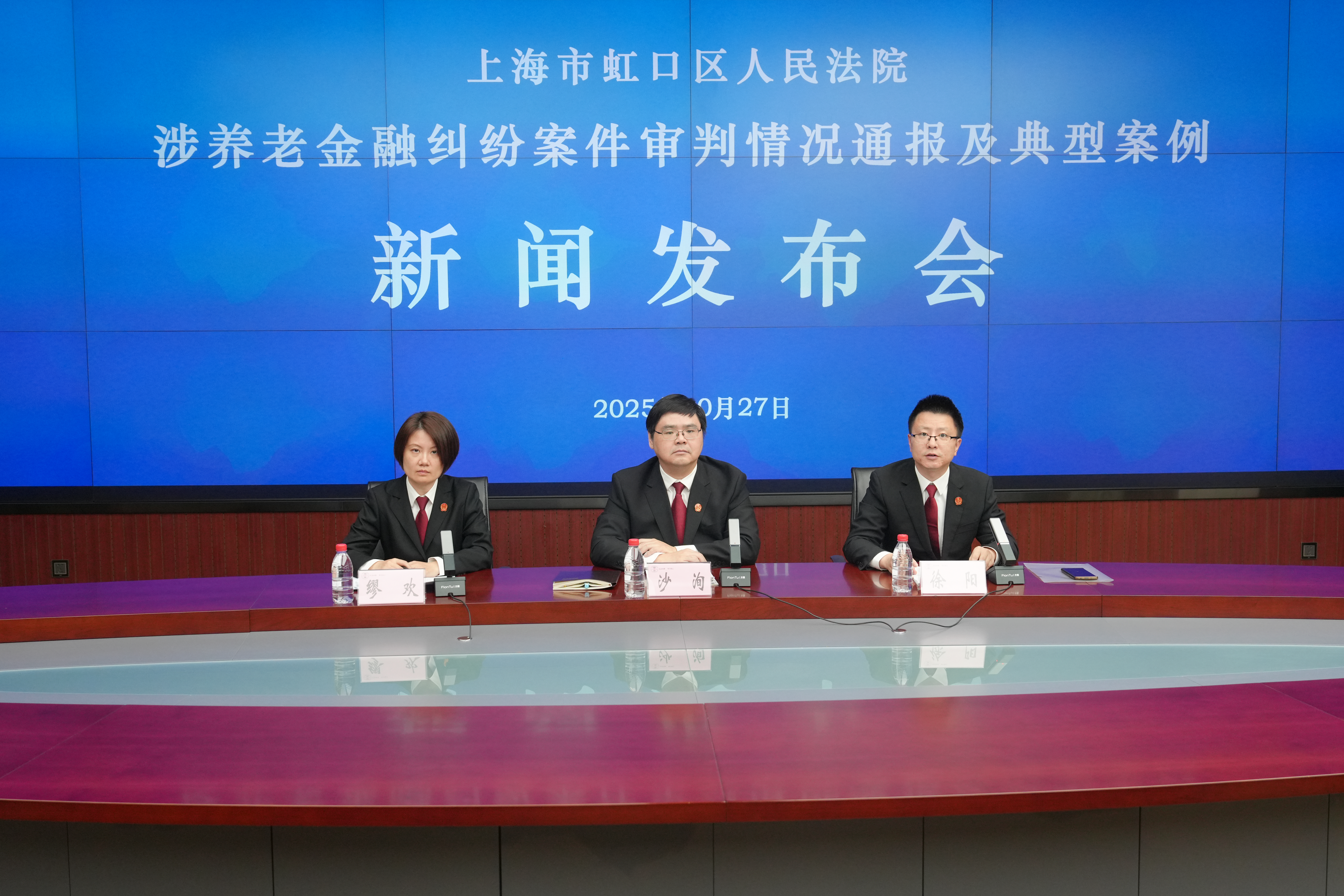
Double Ninth Festival, this afternoon (October 27), the Shanghai Hongkou
District People's Court (hereinafter referred to as the Hongkou District
People's Court) held a press conference to release the 2020-2025 Trial Report
on Pension Finance Disputes by Shanghai Hongkou District People's Court
(hereinafter referred to as the "White Paper") and typical cases
related to pension finance disputes .
At the conference, Sha Xun, Vice
President of the Hongkou District People's Court, reported on the trial of
pension finance-related dispute cases handled by the court from 2020 to 2025.
Miao Huan, Chief Judge of the Financial Division, introduced five typical cases
of pension finance-related trials. Xu Yang, Head of the Political Department
and spokesperson of the Hongkou District People's Court, presided over the
press conference. The event was attended by municipal and district-level
deputies to the people's congresses, members of the political consultative
conferences, representatives from the Hongkou District Civil Affairs Bureau,
financial institutions, and journalists from news media outlets.
Pension finance refers to a series of
financial activities that comprehensively utilize financial instruments such as
credit, insurance, bonds, equity, and wealth management to address the diverse
pension needs of social members and support the development of the "silver
economy".
According to the White Paper, from 2020
to 2025, the Hongkou District People's Court accepted a total of 1,184 pension
finance-related dispute cases and concluded 1,154 of them.
In terms of case types, they are mainly
concentrated in traditional financial fields such as banking and insurance.
Among these, financing-related cases constitute the largest proportion,
accounting for 82.24%. Insurance-related disputes and asset management-related
disputes represent 8.67% and 7.89%, respectively.
The White Paper analyzes that pension
finance-related dispute cases exhibit five characteristics: the case types are
focused on traditional financial fields such as banking and insurance; the
overall proportion of cases involving banking services is relatively high; the
subject matter amounts of cases are mostly small; new types of cases are
gradually emerging, with increasing complexity; and the mediation rate remains
low.
Regarding future trends, the White
Paper predicts that the number of pension finance-related disputes will
gradually increase and their complexity will become increasingly prominent;
however, with the improvement of financial services exclusively for the elderly
population, the growth rate of disputes related to elderly bank cards is
expected to narrow.
The White Paper categorizes and reviews
disputes related to wealth management products, elderly-related asset
management, pension insurance, and pension financing. It also highlights key challenges
within the current pension financial services sector: the pension attribute of
wealth management products is not sufficiently emphasized; the suitability
obligation during the sale of pension asset management products is not
standardized; the obligation to disclose for pension insurance is inadequately
fulfilled, and consumers have misconceptions; the strict liability for breach
of financing contracts hampers the long-term development of the pension
industry.
Based on judicial practice and industry
status, the White Paper proposes four targeted recommendations: comprehensively
upgrading the elderly-friendliness of financial services to enhance
accessibility; enhancing the value-preserving and appreciation functions of
pension financial products, shortening the lock-up period, and increasing
liquidity; constructing a diversified and long-term patient capital supply
system to address the operational difficulties of the pension industry; and
strengthening financial consumer protection with a focus on the elderly
population.
The five typical cases reported at the
conference cover dispute types such as property damage compensation, life
insurance contracts, service contracts, and tort liability, revealing common
legal disputes from different perspectives and clarifying corresponding
adjudication rules and behavioral guidelines.
For example, in one case, Fang, upon
recommendation by Bank A, invested CNY 10 million to subscribe to a certain
asset management plan. After redeeming it two years later, Fang suffered a
principal loss of over CNY 2.7 million. As a professional financial
institution, Bank A failed to accurately prepare external product
introductions, and its customer manager violated regulations by writing risk
awareness content on behalf of the client without authorization. Considering
the degree of fault of both parties, the people's court determined that Bank A
shall compensate Fang for 60% of the principal loss. The judgment clarified
that financial institutions must fulfill obligations to understand clients,
understand products, and conduct appropriate sales when promoting wealth
management products. Any inconsistencies between promotional materials and
contract content, as well as actions such as operating on behalf of clients,
will be deemed as a failure to fulfill duties, and compensation liability will
be borne according to the degree of fault.
In another case, Li purchased a certain
pension annuity insurance (with dividends). Five years later, Li sued the
insurance company to the people's court, alleging that the salesperson engaged
in fraudulent and misleading behavior, and requesting the revocation of the
insurance contract and the refund of the premiums already paid. The people's
court ruled that the insurance company had fully informed Li of the uncertainty
of dividend distribution, and therefore, the people's court would not support
the claim to revoke the contract on the grounds of a material misunderstanding
of the dividend content. This case emphasizes that if financial institutions have
fully fulfilled their risk disclosure obligations through various means, the
contract is binding on consumers, and consumers must take responsibility for
their own actions. "Seller's due diligence" is the prerequisite for
"buyer's self-responsibility."
Pension finance, an essential part of
the pension security system, bears the crucial task of meeting the people's
growing demand for pension wealth accumulation and serving the construction of
a multi-tiered pension insurance system.
This press conference focused on
practical issues in the field of pension finance-related disputes,
systematically reviewed trial data, analyzed typical cases, and strengthened
risk warnings. It helps to foster social consensus through the
"window" of judicial adjudication, jointly creating an honest,
trustworthy, fair, orderly, safe, and stable ecological environment for pension
finance.
Representative Comments
Xu Xin, Deputy to the Shanghai
Municipal People's Congress, Deputy General Manager of the Centralized
Operations Center, China Mobile Communications Group Shanghai Co., Ltd.
Currently, China's social aging process
is accelerating, and the pension finance market is flourishing, with related
disputes gradually becoming prominent. This White Paper fully demonstrates the
high sense of responsibility and judicial commitment of the people's courts in
serving the overall situation, safeguarding people's livelihood, and
maintaining social stability. It conducts an in-depth analysis of emerging
disputes related to pension finance and transforms judicial adjudication
results into vivid legal popularization materials through the approach of
"typical cases + risk warnings," reflecting a shift from
"post-event resolution" to "pre-event prevention." It provides
valuable decision-making references for promoting governance in related fields.
Wang Qing, Deputy to the Hongkou
District People's Congress of Shanghai, Special Supervisor of the Hongkou
District People's Court, Director of the Elderly Care Service Development
Center of Hongkou District, Shanghai
Optimizing and improving the legal environment
for pension finance requires the joint efforts from government departments,
financial regulatory authorities, judicial organs, and financial market
entities. This White Paper systematically summarizes four prominent issues in
the pension finance service industry, providing not only a highly valuable risk
map and action guide but also prompting us to place the construction of a
diversified elderly care service system in a more prominent position. It is
hoped that through multi-party collaboration, we can jointly build a
"firewall" for elderly care rights and interests and jointly create a
happy vision of a secure and comfortable old age.
Gao Zhilei, Member of the Chinese
People's Political Consultative Conference of Hongkou District, Shanghai,
Special Supervisor of the Hongkou District People's Court, Senior Partner of
Shanghai Everbright Law Firm
The White Paper meticulously reviews
the types, characteristics, and causes of pension finance-related dispute
cases, accurately grasping new situations and issues in the pension finance
field, and providing important judicial guidance for regulating pension finance
development. In particular, the relevant recommendations for promoting the
healthy and sound development of pension finance, including comprehensively
upgrading the elderly-friendly level of financial services and constructing a
diversified and long-term patient capital supply system to address operational
difficulties in the elderly care industry, are highly relevant in reality. It
is hoped that the people's courts can continue to deepen their extended
judicial functions and actively participate in grassroots social governance.
附件:上海市虹口区人民法院涉养老金融纠纷审判典型案例.pdf
>> Chinese Version
