
 Your current location >> Press Release
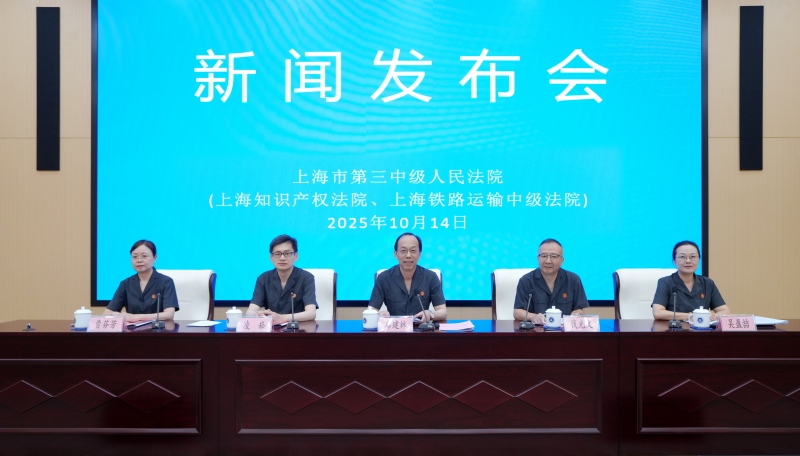
On October 14, the Shanghai Third
Intermediate People's Court (Shanghai Intellectual Property Court and Shanghai
Railway Transportation Intermediate Court) held a press conference to release
the Implementation Opinions on Strengthening Intellectual Property
Adjudication in the New Era to Serve and Support Shanghai's Further Development
of International Center for Science and Technology Innovation (hereinafter
referred to as the "Implementation Opinions"), together with a
selection of representative cases. This move aimed to thoroughly implement
relevant requirements for the central and municipal Party committees, fully
leverage the role of intellectual property adjudication in encouraging,
safeguarding, and guiding technological innovation, and serve and support
Shanghai's continued efforts to deepen the development of the International
Center for Science & Technology Innovation (ICSTI).
Attendees at the press conference
included Xi Jianlin, Secretary of the Leading Party Members' Group and
President of the Shanghai Third Intermediate People's Court (Shanghai
Intellectual Property Court, Shanghai Railway Transportation Intermediate
Court); Qian Guangwen, Chief Judge of the Intellectual Property Comprehensive
Trial Second Division; Ling Song, President of the Intellectual Property
Comprehensive Trial First Division; and Cao Fenfang, Deputy Chief Judge of the
Criminal Division. The press conference was chaired by Wu Yingzhe, Chief Judge
and Spokesperson of the Appeals Review and Judicial Supervision Tribunal (Research
Office and Adjudication Management Office).
Xi Jianlin noted that, General
Secretary Xi Jinping provided strategic guidance for advancing the development
of Shanghai's ICSTI during a visit to Shanghai in April; at its seventh plenary
session in July, the 12th Municipal Committee set out practical pathways for
deepening the development of the ICSTI. To implement these guiding principles
and give full play to the core role of intellectual property adjudication in
"encouraging innovation and safeguarding development", the Shanghai
Third Intermediate People's Court (Shanghai Intellectual Property Court,
Shanghai Railway Transportation Intermediate Court) formulated the
Implementation Opinions after extensive research and deliberation.
Additionally, the Court selected a series of representative cases, marking the
service and support for Shanghai's deepened development of the ICSTI as a major
mission of IP adjudication.
The "Implementation
Opinions", with the focus on "protecting achievements, safeguarding
entities, and optimizing the ecosystem", set out three major areas and
nine key tasks:
I. Strengthen judicial protection of
scientific and technological innovation achievements to facilitate
breakthroughs in key fields
1.Establish rules for emerging fields: Handle, according to laws, disputes involving new issues, such
as data rights, AI data training, and infringement arising from outputs
generated by large models, promptly clarify judicial rules, and guide the sound
development of emerging industries.
2.Provide strong protection for core
technologies: Strictly crack down on crimes of
intellectual property (IP) infringement, effectively exerting the punitive and
deterrent functions of criminal penalties. For pioneering inventions and
original innovations with high levels of creativity and considerable impact on
technological advancement, provide broad and strong protection to deliver solid
legal guarantees for breakthroughs in integrated circuits, innovative
pharmaceuticals and medical devices, and the iterative upgrading of AI.
3.Demonstrate the deterrent effect of
punitive damages:
Refine rules on awarding punitive damages in IP cases, increase their
application, and ensure that the system fulfills its role in punishing
infringers, providing effective relief to right-holders, and stimulating
innovation.
II. Strengthen judicial protection
for all types of scientific and technological innovators and accelerate the
commercialization of R&D achievements
1.Ensure equal and comprehensive
protection for all types of entities: Properly handle disputes involving state-owned enterprises
(SOEs), private enterprises, and foreign-invested R&D centers; support SOEs
in their role as sources of original innovation; enhance private enterprises'
capability to safeguard their rights overseas; and help foreign-invested
R&D centers upgrade their capacities and boost Shanghai's attractiveness to
global innovation resources.
2.Clarify rights and obligations of
technology transfer: Clearly
define ownership and benefit-sharing for employee inventions, safeguard
researchers' entitlement to rewards and remuneration, stimulate their
creativity, and accelerate the transformation of scientific and technological
achievements into real productivity.
3.Remove barriers to talent mobility: Balance the protection of trade secrets with employees'
freedom to choose jobs, and lawfully resolve disputes arising from the
departure of technical personnel, providing strong support for the orderly flow
of S&T talent and the emergence of innovative enterprises.
III. Safeguard fair competition to
build a world-class innovation ecosystem per laws
1.Place equal emphasis on the antitrust
enforcement and the fight against unfair competition: Accurately distinguish between the
lawful exercise of IP rights and their abuse to eliminate or restrict
competition, ensure fair access to innovation resources for all types of
enterprises, promote rational allocation and efficient utilization of such
resources, curb "rat race" competition, and contribute to the
development of a unified national market.
2.Crack down on acts that impede
technological innovation according to laws: Curb false IP rights litigation, malicious lawsuits, and other
abuses of procedural rights that hinder innovation, prevent litigation from
being used to disrupt competitors' legitimate development or obtain improper
benefits, and foster a sound rule-of-law environment for entrepreneurship and
innovation.
3.Strengthen coordinated protection: Improve the linkage among civil,
administrative, and criminal proceedings; work in concert with the Municipal
Science and Technology Commission, the Shanghai Intellectual Property
Administration, and other relevant authorities and industry associations; and
build strong synergies to enhance the overall effectiveness of IP protection.
Xi Jianlin pointed out that to ensure
effective implementation of the Implementation Opinions, the Shanghai Third
Intermediate People's Court (Shanghai Intellectual Property Court, Shanghai
Railway Transportation Intermediate Court) is introducing three supporting
measures: improving IP adjudication institutions and mechanisms, building a
high-caliber specialized judiciary team, and empowering adjudication with
digital technologies, so as to provide high-quality judicial services for great
sci-tech innovation.
At the press conference, Qian Guangwen
released and interpreted eight representative cases in the field of scientific
and technological innovation. The cases cover key and emerging technologies
such as integrated circuits, biomedicine, and data rights. They include a
trade-secret infringement case that clarifies the criteria for "improvement-based
use" and "passive use" of trade secrets and adopts exit-ban
measures to prevent the outflow of core integrated-circuit (IC) technology; a
pharmaceutical technology contract dispute involving more than CNY 100 million;
an unfair-competition case concerning the resale of split membership rights and
data scraping; and the nation's first criminal case involving the manufacture
and sale of pirated "dongles" used for medical software. These cases
directly respond to pressing issues in the protection of technological
innovation and offer clear guidance for the adjudication of similar cases in
the future.
At the press conference, Xi Jianlin,
Ling Song, and Cao Fenfang answered questions from journalists. The conference
was also attended by deputies to the Shanghai Municipal People's Congress,
members of the Shanghai Municipal Committee of the Chinese People's Political
Consultative Conference (CPPCC), experts, scholars, representatives of hi-tech
enterprises, and media journalists.
Comments by Deputies, Committee
Members, and Experts
Fan Zheng, Deputy to the Shanghai
Municipal People's Congress, Deputy Secretary of the Party Committee, and
Deputy General Manager of Shanghai Patent & Trademark Law Office, LLC: The Shanghai Third Intermediate
People's Court (Shanghai Intellectual Property Court, Shanghai Railway
Transportation Intermediate Court), embracing its mission in the new era, has
made supporting the development of Shanghai as an international science and
technology innovation center the core mission of IP adjudication. By focusing
on the protection of emerging technologies, incentives for technology transfer,
and the optimization of the innovation ecosystem, the Court has injected strong
rule-of-law momentum into the city's scientific and technological development.
From cutting-edge explorations involving AI and data rights to precise
protection of original achievements, employee inventions, and trade secrets,
and further to the application of powerful tools such as punitive damages and
measures to curb malicious litigation, each step reflects the judiciary's sense
of responsibility and foresight in keeping pace with industrial development.
The release of the eight representative cases not only summarizes judicial
experience but also serves as a model, offering clear guidance for enterprises
and researchers.
Chen Lei, Member of the Shanghai
Municipal Committee of the CPPCC, Executive Director of the Data-Driven Center
at Zhiji Automotive Technology Co., Ltd. (IM Motors): The Implementation Opinions center on
three key dimensions—judicial protection of scientific and technological
achievements, safeguarding the rights and interests of all innovation entities,
and maintaining fair competition in accordance with the law—putting forward a
series of practical and actionable measures that provide strong institutional
support for tackling key technological challenges, promoting the efficient
transformation of R&D results, and fostering a world-class innovation ecosystem.
As new energy vehicles, large models, and AI advance rapidly, breakthroughs in
emerging and core technologies will continue to generate new judicial issues
and practical needs. We look forward to the courts taking the release of the
Implementation Opinions as a new starting point to further enhance the
effectiveness of IP protection and, through high-quality IP adjudication,
better serve and support Shanghai's efforts to deepen the development of ICSTI.
Xu Chunming, Director of the IP
Discipline Committee of Tongji University, Professor at the Shanghai
International College of Intellectual Property: In Shanghai's efforts to deepen its
development of ICSTI, the judicial protection of IP has always been a core
issue. The Implementation Opinions focus on emerging technology fields,
directly address cutting-edge challenges such as AI and data rights, and tackle
the problem of legal lag by formulating dynamic rules, thereby providing an
institutional safeguard for Shanghai to secure a leading position in frontier
technologies. The document strengthens the balancing of interests by clearly
distinguishing the technology-origination responsibilities of SOEs from the
overseas risk-management needs of private enterprises, and especially by
refining rules on the ownership and benefit-sharing of employee inventions for
the purpose of stimulating researchers' creativity and accelerating the
commercialization of innovations. It also optimizes the innovation ecosystem by
curbing false litigation, malicious lawsuits, and other abuses of procedural
rights that hinder innovation, demonstrating a firm stance on maintaining fair
competition, removing the disruptions caused by "rat race"
competition, and creating a new sound environment for sci-tech enterprises.
附件一:上海市第三中级人民法院(上海知识产权法院、上海铁路运输中级法院)关于加强新时代知识产权审判工作 服务保障上海深化国际科技创新中心建设的实施意见.pdf
附件二:服务保障上海深化国际科技创新中心建设典型案例.pdf
>> Chinese Version