
 Your current location >> Press Release
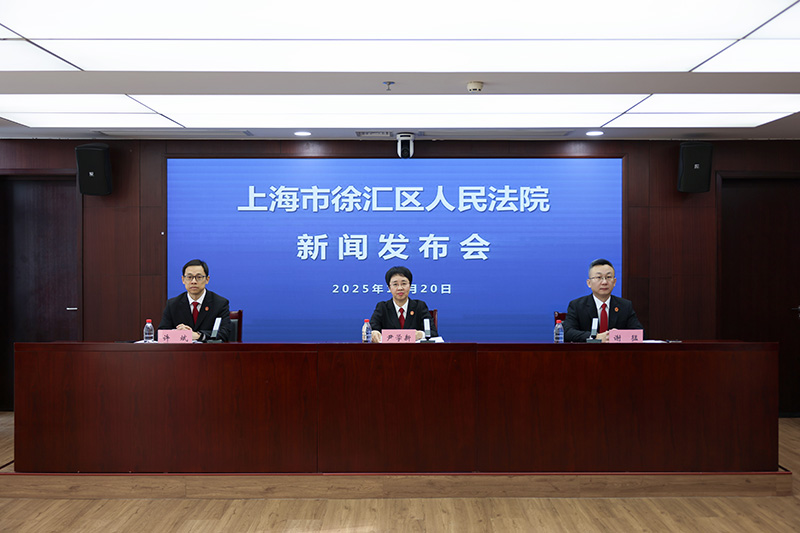
In recent years, employers have
increasingly emphasized the use of non-competition measures to safeguard their
own competitive advantages and lawful rights and interests, and such disputes
have gradually entered the public eye. In order to lawfully protect employers'
rights and interests in safeguarding trade secrets while also taking into
account employees' freedom of career choice and promoting the formation of a
fairer and more orderly market competition order, this morning (November 20),
the Xuhui District People's Court of Shanghai (hereinafter referred to as the
"Xuhui District People's Court") held a press conference to release
the White Paper on the Adjudication of Non-Competition Disputes from 2020 to
2024 (hereinafter referred to as the "White Paper") and to brief
the public on the Xuhui District People's Court's adjudication work regarding
non-competition disputes in recent years.
At the press conference, Yin Xuexin,
Vice President of the Xuhui District People's Court, and Xu Bin, Chief Judge of
the Enforcement Adjudication Division, provided relevant information and
answered questions from reporters. The press conference was presided over by
Xie Meng, Head of the Political Department and Spokesperson of the Xuhui
District People's Court. Central and local media outlets, including Legal
Daily, The Democracy and Law Times, Jiefang Daily, and Shanghai Law Journal,
attended the event. Some deputies to the Xuhui District People's Congress, the
Xuhui District Federation of Trade Unions, the Xuhui District Labor
Association, and representatives of enterprise employees were also invited to
attend the press conference.
The White Paper notes that over the
past five years, the Xuhui District People's Court has concluded a total of 105
cases involving non-competition disputes, with the number showing a year by
year upward trend. These cases demonstrate the following characteristics:
first, the positions involved are both
"high tech" and "high paying", with large amounts in
dispute; second, there is an imbalance between liquidated damages and
compensation, making dispute resolution more difficult; third, non-competition
practices are concealed and diverse, resulting in a high proportion of findings
of breach.
The White Paper analyzes the problems
reflected in non-competition disputes and their underlying causes, which mainly
include the following: the overbroad identification of personnel subject to
non-competition obligations, leading to the frequent occurrence of
non-competition disputes; the improper expansion of the scope of
non-competition, impairing workers' right to free choice of employment; the
imbalance between liquidated damages and compensation, unreasonably increasing
the burden on workers; and increasingly concealed non-competition conduct,
which heightens the difficulty for employers in collecting evidence.
With the accelerated advancement of
technological innovation and intensifying competition for talent,
non-competition, as an important mechanism for balancing the protection of
enterprises' trade secrets and workers' freedom of employment choice, has seen
its boundaries of application, determination of validity, and performance
standards become focal and challenging issues in the field of labor relations.
To prevent the abuse of rights and
maintain a fair employment order while lawfully protecting enterprises'
legitimate rights and interests, the Xuhui District People's Court has focused
on advancing the source prevention and substantive resolution of
non-competition disputes from three aspects: first, promoting diversified
co-governance and building a new pattern of front end dispute resolution;
second, strengthening rule-based guidance to promote the unification of
adjudication standards; and third, extending judicial services to empower new
practices for enterprise development.
It is worth noting that, relying on the
"Under the Gantang Tree" Community Judge Studio, the Xuhui District
People's Court has developed the distinctive "Haiyan Mailbox" service
brand, providing legal consultation, risk alerts, and mediation coordination
both online and offline simultaneously. Judges are organized to visit key
industrial parks and high-technology enterprises to gain a face-to face
understanding of the pain points and bottlenecks in employment management and
to provide tailor-made compliance recommendations. Circuit trial stations are
established in industrial cluster areas, and circuit trial points are set up in
comprehensive governance centers, using the "hearing one case" to
drive the "standardization of an entire sector". Specialized training
sessions are conducted for enterprises, systematically explaining the key
points in the conclusion of non-competition agreements, the boundaries of
performance, and the legal consequences, guiding enterprises to shift from
"passive response to litigation" to "proactive compliance".
On this occasion, the Xuhui District
People's Court selected five typical cases for release in the White Paper,
presenting adjudication approaches to such cases from multiple perspectives,
including the identification of the subjects of non-competition obligations,
the determination of concealed non-competition practices, the determination of
liquidated damages for breach of non-competition obligations, and the
relationship between objections to compensation and the performance of
non-competition obligations, thereby providing judicial guidance for the
prevention and resolution of such disputes.
For example, in the non-competition
dispute case of Sun v. Company B, it was clarified that establishing a company
in the same industry prior to resignation and continuing its operations may be
determined to constitute a violation of non-competition obligations. Similarly,
in the non-competition dispute case of Liu v. Company E, the People's Court
conducted a penetrating review and determined that conduct such as a
third-party company paying social insurance contributions and salaries on
behalf of the employee, with the employee in fact working for a competing
company, constituted a violation of non-competition obligations.
The rule of law is the best business
environment and a solid safeguard for the orderly mobility of talent. Going
forward, the Xuhui District People's Court will continue to perform its
adjudicative functions in accordance with the law and, through more proactive
efforts, higher quality adjudication, and judicial services that are more
closely aligned with the needs of the people, promote the steady and sustained
development of the non-competition system within the framework of the rule of
law, injecting stronger rule of law momentum into high-quality regional
development.
Representative Comments
Wen Chenjing, Deputy to the Xuhui
District People's Congress, Member of the Legal Affairs Committee of the
Standing Committee of the District People's Congress, and President of the
District Labor Association
The non-competition adjudication White
Paper released by the Xuhui District People's Court systematically organizes
judicial practice in recent years. With detailed data and representative cases,
it possesses high instructional value. The White Paper accurately identifies
the core points of dispute in current non-competition cases. The "fair and
reasonable" principle it advocates and the "penetrating review"
approach it promotes provide clear judicial guidance for balancing the
protection of enterprises' rights and interests with the reasonable mobility of
talent. This not only helps enterprises standardize employment management and
prevent disputes at the source but also plays a positive role in fostering a
sound and orderly market competition environment, reflecting the judiciary's
sense of responsibility in serving and safeguarding high-quality economic and
social development. It is hoped that the White Paper will guide all parties in
building consensus and jointly promoting the harmonious and stable development
of labor relations.
Shen Yanli, Deputy to the Xuhui District
People's Congress, Director and Board Secretary of Shanghai Sunrise Polymer
Material Co., Ltd.
The release of the White Paper on
non-competition adjudication has played a positive role in promoting and
optimizing the law-based business environment, and constitutes a constructive
and forward-looking judicial innovation measure of the Xuhui District People's
Court. Its positive significance is mainly reflected in the following three
aspects: first, it transforms "passive adjudication" into "proactive
guidance", demonstrating the innovativeness and forward-looking nature of
judicial services; second, it achieves "two-way protection" for both
enterprises and workers, is committed to building harmonious labor relations,
and supports the high-quality development of enterprises within the
jurisdiction; and third, through the precise output of judicial wisdom, it
promotes the unification of law application and also helps to optimize the
law-based business environment.
