
 Your current location >> Press Release
In order to fully leverage
administrative adjudication functions and serve the high quality economic and
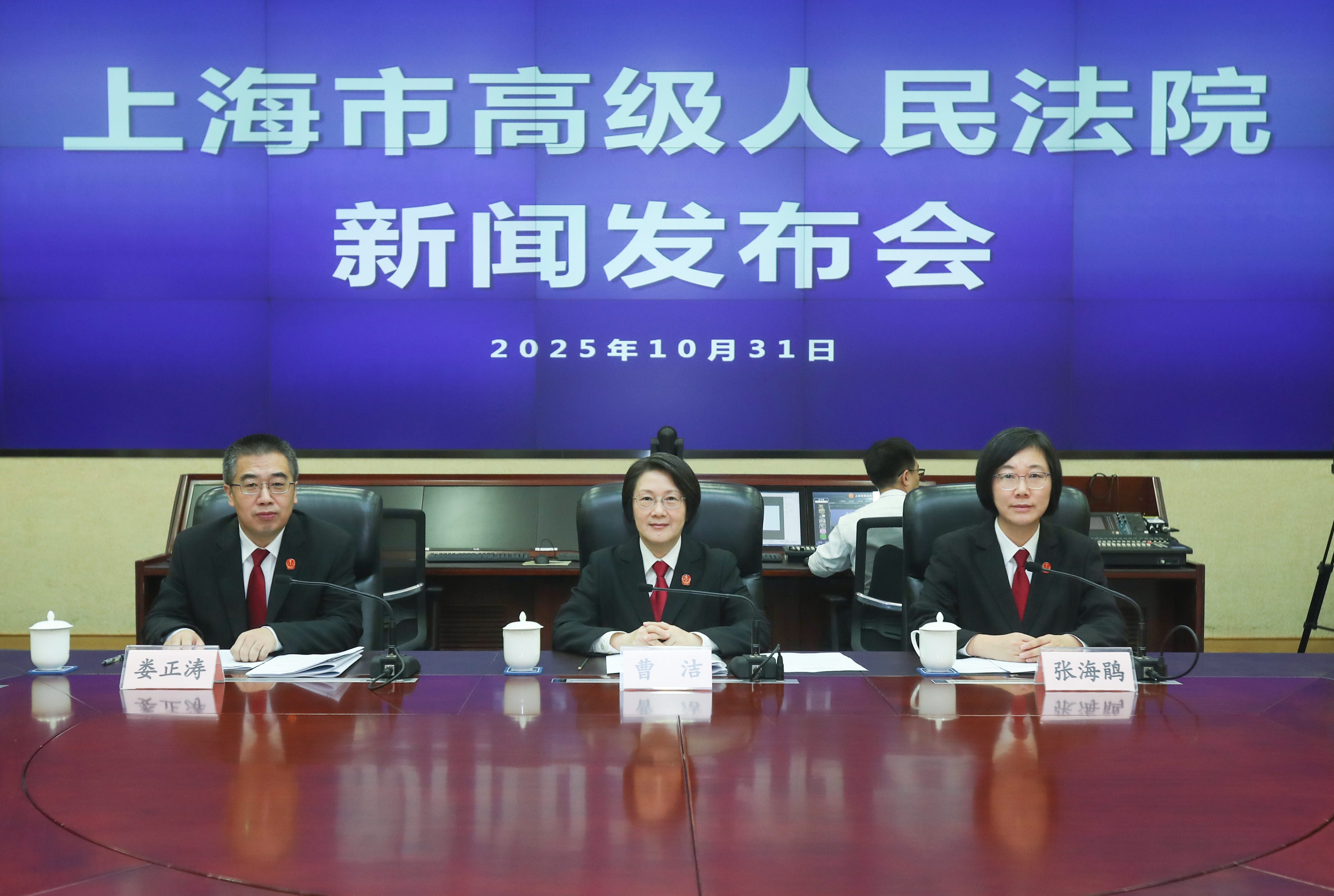
social development of Shanghai, this morning (October 31), the Shanghai High
People's Court held a press conference to brief on the administrative adjudication
work of Shanghai courts in 2024, and to release the 2024 White Paper on
Administrative Adjudication in Shanghai (hereinafter referred to as the
"White Paper"), as well as typical administrative adjudication cases
and typical cases on the substantive resolution of administrative disputes.
Cao Jie, Vice President of the Shanghai
High People's Court, and Lou Zhengtao, Chief Judge of the Administrative
Division (Compensation Committee Office), attended the press conference and
answered questions from reporters. Zhang Haijuan, Director of the Law Publicity
Department (News Center) and Spokesperson of the SHPC, chaired the press
conference.
Focusing on
Overall Central Tasks and Deepening the Substantive Resolution of
Administrative Disputes
The White Paper shows that in 2024,
Shanghai courts accepted a total of 8,406 administrative cases of first
instance, a year-on-year increase of 32.07%. From the perspective of the
administrative law enforcement fields involved, four categories of cases were
relatively numerous, namely housing expropriation, public security, human
resources and social security, and market regulation, totaling 5,435 cases and
accounting for 64.7%. From the perspective of the appearance of heads of
administrative authorities in court to respond to lawsuits, the appearance rate
of heads of administrative authorities in court to respond to lawsuits reached
84.9%, representing a year-on-year increase of 9.2%.
The White Paper notes that in 2024,
administrative adjudication by Shanghai courts focused on overall central
tasks, continuously strengthened service and safeguards. Their efforts were
closely aligned with the advancement of Shanghai's "five centers"
development, the construction of a law-based business environment, and the development
of a livable city, with corresponding work measures being strengthened in a
targeted manner. In February 2024, Shanghai courts established China's first
tax affairs tribunal at the Shanghai Railway Transportation Court, and
concurrently designated a tax affairs tribunal within the Administrative
Division of the Shanghai Third Intermediate People's Court (Shanghai
Intellectual Property Court and Shanghai Railway Transportation Intermediate
Court), with centralized jurisdiction over administrative cases where tax
authorities of Shanghai are involved as parties, effectively safeguarding the
tax order and protecting the lawful rights and interests of market entities.
The White Paper further points out that
Shanghai courts have put the “people-centered” approach into practice, and have
continuously deepened the substantive resolution of administrative disputes. In
2024, 22 administrative dispute diversified resolution centers were established
across 16 districts, achieving "full coverage". The coordination and
resolution rate of administrative cases of first instance in Shanghai courts
reached 46.4%, representing a year-on-year increase of 8.7%.
With regard to further advancing the
development of a government ruled by law, the White Paper puts forward four
recommendations: focusing on promoting law-based administration and
continuously strengthening the development of a government ruled by law;
focusing on the prevention and resolution of administrative disputes and
continuously strengthening government-court collaboration; focusing on the
appearance rate of heads of administrative authorities in court in respond to
lawsuits and continuously deepening the effectiveness of such appearances; and
focusing on enhancing administrative law enforcement capacity and continuously
strengthening team development.
Building
Demonstrative Typical Cases to Advance the Development of a Government Ruled by
Law
In order to better give play to the
demonstrative and guiding role of typical cases and to showcase the effectiveness
of administrative adjudication by Shanghai courts in fully performing
adjudicative functions and substantively resolving administrative disputes, the
press conference also briefed on 9 typical administrative adjudication cases
and 6 typical cases on the substantive resolution of administrative disputes.
The cases announced on this occasion
cover multiple areas of administrative management, including customs
supervision, market regulation, planning and natural resources, public
security, housing expropriation, and taxation. They involve administrative
authorities at the municipal, district, and township or sub-district levels, as
well as vertically managed authorities such as customs. They comprehensively
reflect the latest developments in Shanghai courts' implementation of Xi
Jinping Thought on the Rule of Law, their provision of high quality
administrative adjudication services for Shanghai's "five centers"
development, and their efforts to promote the development of a government ruled
by law.
For example, among the typical
administrative adjudication cases, in the case of Zhao v. a customs authority
& Shanghai Customs concerning an administrative penalty decision and
administrative reconsideration, the key adjudicative point clarified that
declaring imports through cross border e-commerce transactions by "order
brushing" using fabricated orders and payment information in order to
qualify for preferential import tax rates constitutes smuggling, and that where
customs authorities impose penalties on such conduct, the People's Court shall
support such penalties in accordance with the law. In the case of Xiao v. a
district market supervision administration and a district people's government
concerning industrial and commercial registration and administrative reconsideration,
the scope of the examination obligation of the registration authority for
market entities under specific circumstances was clarified. The relevant cases
play a positive role in further strengthening the standardized development of
administrative law enforcement, provide referenceable approaches and methods
for the review of similar cases, and are also conducive to enhancing the
expectations of citizens, legal persons, and other organizations regarding
judicial adjudication.
Similarly, among the cases involving
the substantive resolution of administrative disputes, in the case of Wu v. the
Shanghai Municipal Bureau of Natural Resources Confirmation and Registration
concerning an information notice, the People's Court facilitated resolution by issuing
a letter for the coordination and resolution of contradictions. Through
constructive dialogue with the plaintiff and administrative authority, the
court systematically addressed institutional "pain points and
bottlenecks" in real property rights registration, achieving holistic and
substantive conflict resolution. This approach promoting the conclusion of
cases and the resolution of underlying issues in administrative disputes.
The white paper on administrative
adjudication is an important avenue and means for Shanghai courts to extend
adjudicative functions and promote the development of the rule of law. It is
reported that since the Shanghai High People's Court began issuing the white
paper on administrative adjudication at an early stage nationwide in 2004, this
year marks the 22nd consecutive year of the release of the white paper on
administrative adjudication, which has received great attention from municipal
and district level governments and positive feedback from relevant
administrative authorities, with its role becoming increasingly prominent.
Going forward, Shanghai courts will
give full play to their adjudicative functions, consistently uphold the
fairness and impartiality of administrative adjudication, and reinforce
judicial contributions to protecting citizens' rights and advancing law-based
administration.
