
 Your current location >> Press Release
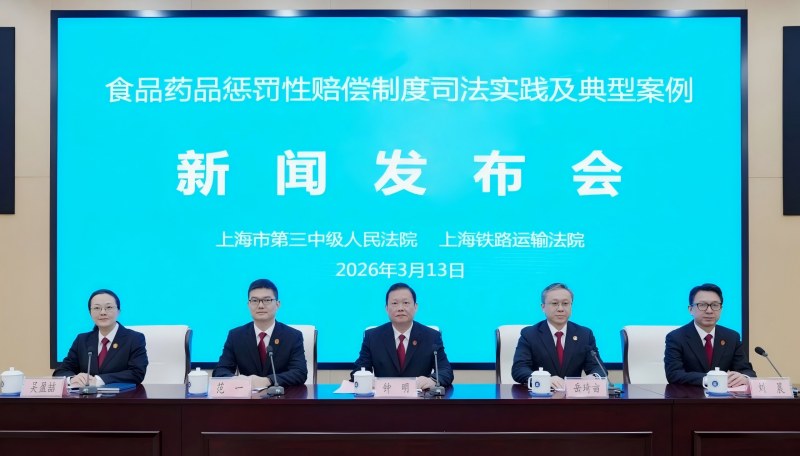
On
March 13, as the 44th World Consumer Rights Day approached, the
Shanghai No. 3 Intermediate People’s Court (Shanghai Intellectual Property
Court, Shanghai Railway Transport Intermediate Court) (hereinafter collectively
referred to as the “Shanghai No. 3 Court”) and the Shanghai Railway Transport
Court (hereinafter referred to as the “SRTC”) jointly held a press conference
on judicial practice and typical cases concerning punitive damages in food and
pharmaceutical cases.
Zhong Ming, Vice
President of the Shanghai No. 3 Court, reported on the application of the
judicial interpretation on punitive damages in food and pharmaceutical cases.
Yue Qimu, Chief Judge of the Civil Division of the Shanghai No. 3 Court, and
Liu Chen, Chief Judge of the Civil Division of the SRTC, introduced five
typical cases. The press conference was hosted by Wu Yingzhe, Chief Judge of
the Petition Review and Adjudication Supervision Division (Research Office,
Adjudication Management Office) and Spokesperson of the Shanghai No. 3 Court.
Journalists from central and Shanghai media outlets attended the press
conference.
Food-related
civil cases show distinct characteristics, with notable effectiveness in implementing
the Interpretation
According
to Mr. Zhong, since the Interpretation of the Supreme People’s Court on
Issues Concerning the Application of Law in Adjudicating Cases Involving
Punitive Damages in Food and Pharmaceutical Matters (hereinafter referred
to as the “Interpretation”) took effect on August 22, 2024, food-related civil
cases heard by the Shanghai No. 3 Court and the SRTC have demonstrated the
following characteristics:
In
terms of adjudication efficiency, thanks to the extensive application of small
claims procedures, these cases are primarily concentrated at the first
instance, with an appeal rate of 1.4%—far lower than that of other civil and
commercial cases. The average adjudication period has shortened by 15% compared
to the period before the Interpretation took effect, while the rate of
disputes resolved through mediation and withdrawal has reached 53.73%,
reflecting strong efficiency and a high rate of acceptance of judgments.
In
terms of case types, disputes over information network sales contracts remain
the predominant category (accounting for 78.2%), along with those over product
liability, sales contracts, and right to health—largely consistent with the
situation before the Interpretation came into force. Additionally, small
and medium-sized operators remain the primary litigation subjects, with 62.1%
of cases where individual businesses and small food operators serve as
defendants.
Among
cases resolved by judgment, around 50% result in rulings in favor of the
plaintiffs, either because the quantity of goods purchased by the plaintiff falls
within the scope of reasonable daily consumption, or because the plaintiff
voluntarily adjusts their claims downward to a reasonable range after being
guided by the court. In the remaining 50% of cases where the plaintiffs’ claims
are not upheld, the key reasons include: the plaintiff’s purchases exceeding
reasonable daily consumption needs, insufficient evidence to prove any violation
of food safety standards, minor labeling defects only, and sellers having
fulfilled their duty of inspection upon purchase.
Statistics show that
lawsuits initiated by “knowing buyers seeking compensation” account for 32.46%
of the total. This represents a significant decline compared to the period
before the Interpretation, when such cases accounted for over 95%. Mr. Zhong
noted that the Interpretation has effectively curbed the traditional profit-driven
behavior of the buyers who would knowingly purchase large quantities of
problematic products to maximize their compensation base. However, new trends
have emerged, characterized by more covert, diverse, and sophisticated
practices, such as spreading purchases across multiple sellers to accumulate
quantities beyond reasonable limits, targeting high-value products with
repeated purchases for compensation claims, and deliberately inducing merchants
to violate regulations to create grounds for claims. These evolving tactics not
only reflect how “knowing buyers seeking compensation” are adapting to
circumvent the Interpretation, but also impose higher judicial demands
on courts to accurately understand and apply the Interpretation’s
principles in distinguishing legitimate rights protection from such claims.
Three
targeted measures to precisely regulate and protect both parties in transactions
equally in accordance with the law
In
response to these new developments and challenges, the Shanghai No. 3 Court and
the SRTC have consistently upheld the bottom line of food and pharmaceutical
safety and accurately applied the Interpretation, thereby protecting the
legitimate rights and interests of both consumers and producers/operators, and
using judicial rulings to guide high-quality development of the food and
pharmaceutical market. These efforts are primarily reflected in three aspects:
First,
upholding the bottom line of food and pharmaceutical safety to safeguard the well-being
of the people. The courts support consumers in exercising their rights in
accordance with the law, use judicial rulings to curb illegal practices in the
food sector, regulate production and operations at the source, encourage high-quality
and efficient food supply, and enable honest and trustworthy market entities to
stand out through competition.
Second,
protecting both parties in transactions equally in accordance with the law,
adhering to the core adjudicative principle of “reasonable daily consumption
needs.” While regulating the activities of producers and operators, the courts
prevent abuse of rights by “knowing buyers seeking compensation.” At the same
time, they apply differentiated adjudicative standards to different types of
market entities. For small businesses, small merchants, and small workshops, the
courts do not mechanically apply the national mandatory standards applicable to
industrialized mass-produced products, thereby achieving alignment between the
rights, responsibilities, and interests of market entities at different levels.
Third, accurately
applying the Interpretation by treating different types of litigants
differently based on their circumstances. The courts distinguish between
ordinary consumers exercising their rights and “knowing buyers seeking
compensation.” For conduct constituting fraudulent litigation or extortion, they
will promptly refer relevant leads to public security authorities for criminal
liability to be pursued in accordance with the law. The courts also distinguish
between different scenarios of “purchasing on behalf of others”: for
professional agents who purchase on behalf of others as a business, they hold
them to the standards applicable to business operators in reviewing their duty
of inspection upon purchase. Additionally, the courts differentiate the impact
of labeling or instruction defects: if such defects do not affect food safety
and do not mislead consumers, claims for tenfold punitive damages are no longer
supported.
Five
typical cases released to clarify the application of the Interpretation
At
the press conference, the Shanghai No. 3 Court and the SRTC released and
analyzed five typical cases involving the application of the Interpretation,
fully demonstrating the judicial wisdom of the people’s courts in actively
responding to the public’s new expectations for food and pharmaceutical safety
in the new era and in serving to ensure high-quality economic and social
development.
For
example, in a case where a claim for compensation was brought against
agricultural products based on prepackaged food standards, the tea in question
was produced and sold by tea farmers themselves. To prevent the finished
product from breaking, it was packaged in simple small packaging. The buyer then
claimed a refund and tenfold compensation, arguing that the tea constituted
prepackaged food and did not comply with the “GB/T18745” standard printed on
the outer packaging. The Shanghai No. 3 Court conducted a substantive review of
the tea’s production and processing conditions, accurately determined its
nature as an agricultural product, and distinguished between the different food
safety standards applicable to products from small family workshops and those
from standardized industrial production. It did not mechanically apply the
national mandatory standard for similar products. Having determined that the
tea met substantive safety requirements in accordance with the law, the court
did not impose the heavy liability of tenfold punitive damages, thereby equally
protecting the legitimate rights and interests of both consumers and producers/operators
at both ends of the consumption chain.
In
a compensation case involving the purchase of a large quantity of “food
products with no label, no date, and no manufacturer,” the buyer placed an
initial order for 20 units of kidney-tonifying tablets from an online store,
each priced at 180 yuan and sufficient for about half a month of use. Since the
outer packaging bore no information such as the manufacturer’s name, address,
or contact details, the buyer claimed a refund and tenfold compensation from
the seller, arguing that the product did not meet China’s food safety
standards. The SRTC found that the product fell into the category of “food
products with no label, no date, and no manufacturer.” Accurately grasping that
reasonable daily consumption needs constitute a statutory element for the
application of punitive damages in food-related cases, and considering factors
such as the quantity purchased, shelf life, and usual consumption habits of
ordinary consumers, the court upheld punitive damages corresponding to two
units of the product—amounting to 3,600 yuan—within the scope of reasonable
daily consumption needs. This case serves as an example of how the Interpretation
should be applied to “food products with no label, no date, and no manufacturer.”
“The Shanghai No. 3
Court and the SRTC will continue to ensure the safety of what people consume through
precise judicial rulings, balance the protection of the legitimate rights and
interests of both consumers and producers/operators, and deeply implement the
fundamental principles of the Interpretation, which are ‘safety first,
balanced protection, and precise regulation,’ thereby providing stronger
judicial guarantees for the high-quality development of Shanghai’s food and
pharmaceutical market and the development of a rule-of-law business
environment,” said Mr. Zhong.
Selected
Typical Cases Concerning Consumer Rights Protection
