
 Your current location >> Press Release
If an accident occurs
while using “smart driving,” is it possible to request access to the vehicle’s
driving data? If an order is placed by exploiting a system vulnerability, is
the sales contract valid? If a merchant goes out of business, how can the prepaid
card balance be refunded?
To
implement the strategy of expanding domestic demand, actively respond to the
relevant provisions in the Outline of the 15th Five-Year Plan
on “vigorously boosting consumption,” accelerate the development of Shanghai as
an international consumption center, fully leverage the judicial function,
strengthen the protection of consumer rights, and foster a healthy rule-of-law
environment for consumption, the Shanghai Jiading District People’s Court
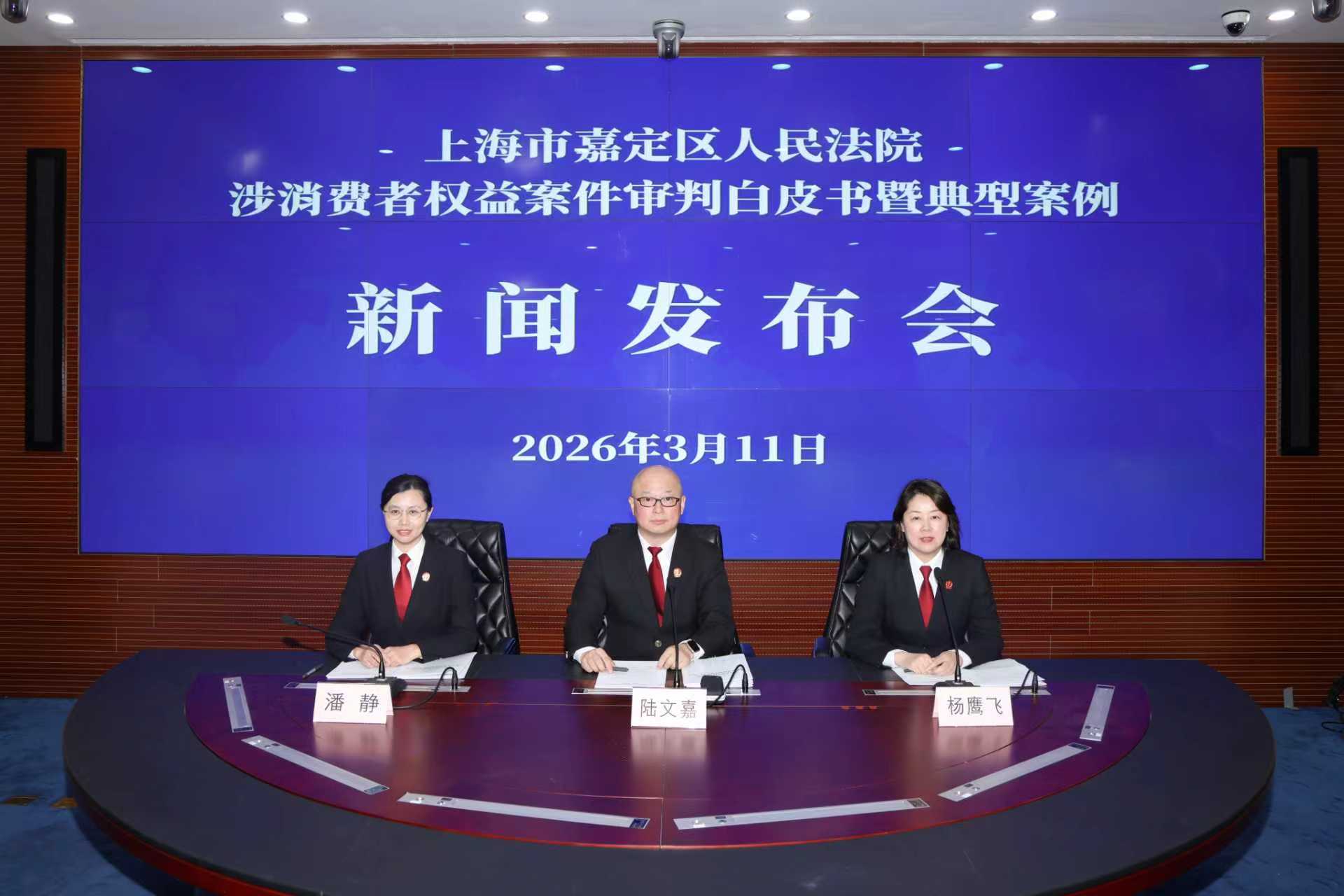
(hereinafter referred to as the “Jiading Court”) recently held a press
conference to release a white paper and typical cases on consumer rights
disputes. It reported on the adjudication of such cases in 2025 and announced
and analyzed ten typical cases concerning consumer rights.
Lu Wenjia, Vice
President of the Jiading Court, and Pan Jing, Chief Judge of the Nanxiang
People’s Court of the Jiading Court, attended the press conference and answered
questions. Deputies to the Jiading District People’s Congress, members of the
Jiading District Committee of the Chinese People’s Political Consultative
Conference (CPPCC), and representatives from several news outlets were invited
to the event. The press conference was hosted by Yang Yingfei, Director of the
Political Department and Spokesperson of the Jiading Court.
Adjudication of consumer
rights cases
According
to the white paper, in 2025, the Jiading Court accepted a total of 1,496 cases
related to consumer rights, representing a year-on-year increase of 39.94% from
1,069 cases in 2024. Such an increase is highly correlated with the growing
awareness of consumer rights protection, the increasing frequency of goods and
services trade, and the accelerated flow of production factors.
In
terms of case types, among the consumer rights cases accepted, the top five causes
of action are: service contract disputes (669 cases, 44.72%); sales contract
disputes (272 cases, 18.18%); disputes over online information network sales
contracts (162 cases, 10.83%); online service contract disputes (107 cases,
7.15%); and education and training contract disputes (92 cases, 6.15%).
Regarding the
application of procedures, among the various consumer rights cases accepted in
2025, 210 cases are subject to ordinary procedures, 669 to summary procedures,
and 617 to small claims procedures. The application rate of summary procedures
(including small claims procedures) is 85.96%.
Consumer
rights cases demonstrate these characteristics:
1.
Multi-dimensional consumer disputes across various sectors, showing notable
regional industrial features
Consumer
rights cases accepted in 2025 involve online, livestream, and offline shopping
channels. The goods and services involved include traditional sectors, cultural
and sports industries such as fitness and education and training, as well as
emerging sectors such as new energy vehicles and custom smart home solutions. Specifically,
there are 143 cases involving automobile consumption, accounting for 9.56%; 204
involving online consumption such as e-commerce and livestream shopping,
accounting for 13.63%; and 78 involving gaming consumption, accounting for
5.21%.
2.
Growing impact of deep integration in the Yangtze River Delta, with a
relatively high proportion of cross-regional disputes
Among
the consumer rights cases accepted, 719 cases—or 48.06%—involve parties all
located in the Yangtze River Delta region, spanning sectors such as cultural
and sports, automobile, and food and pharmaceutical consumption. This figure represents
a year-on-year increase of 39.07% from 517 cases in 2024, further highlighting
the agglomeration effect of a deeply integrated Yangtze River Delta.
3.
Low success rate for punitive damages claims, indicating consumer
misunderstandings
In
2025, among the consumer rights cases accepted by the Jiading Court, 171 cases
involving punitive damages claims such as “triple compensation” or “tenfold
compensation” were concluded. Of these, 27 were settled through mediation, 75 were
withdrawn, 64 were resolved by judgment, and 5 were concluded by other means.
As most claims are improperly asserted by consumers, among the cases resolved
by judgment, 11 result in punitive damages being awarded, yielding a success
rate of 17.19%.
4.
Frequent occurrence of professional claims and prepaid card disputes, with a
high number of batch cases
There
is a significant number of batch cases among the civil consumer protection
cases accepted in 2025. There are 12 batches involving the same plaintiff,
totaling 80 cases, in which the plaintiff filed separate lawsuits for punitive
damages based on multiple consumption acts, indicating a high likelihood of
professional claimants. There are 81 batches involving the same defendant,
totaling 512 cases, spanning cultural and sports consumption sectors such as
fitness, maternal and child services, and education and training, giving rise
to group litigation stemming from prepaid disputes.
5.
Declining trend in platform-related consumer disputes, thanks to notable
progress in platform co-governance
With
the development of the platform economy, disputes related to platform
consumption have continued to emerge. Leveraging the Shanghai Court Digital
Economy Judicial Research and Practice (Jiading) Base and its think tank
consortium, the Jiading Court has conducted practical research on various
platform economy-related disputes—including those involving platform
consumption—to facilitate the resolution of such cases. In 2025, there were 205
cases involving disputes related to online platform consumption, representing a
decrease of 20.54% from the previous year and indicating a clear downward
trend.
Consumer rights disputes
arise from a booming and expanding consumer market, and are closely tied to
industrial development trends and the behavioral patterns of various
stakeholders. In light of this, the white paper, drawing on regional industrial
characteristics and case adjudication experience, selects four categories of
cases for analysis: automobile consumption, gaming consumption, cultural and
sports consumption, and food and pharmaceutical consumption.
The
white paper summarizes three areas of challenges identified in the adjudication
of consumer rights cases:
1.
On Cognition and Capacity:
(1)
Consumers lack prudent transaction awareness;
(2)
Some business operators have little awareness of the rule of law.
2.
On Regulation and Mechanisms:
(1)
Some business operators lack proper internal control mechanisms;
(2)
Dispute resolution mechanisms require further optimization.
3.
On Resources and Enforcement:
(1)
There is a mismatch between the supply of dispute resolution resources and the
demand for dispute resolution;
(2) Regulatory
coordination mechanisms require improvement.
To effectively protect
consumers’ legitimate rights and interests, guide business operators to comply
with the law, and ensure the steady and orderly development of the consumer
market, the white paper proposes accordingly to improve consumer rights-related
work:
1.
Pathways for Cognitive and Behavioral Improvement
(1)
Strengthen consumer risk awareness:
- Fully verify basic transaction information;
- Carefully review key contract terms;
- Establish a protection system for special
consumer groups.
(2)
Strengthen business operators’ awareness of lawful operations:
- Enhance integrity awareness and eliminate
false advertising;
- Improve complaint handling mechanisms and
open up channels for rights protection.
2.
Measures for Regulatory and Mechanism Enhancement
(1)
Improve business operators’ compliance and operational management:
- Enhance contract management and implement
electronic contract signing systems;
- Strengthen internal management systems and
enhance staff training;
- Implement quality control position responsibilities
and establish safety records.
(2)
Improve diversified dispute resolution and coordinated mechanisms:
- Establish a
“negotiation–complaint–mediation–litigation” mechanism;
- Strengthen coordination to enhance the
effectiveness of consumer rights protection in cases involving multiple
consumers.
3.
Recommendations for Resource and Enforcement Optimization
(1)
Improve alignment between dispute resolution resources and needs:
- Enhance the categorized handling system
for complaints and reports;
- Explore information sharing mechanisms.
(2)
Strengthen coordinated governance and digital regulatory mechanisms:
- Promote coordinated regulatory governance
and enhance cross-regional protection effectiveness;
- Optimize regulatory approaches and
establish mechanisms for consumer risk prevention and resolution.
Ten
cases released to serve as typical examples
At
the press conference, the Jiading Court also announced and analyzed the Typical
Cases Concerning Consumer Rights. The ten cases focus on areas of public
concern such as gaming consumption, automobile consumption, online shopping,
food and pharmaceutical consumption, used car transactions, and prepaid card
consumption. By interpreting the law through specific cases and promoting
governance through case handling, the court safeguards the bottom line of fair
consumption and helps foster a safe, trustworthy, and reassuring consumption
environment.
For
instance, the case of Ma v. X Company over an online service contract
holds that online game operators may not unilaterally suspend services at will,
and that virtual property formed through consumer recharges should be protected
in accordance with the law, demonstrating the judiciary’s strong protection of
consumers’ property rights in the digital age.
The
case of Qian v. Shanghai X Technology Service Co., Ltd. over a sales
contract clarifies the boundaries of accessing smart vehicle data. It has not
only protected consumers’ rights to know and oversee driving data in accordance
with the law, but also balanced enterprises’ legitimate rights to data security
and technological innovation, providing valuable guidance for the orderly
development of the smart driving industry.
The cases of Zhang
v. Xu over a sales contract and Deng v. Shanghai X Trading
Company over an online information network sales contract focus on the
identification of the contracting party and contract validity. By establishing
that a “private seller” of a used car may be deemed a business operator, and
that a contract formed by maliciously exploiting platform vulnerabilities is
not formed, these cases provide clear judicial guidance for regulating online
consumption and used car transactions.
Comments
from Deputies and Members
Sun
Jian
Deputy
to the Jiading District People’s Congress, Secretary of the General Party
Branch of Jinlü Village, Huating Town,
Jiading District
It
is a great honor to attend today’s press conference for the White Paper on
Adjudication of Consumer Rights Cases and Typical Cases by the Jiading District
People’s Court. The white paper systematically reviews the current state and
development trends of consumer rights case adjudication in the district,
provides a precise analysis of common issues faced by consumers and business
operators in case handling, and proposes targeted risk prevention measures and
standardized guidance for rights protection. Notably, the practical measures
outlined in the white paper—such as strengthening
consumer risk awareness, guiding business operators to operate in compliance
with the law, improving diversified dispute resolution and coordination
mechanisms, advancing digital collaborative governance, and optimizing
regulatory effectiveness—provide solid judicial
support and professional solutions for addressing common governance challenges
in the consumer sector and enhancing regional consumer governance capabilities.
Through this press conference, I have come to appreciate that the Jiading Court
not only fulfills its judicial function by upholding fairness and justice in
individual cases and effectively protecting consumers’ legitimate rights and
interests, but also proactively extends judicial services to support the
healthy development of the district’s consumer market. In doing so, it
demonstrates solid judicial performance and outstanding achievements in
fostering a rule-of-law business environment and advancing regional governance
modernization.
Wang
Yi
Member
of the CPPCC Jiading District Committee, Principal of Xuhang Middle School,
Jiading District
As a CPPCC member and
also a consumer, I believe that the White Paper on Adjudication of Consumer
Rights Cases released by the Jiading Court is both practical and
forward-looking. Meanwhile, the ten typical cases released at the press
conference precisely focus on consumer pain points such as “online gaming,” “smart
vehicles,” and “prepaid cards,” drawing clear lines of responsibility. They
establish boundaries for business operators on what they must not do, while
also pointing consumers toward pathways for rights protection, offering
practical guidance and serving as valuable references. This reflects not only
judicial wisdom but also a strong commitment to “safe consumption.” These cases
provide guidance for industry compliance, help promote coordination among
platforms, merchants, and regulators, making “lawful operation” a market
consensus and “rational rights protection” a social norm. Together, they
protect consumer rights and reinforce the foundation of consumer confidence.
>> Chinese Version
