
 Your current location >> Press Release
Finance serves as the lifeblood
of the national economy and is a key component of a country’s core
competitiveness. Building Shanghai into an international financial center is a
strategic mission entrusted by the central government. At the Central Financial
Work Conference, General Secretary Xi Jinping proposed the grand goal of
accelerating the building of China into a financial powerhouse; and the 15th
Five-Year Plan explicitly calls for “accelerating the development of Shanghai into
an international financial center.” How can the judiciary provide high-quality rule
of law supply in the financial sector? How can finance advance with high
quality within the framework of the rule of law?
In recent years, focusing on its
goal of becoming a “specialized, internationalized, and digital” world-class
financial court, the Shanghai Financial Court (SFC or the “Court”) has
intensified efforts in developing high-profile cases, persistently advanced the
establishment of rules, strengthened institutional innovation, and fully
leveraged the demonstrative and market-guiding role of judicial adjudication.
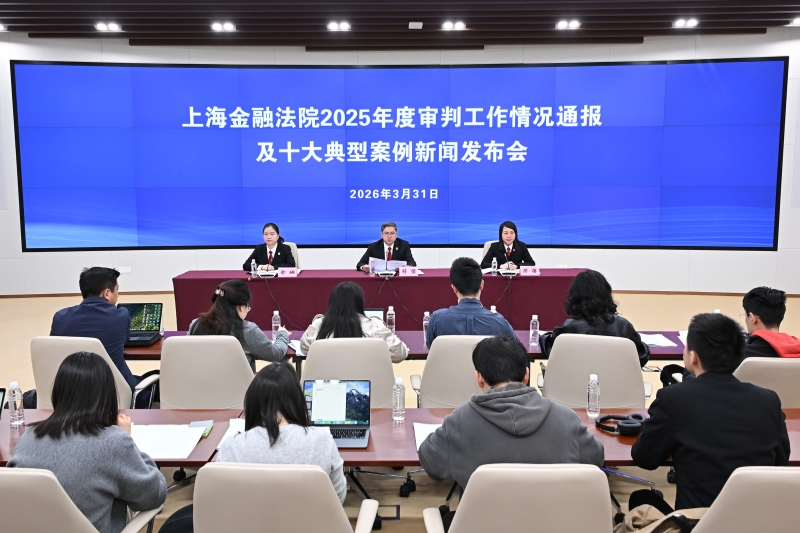
On March 31, the SFC held a press conference to release its 2025 Report on
the Trial Work of the Shanghai Financial Court (“Report”) and the top ten financial
cases of the year.
Fu Wang, Standing Member of the Adjudication
Committee, and Yu Xi, Deputy Chief Judge of the Appeal Review and Judicial
Supervision Division, delivered briefings and answered questions from
journalists. The press conference was hosted by Li Bei, Director of the General
Office and Spokesperson of the SFC. Journalists from the central and
Shanghai-based media outlets attended the press conference.
The Report summarizes the cases handled
by the SFC in 2025 from three perspectives: case volume, case types, and
overall trends. In 2025, the Court accepted a total of 9,485 financial cases,
with a total value of claims of 214.063 billion yuan. The number of cases
accepted increased by 29.75% year-on-year, reflecting a concurrent rise in
financial transaction activity and the effectiveness of judicial services. The
types of cases spanned various financial sectors. Among adjudicative cases, liability
disputes over false statements in the securities market ranked as the top cause
of action by case volume, and together with financial loan contract disputes
and financial leasing contract disputes, these three categories accounted for
over 50% of all newly filed adjudicative cases; among enforcement cases, cases
involving enforcement of arbitral awards numbered 1,456, ranking first in case
volume, indicating the growing oversight and support for arbitration by the
financial judiciary.
According to the Report, in
2025, the Court accepted 239 cases involving foreign, Hong Kong, Macao, or
Taiwan elements, representing a year-on-year increase of 21.94% and the fourth
consecutive year of growth. Among these, 139 cases, or 58.16%, involved Belt
and Road countries, signaling that Shanghai is gradually becoming a preferred
venue for international financial dispute resolution.
The Report outlines the characteristics
of the four categories of banking, securities, insurance, and enforcement
cases, analyzes the concentrated trends and underlying risks reflected in
financial cases and proposes targeted recommendations.
Banking cases accounted for
26.97% of the total, presenting a complex picture in which traditional and
emerging risks are intertwined. These cases reflect prominent issues such as
disputes arising from digital transformation in the industry, frequent disputes
over the validity of corporate guarantees, operational malfeasance among
financial asset management companies, and weaker risk control among local
financial organizations. It is recommended that financial market participants
further adhere to compliance standards and improve governance frameworks. Securities
cases accounted for 59.18% of the total, exhibiting an overall trend of
“concealed illegal conduct, diversified liable entities, and a
multi-dimensional accountability system.” Disputes reflect prominent issues
such as the rise of new types of securities infringements, increasing demands
for look-through recovery in asset management disputes, frequent incidents of
financial fraud among listed companies, and the prominent phenomenon of
multiple entities being held jointly liable. In this context, it is necessary
to further strengthen the integrity foundation of the market, strengthen
accountability for fraud by all responsible parties, and improve the
multi-dimensional accountability system in the capital market. Insurance cases
accounted for 7.54% of the total, revealing a supply-demand imbalance,
manifested in insufficient coverage in new business forms and poor coordination
in emerging areas. Disputes mainly arose in livelihood-related sectors, such as
automobile insurance involving new business forms, commercial insurance for new
types of occupational injuries, and health insurance, as well as cross-border
cargo insurance in international trade. Recommendations include accelerating
efforts to close insurance coverage gaps in new business forms, promoting
orderly integration between commercial insurance and social security, and
enhancing cross-border insurance service capabilities. With respect to
enforcement cases, challenges persist in revitalizing existing assets and in delivering
properties after the disposal of real estate, alongside an increase in new
types of financial enforcement cases. It is recommended to further deepen the government-court
coordination mechanism and establish an efficient governance framework.
As China’s first
specialized financial court, the SFC continues to serve as a model and pioneer,
focusing on establishing rules and promoting institutional innovation. It has
taken a series of measures and achieved relevant outcomes in three major
aspects: supporting the broader central mission, upholding the judicial
commitment to serving the people, and undertaking the mission of demonstration
and leadership. Through these efforts, the Court strives to position Shanghai
as a preferred destination for global financial rule of law practices, a
preferred venue for financial dispute resolution, and a source of financial
rule innovation.
To further demonstrate the
guiding and market-oriented role of typical cases, the press conference also
released the SFC’s top ten financial cases for 2025. These cases cover a wide
range of high-profile legal issues in the financial market, and a number of them
were selected as 2025 Top Ten Nominated Cases Advancing the Rule of Law in the
New Era and typical financial adjudication cases in the Yangtze River Delta
region.
The annual typical cases released
reflect three characteristics:
First, more effective support
for the development of the real economy. Through measures such as lawfully
ensuring and promoting direct financing, strictly penalizing practices that
implicitly raise borrowing costs, and improving mechanisms for preservation and
enforcement involving enterprises, the SFC helps to enhance the effectiveness
of financial services in supporting the real economy. For example, in the case
of X Property Insurance Co., Ltd. Shanghai Branch v. Xing over subrogation
right, the Court determined that the insurer has the right to seek recovery
against a party who abused litigation preservation, guiding preservation
applicants to exercise their right reasonably and minimizing the impact on the
production and operations of market entities.
Second, more comprehensive
support for the opening-up and innovation of the financial industry. The SFC
has strengthened the supply of rules in frontier areas of financial opening-up
and innovation, ensuring high-quality development of the financial sector
within the framework of the rule of law. For instance, in the country’s first
case involving a dispute over tort liability brought by a bill holder against
an exchange regarding the functional setup of the electronic commercial bill
system, the Court clarified that the judiciary should encourage financial
infrastructure institutions to continuously optimize system functions and
promote the digital transformation of the bill market. In the case of Yang v.
Shanghai X Group Co., Ltd. over liability for false statements in securities,
the Court established the standards for its jurisdiction and authority in
disputes arising from false statements in the overseas issuance and trading of
securities by domestic entities, effectively supporting Chinese enterprises in
their overseas financing efforts.
Third, more effective prevention
and resolution of financial risks. The SFC has prudently concluded a series of
major, sensitive, and complex financial cases, strictly preventing risk
spillover and firmly holding the line against systemic financial risks. For
example, in the country’s first case involving substantive consolidation of an
insurance group and its member companies in bankruptcy, considering that
capital deployment and transactional relationships within insurance groups tend
to facilitate risk diffusion, the Court ultimately issued a ruling for
substantive consolidation after comprehensive review, providing judicial
support for “precise risk dismantling” in the market.
“In 2026, the SFC will continue
to pursue the goal of building itself into a ‘specialized, internationalized,
and digital’ world-class financial court and leverage its role in financial
adjudication. By continuing to play its exemplary and landmark role as China’s
first specialized financial court, it will strengthen the competitiveness and
influence of Shanghai as an international financial center, and provide solid
financial judicial guarantees for a strong start to the 15th Five-Year
Plan,” said Mr. Fu.
>> Chinese Version
