
 Your current location >> Press Release
How
can people’s court adjudication precisely serve the development of new quality
productive forces? How can the judiciary provide solid protection for
intellectual property rights in emerging fields?
Nowadays,
emerging fields represented by artificial intelligence and biomedicine are
flourishing, and technology-related intellectual property transactions are
increasingly active. However, behind this wave of innovation, disputes over
technology-related intellectual property contracts are gradually unfolding, and
legal risks in these areas have become a prominent obstacle to technological
development.
On
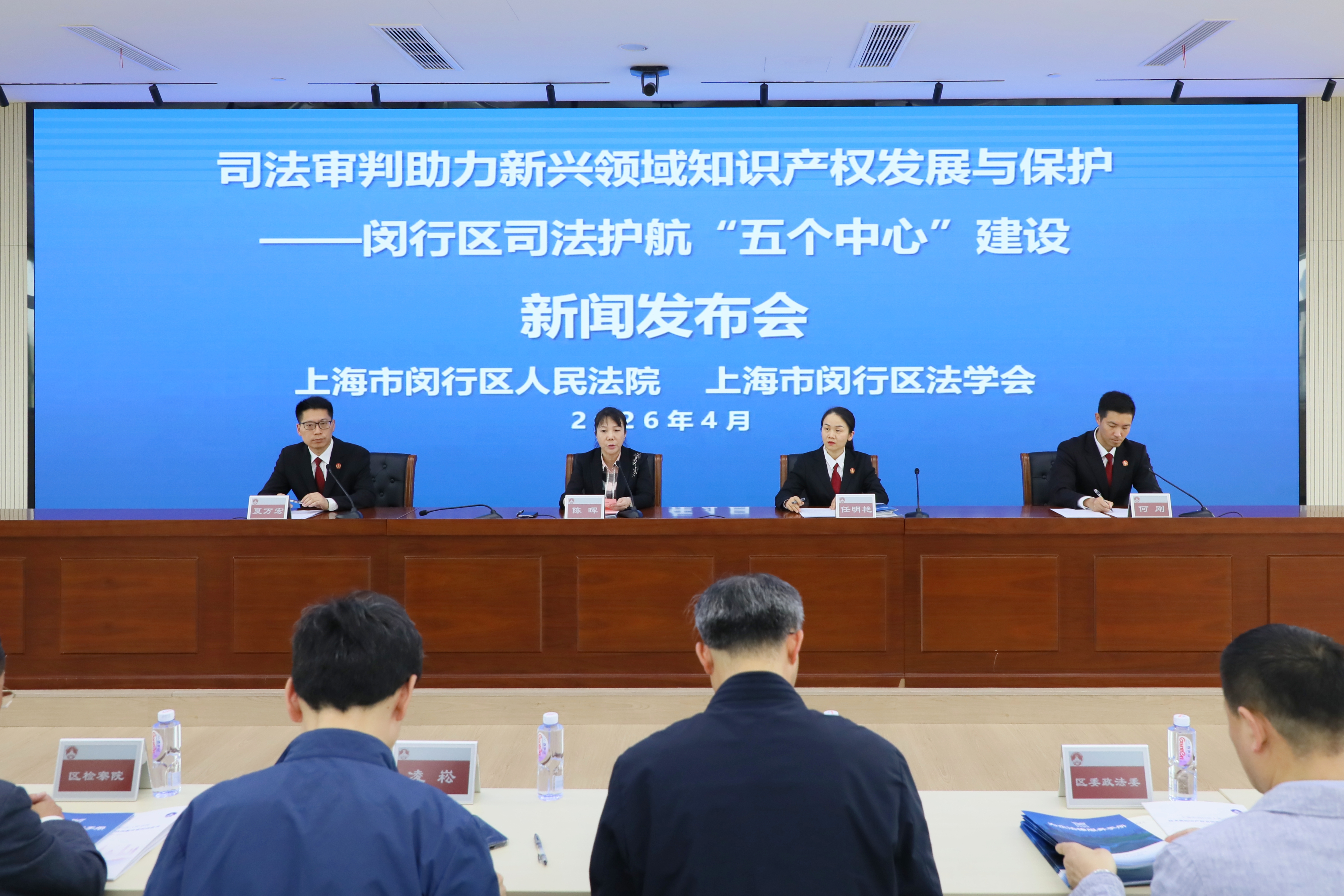
April 17, the Shanghai Minhang District People’s Court (hereinafter the “Minhang
Court”) and the Minhang District Law Society jointly held a press conference
titled “Judicial Adjudication Empowering the Development and Protection of
Intellectual Property in Emerging Fields—Minhang District Judicial Services Safeguarding
the Building of the ‘Five Centers’.” At the event, the Minhang District
Legal Service Manual for Enterprises (hereinafter the “Service Manual”) and
the Shanghai Minhang District People’s Court: White Paper on the
Adjudication of Technology-Related Intellectual Property Contract Cases
(2022-2025) were released along with typical cases. These materials aim to
help innovation entities enhance their awareness of risk prevention, “conduct
check-ups and prescribe remedies” for technological transactions, and discharge
judicial duties to serve and safeguard regional technological innovation, and
support Shanghai’s development into an international center for science and
technology innovation.
At
the press conference, Chen Hui, Deputy Secretary of the Political and Legal
Affairs Committee of the CPC Minhang District Committee, outlined the
background and main content of the Service Manual. Ren Mingyan, Member of the
Party Leadership Group of the Minhang Court, introduced the background of the
White Paper. He Gang, Chief Judge of the Commercial Adjudication Division of
the Minhang Court, presented the main content of the White Paper and related
cases. The press conference was moderated by Xia Wanhong, Chief Judge of the
Adjudication Supervision Division and spokesperson of the Minhang Court.
Attendees included representatives from the Minhang District People’s
Procuratorate, Minhang Public Security Sub-Bureau, Minhang District Bureau of
Justice, Minhang District Administration for Market Regulation, Minhang
District Law Society, deputies to the municipal and district people’s congresses,
as well as representatives from subdistricts, townships, industrial zones,
parks, enterprises, and media outlets.
Three
Major “Pain Points” Hindering Technology Protection and Transaction Security
Based
on the trial data of all technology-related intellectual property contract
cases accepted by the Minhang Court over the past four years, the White Paper
clearly shows a yearly increase in such cases in Minhang District, reflecting
the growing vibrancy of transaction activities involving technology achievements
and technology services within the jurisdiction and a corresponding rise
in civil disputes.
By
case type, technology service contract disputes rank first, totaling 286 cases,
accounting for 58% of all technology-related IP contract cases. Computer
software development contract disputes total 111 cases, accounting for 22%.
These two types together account for 80% of all technology-related IP contract
cases, making them the principal types of disputes in this field and indicating
that disputes are frequent for market entities during technology services and
software development.
The
White Paper indicates that, by dispute area, high-tech sectors account for a
high proportion. Cases cover high-tech fields such as computer software,
biomedicine, new energy, and materials. Some cases also intersect with
cutting-edge technology fields including artificial intelligence, genetic
technology, and aerospace communications. By case outcome, the proportion of
cases resolved through mediation or withdrawal is relatively high. Most cases
were mediated either by the court or by assigned mediation organizations,
facilitating settlement between the parties, achieving resolution of the
dispute, and demonstrating significant effectiveness in substantive dispute
resolution. By adjudication result, plaintiffs have a relatively high success
rate. In successful cases, the plaintiffs are mostly technology providers, who
possess greater legal risk control capabilities during contracting and
performance, while technology service recipients have a relatively weaker
understanding of the legal risks associated with entering into and performing
such contracts.
Based
on adjudication practices, the White Paper accurately identifies three major
pain points that frequently give rise to technology-related IP contract
disputes, directly pointing to the “hidden minefields” restricting technology
protection and transaction security:
1.
Non-standard contract formation. Irregular contracting practices such as
“performance before signing,” “signing while performing,” and “vague
stipulation of core terms” lead to unclear definition of rights and
obligations. 2. Unauthorized transfer of obligations. Technology providers
often “subcontract” their contractual obligations to others or split them among
multiple entities, increasing contract performance risks. 3. Lack of documented
evidence during performance. Some market entities focus heavily on project
research and development but neglect to maintain performance documentation or
develop awareness of evidence collection, making it more difficult to ascertain
the facts of a case.
“Four
Measures and Four Recommendations” to Build a Full-Chain Protection System
To
address the above issues, the White Paper proposes four measures for the proper
handling of technology-related IP contract disputes:
1.
Introducing professional mediation organizations. The court has improved
mediation quality and efficiency and promoted diversified dispute resolution by
offering mediation organization options promptly after case filing, refining
case triage, and adopting a “presiding judge of the trial team + senior judge +
mediator” model.
2.
Strengthening the intensive adjudication mechanism for difficult cases. The
court has adopted a “written submissions first” approach, unified pleadings and
arguments, explored reforms to trial methods, and established a “issue-centric”
trial model.
3.
Establishing a technical consultation mechanism. Relying on the technical
expert database of the Minhang District Science and Technology Commission, the
court has established a regular mechanism for technical expert consultation in
IP adjudication, thereby ensuring efficient determination of technical facts
and improving the quality and efficiency of IP adjudication.
4.
Expanding judicial extension services. The court has established judge workshops
and a “fixed time, fixed location, fixed personnel” service mechanism, carried
out legal education activities, and continued programs bringing law to
industrial parks and enterprises to help enterprises reduce the occurrence of
technology-related IP contract disputes at the source.
Additionally,
the White Paper proposes four recommendations for market entities to prevent
and resolve disputes:
1.
Raising risk awareness and improving contract formation
practices. Priority should be given to written forms of contracting; core
terms should be as accurate and clear as possible; any changes to the contract
should be confirmed in writing promptly.
2.
Cultivating good-faith awareness and standardizing contract performance. Market
entities should avoid unauthorized transfer of contractual obligations and
ensure due performance; strengthen communication and cooperation, and
prioritize negotiated resolution when disputes arise.
3.
Enhancing evidence awareness and improving project process management. Market
entities should establish dynamic project management records, standardize
evidence collection during contract performance, and enhance the legal validity
of evidence.
4.
Promoting diverse co-governance and fostering an innovation-friendly legal
environment. Enterprise self-management and industry guidance should be
strengthened, and publicity for intellectual property protection should be increased,
so as to create a social atmosphere that respects and protects innovation.
Typical
Cases Released to Provide Judicial Guidance
The
ten typical cases released at the press conference cover various types of
disputes, including computer software development contracts, technical service
contracts, software copyright licensing contracts, and patent right transfer
contracts. These cases focus on high-frequency disputes in judicial practice, such
as contract pricing, acceptance delays, patent right transfers, and breach of
contract determinations, and provide, from a judicial perspective, clear
behavioral boundaries and compliance guidance for technology-oriented market
entities.
For
example, in a dispute over a technical service contract, the contract adopted a
fixed-price model. During performance, the technical service provider claimed
payment based on working hours, citing “significant overruns of working hours.”
The court explicitly held that the contract took the achievement of specific
technical service results as the milestone for performance completed, rather
than the provision of technical services within a specified period. The
provider could not demand a change in the pricing method based on working hour
overruns, but could only receive corresponding consideration based on the
extent to which it had fulfilled its contractual obligations. The adjudication
of this case establishes a clear rule for determining the pricing standard for
technical service contracts.
In
another example, a dispute over a computer software development contract, the
defendant subcontracted the software development obligation multiple times to
third parties, and ultimately failed to deliver qualified software on time. The
court held that, under the principle of privity of contract, the nominal
developer, as the contracting party, bears direct responsibility for the
quality, progress, and final delivery of the developed software, and that
“subcontracting does not exempt liability.” This ruling reinforces the judicial
orientation toward good-faith performance and encourages enterprises to uphold
the spirit of contract in technical cooperation.
“One-stop”
Guidance for the Entire Lifecycle of Enterprises
The
Service Manual thoroughly implements the guiding principles from the important
speech made by General Secretary Xi Jinping during his inspection of Shanghai
and the directives he gave regarding the work of Minhang District. It takes the
implementation of Minhang District’s “One South, One North” development
strategy as a key measure to serve major national initiatives. Using Shanghai’s
goals of building the “five centers” and strengthening its “four major
functions” as important anchors, and taking into account the legal issues faced
by enterprises in their development, the manual provides authoritative,
convenient, and systematic legal guidance. Specifically, the court section of
the Service Manual focuses on justice and efficiency, providing a detailed
introduction to the litigation service framework (the “one general, five
specific” structure), online case filing and preservation guidelines, and a
resource map for diversified dispute resolution. For key areas such as
commercial transactions, foreign-related commercial matters, intellectual
property protection, criminal risk prevention, and enforcement, the manual
offers specific risk alerts and practical guidance to help enterprises efficiently
resolve disputes and reduce litigation costs.
The
Service Manual released at the press conference is designed to provide
enterprises with one-stop legal guidance covering their entire lifecycle and
all business areas, aiming to achieve three goals: one, to provide enterprises
with a clear and stable legal expectation; two, to build a coordinated and
efficient intellectual property protection framework; and three, to create a
convenient and targeted legal service ecosystem for enterprises. Through
high-quality legal safeguards, it supports the development of new quality productive
forces and contributes to the development of Shanghai’s “five centers” as well
as Minhang District’s goal of becoming a “modernized main urban area and a main
hub for new quality productive forces that is innovative, open, ecologically
and culturally rich, and livable and secure.”
Comments
from Deputies to the People’s Congresses
Yan
Yang, Deputy to the Shanghai Municipal People’s Congress; Deputy Director of
the Key Laboratory and Deputy Director of the New Technology Research
Institute, Shanghai Aviation Electric Co., Ltd.
High-tech
sectors, such as the aerospace industry, are characterized by technology
intensity, high R&D investment, and high risk, which can easily lead to
various disputes and impose higher demands on the professionalism of judicial
adjudication. The newly released White Paper and typical cases focus on
technology-related intellectual property contracts, identifying prominent
issues such as non-compliant contract signing, technology providers
transferring their obligations without authorization, and a lack of
documentation during performance in relevant cases. These materials provide
innovation entities with targeted risk prevention guidance, offering
distinctive industry-specific insights and practical value, and are of great
significance in regulating the order of technology transactions and
safeguarding the transformation of scientific and technological achievements. We
hope that the Minhang Court will continue to improve its innovative mechanisms
and measures, injecting strong judicial momentum into the cultivation and
development of new quality productive forces.
Li
Hui, Deputy to the Minhang District People’s Congress; Head of the Development
Planning Department, AECC Commercial Aircraft Engine Co., Ltd.
The
White Paper released by the Minhang Court conducts a systematic analysis of
technology-related intellectual property contract cases, accurately identifying
the potential legal risks faced by technology providers and recipients during
contract formation and performance. It advances responses and recommendations
that are both legally sound and practically valuable, addressing key aspects
such as the formulation of core clauses, clarification of acceptance standards,
and management of performance evidence. This helps deputies to people’s
congresses gain a deeper understanding of the adjudication of cases in relevant
fields and promotes the supervision and advancement of regional intellectual
property protection efforts. Additionally, it is of great significance for
improving the legal framework for the transformation of technological
achievements, enhancing the risk awareness of various innovation entities, and
fostering a legal environment conducive to innovation.
