
 Your current location >> Press Release
In
a proactive move to implement the CPC Central Committee’s directives on
strengthening intellectual property protection, support the national strategy
of innovation-driven development and the broader vision of building a Digital
China, and to act on the “15th Five-Year Plan” goals of “enhancing
law enforcement and judicial administration efforts to tackle monopolies and
unfair competition” and “making thorough efforts to develop a unified national
market,” among others, the Shanghai Jiading District People’s Court (hereinafter
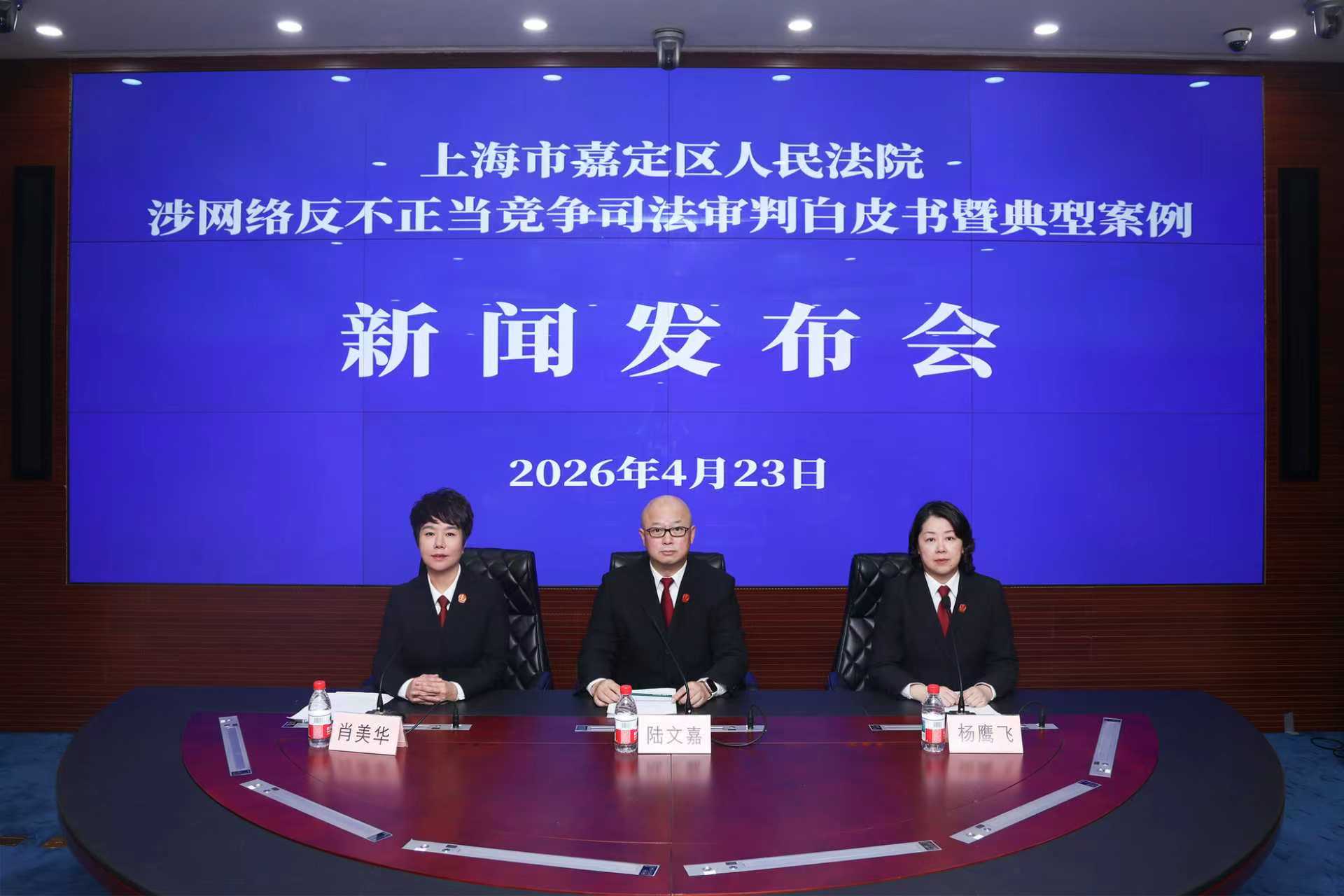
the “Jiading Court”) convened a press conference on April 23. The event focused
on leveraging the court’s adjudicative functions in intellectual property to
foster a fair, well-regulated, credible, and orderly online business
environment. At the conference, the court released a white paper on the
judicial handling of online unfair competition disputes, along with a set of
typical cases.
During
the conference, Lu Wenjia, Member of the Party Leadership Group and Vice
President of the Jiading Court, presented an overview of the court’s
adjudication of online unfair competition disputes from 2023 to 2025. Xiao
Meihua, Chief Judge of the Civil Division, introduced the Typical Cases on
Judicial Protection Against Online Unfair Competition. The press conference
was moderated by Yang Yingfei, Member of the Party Leadership Group, Director
of the Political Department, and spokesperson of the court. Reporters from
various media outlets attended the conference online, including Legal Daily, The
Democracy and Law Times, Jiefang Daily, Xinmin Evening News, Shanghai Morning Post,
Laodong Daily, Shanghai Law Journal, eastday.com, and the Jiading District
Media Center.
Online
Unfair Competition Cases Adjudicated: Overview
According
to the white paper, the Jiading Court accepted a total of 281 online unfair
competition cases between 2023 and 2025. Specifically, 93 cases were accepted
in 2023, 78 in 2024, and 110 in 2025, showing a fluctuating upward trend in
case handling.
In
terms of case outcomes, mediation and withdrawal were the primary means of
resolution. In 2023, 93 cases were concluded, of which 49 (52.69%) were
resolved through mediation or withdrawal. In 2024, 78 cases were concluded,
with 52 (67.53%) ending in mediation or withdrawal. In 2025, 98 cases were
concluded, of which 76 (77.55%) were mediated or withdrawn, reflecting a steady
increase in the proportion of cases resolved through these means.
A
breakdown of the cases reveals that confusion and imitation remain the most
common issues, while new types of technology-related disputes continue to
emerge. Specifically, 183 cases (approximately 65.12%) involved elements of
confusion or imitation; 43 cases (about 15.30%) involved keyword bidding
ranking; 13 cases (approximately 4.63%) involved false advertising; 8 cases
involved commercial defamation; 4 cases involved the use of technical means to
impede normal business operations; 4 cases involved trade secrets; 3 cases
involved data scraping; and 1 case involved illegal redirection.
The
white paper identifies several key characteristics of online unfair competition
disputes:
·
First, competitive tactics are shifting from surface-level
free-riding to deep-seated technological intervention. In the early stages,
online unfair competition largely involved imitative behaviors in page design,
product naming, and promotional language—essentially “riding on the coattails”
of established brands or popular trends to capture business opportunities. In
recent years, however, it has become more about using technological means to
interfere with others’ online operations, with such examples as data scraping,
batch processing, and automated scripts to divert traffic and disrupt platform
order. These acts are highly concealed and difficult to evidence, with the
competitive battleground now centering on direct contests over technical rules,
traffic gateways, and transactional opportunities.
·
Second, the object of protection is expanding from
individual interests to broader platform order. Traditional unfair competition
disputes typically revolved around the losses of individual business operators,
such as customer attrition, reputational harm, or being unfairly deprived of
transactional opportunities. In the online context, the focus of disputes and
the object of judicial protection have gradually broadened to encompass online
operation order, including platform rating systems, search ranking mechanisms,
and rules governing data use.
Third,
the assertion of rights is evolving from individual actions to systematic,
batch litigation. As their awareness of right protection has increased and
electronic evidence preservation technologies become more widespread, rights
holders have become more organized with increasingly standardized behaviors in
asserting their rights. Some rights holders now rely on methods such as online
monitoring, digital evidence deposit, and notarial evidence preservation to
systematically capture evidence of similar infringements and initiate batch
lawsuits. These cases often feature similar amounts of damages claimed, uniform
forms of evidence, and largely identical complaint language—posing challenges
to the court’s mechanisms for separating complex cases from simpler ones for
streamlined handling.
The
white paper also summarizes five major difficulties encountered in adjudicating
online unfair competition disputes:
1.
Difficulty in identifying the legal subject: The division of labor across
multiple stages weakens the attribution of tort liability.
2.
Difficulty in securing evidence: Technical facts face obstacles in
investigation and verification.
3.
Difficulty in characterizing the act: Defining the boundaries of
competitive conduct remains challenging.
4.
Difficulty in quantifying harm: There is a lack of a unified judicial
model for quantifying intangible competitive interests.
5.
Weak integration of judicial governance with platform governance: Platform
governance needs to be further extended to ex-ante and preventative measures.
Innovative
Judicial Measures Taken to Strengthen Governance Models
The
white paper reviews how the Jiading Court has grounded in the region’s digital
economy development strategy over the past three years and taken practices to
keep refining adjudication mechanisms, distilling rules of decision, enhancing
legal guidance through interpretation, and innovating judicial governance
models.
·
First, adhering to specialized adjudication with a focus on
harmonizing adjudication standards.
·
Second, adopting a category-specific approach to batch cases
to facilitate substantive resolution of disputes.
Third,
strengthening case synthesis and rule interpretation, leveraging the exemplary
role of typical cases.
Fourth,
using circuit trials and public hearings to illustrate legal principles and
highlight compliance risks.
Fifth,
enhancing problem identification and communication channels, pushing governance
requirements into the early stages.
Risk
Prevention Guidelines Published to Regulate and Guide Online Marketplace Order
Online
unfair competition is now no longer confined to the misconduct of individual
business operators. Instead, it often results from a combination of factors,
including platform rules, business practices, third-party service provision,
user behavior, and industry governance standards. To address this, the white
paper proposes risk prevention and control guidelines for four key categories
of stakeholders:
(I)
Platform operators should strengthen their internal management rules
1.
Rules must be clear, and enforcement must be consistent.
2.
High-risk areas require enhanced oversight, with proactive early intervention.
3.
Importance should be attached to evidence preservation and coordination for
dispute resolution.
(II)
Online business operators should conduct their operations in compliance with
the law
1.
The use of technology must stay within established boundaries.
2.
Data acquisition must follow applicable rules.
3.
Traffic management and monetization must be truthful and lawful.
(III)
Third-party service providers should clearly define their service boundaries
1.
Basic due diligence is required before accepting business mandates.
2.
Internal division of labor does not shield external accountability.
3.
Promotional services must present truthful content.
(IV)
Online users and content publishers should adhere to the principle of good
faith
1.
Consumer reviews should be based on genuine experiences.
2.
Content publishers must distinguish between objective information and
commercial promotions.
Typical
Cases Released to Demonstrate Precedential Value
During
the press conference, the Jiading Court also presented and interpreted the Typical
Cases on Judicial Protection Against Online Unfair Competition. These cases
span multiple critical areas, including data processing, algorithm governance,
platform oversight, credit rating, and compliance operations. By illustrating
legal principles through concrete cases and promoting governance through handling
of such cases, the court aims to safeguard a fair, well-regulated, credible,
and orderly online business environment.
For
example, in the case of “Shanghai Kuan X Company and Shanghai Huan X Company v.
Shanghai Xiao X Company over trademark infringement and unfair competition,”
the court clarified the boundaries of legitimate data processing and balanced
data property rights and the protection of prior rights, providing judicial
guidance for regulating data circulation order and unlocking the value of data
elements.
In
the case of “Beijing Bai X Company v. Shanghai Ding X Company over online
unfair competition,” the court held that “SERP Domination” constitutes unfair
competition for manipulating search engine algorithms. This ruling sets an
important precedent for curbing technological abuses and safeguarding platform
ecosystem integrity.
In the case of “Shanghai Zi X Company v. Wanzai County Yi X Studio over unfair competition,” the court ruled that circumventing technical protection measures to illegally parse paid digital resources amounts to unfair competition. This decision strictly penalizes online free-riding, protects the legitimate rights and interests of digital content providers in accordance with the law, and encourages market players to operate honestly and in compliance with regulations.
>> Chinese Version