
 Your current location >> Press Release
Strengthening foreign-related rule of law is an inherent requirement for coordinating both domestic and international imperatives, and for balancing development and security. It also serves as a solid legal safeguard for advancing high-level opening-up and effectively addressing international risks and challenges.
In order to guide various market entities
to conduct business in accordance with the law, prevent and reduce
foreign-related commercial disputes at the source, and help foster a fair,
orderly, stable, and transparent business environment, the Shanghai People’s
Court of Xuhui District (hereinafter referred to as the Xuhui Court or the
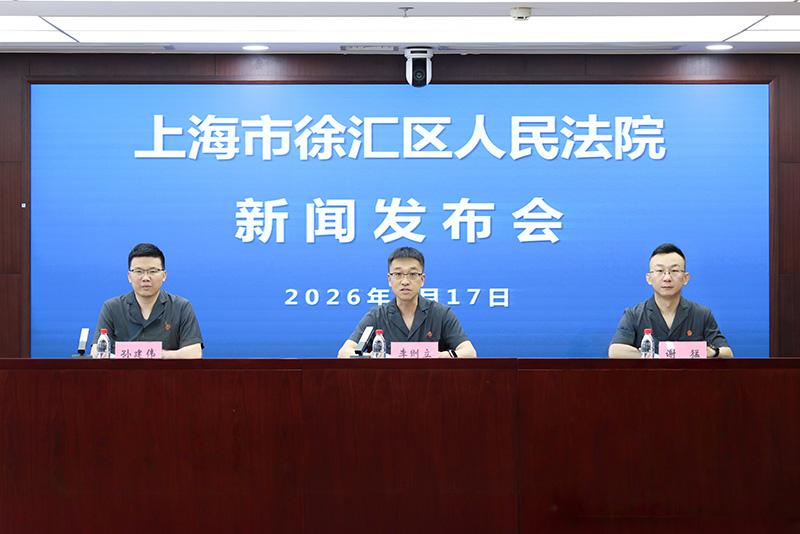
Court) held a press conference on June 17.
Li Zeli, Vice President of the Xuhui Court
briefed the press on the White Paper on the Adjudication of Foreign-Related
and Hong Kong-, Macao- and Taiwan-Related Commercial Cases (2023–2025)
(hereinafter referred to as the “White Paper”), as well as the Five Measures
for Judicial Support in Facilitating Enterprises’ Global Expansion. Sun
Jianwei, Deputy Chief Judge of the Commercial Trial Division introduced
representative cases from foreign-related and Hong Kong-, Macao- and
Taiwan-related commercial adjudication handled by the Xuhui Court between 2023
and 2025. The press conference was presided over by Xie Meng, Director of the
Political Department and spokesperson of the Court. Deputies to the Xuhui
District People’s Congress, journalists from selected central and Shanghai
media outlets, and representatives of commercial mediation organizations
attended the press conference.
Providing Practical Recommendations in Response to Risks
The White Paper indicates that, from 2023
to 2025, the Xuhui Court concluded over 110 foreign-related and Hong Kong-,
Macao- and Taiwan-related commercial cases, showing an overall year-on-year
upward trend. These cases are characterized by a broad range of parties
involved, distinct international features, continuously evolving dispute types
with emerging issues in new sectors, as well as diversified forms of property
and relatively large claim amounts.
Following a review of foreign-related and
Hong Kong-, Macao- and Taiwan-related commercial cases over the past three
years, it is found that market entities engaged in cross-border commercial
transactions face risks such as inadequate internal governance and risk
prevention mechanisms, insufficient capacity to utilize international commercial
dispute resolution procedures, and a mismatch between the supply of
foreign-related legal services and market demand. For example, in a case
involving liability for damage to shareholders’ interests, a China-foreign
joint venture catering company had failed to establish internal mechanisms for
resolving governance deadlocks such as shareholder disputes and non-compete
conflicts. Once disputes arose among shareholders, the company lacked internal
channels for resolution, making it difficult for the parties involved to settle
the dispute on their own, which ultimately led to foreign-related commercial
litigation.
In response to these risks, the Xuhui Court
put forward three policy recommendations: first, to improve internal governance
and risk prevention mechanisms; second, to enhance the capacity to apply
international commercial dispute resolution mechanisms; and third, to
strengthen foreign-related legal services and talent development.
Introducing Distinctive Judicial Service Initiatives
The Xuhui Court, anchored in its strategic
role in serving high-level opening-up, has developed a deep understanding of
the evolving patterns of foreign-related and Hong Kong-, Macao- and
Taiwan-related commercial adjudication in the new era. It has continuously
improved the quality and efficiency of adjudication, and is advancing its work
in this field along three key dimensions.
The first is focusing on model-case
demonstration to form the “Xuhui Experience.” The second is advancing
multi-stakeholder collaborative governance to enhance dispute resolution
capacity. The third is optimizing adjudication management to improve efficiency
in handling foreign-related matters. Through guidance from model cases,
strengthened government-court coordination, and accelerated process
reengineering, the court continues to consolidate its capacity in
foreign-related and Hong Kong-, Macao- and Taiwan-related adjudication.
To ensure the effective implementation of
the memorandum on “Judicial Services Supporting Enterprises’ Overseas
Expansion” and to help enterprises enhance their international competitiveness,
the Xuhui Court has further addressed the whole-chain needs of cross-border
business operations and systematically introduced five judicial service
measures: First, front-loading service access points to strengthen early-stage
risk prevention for enterprises going global; second, improving the diversified
dispute resolution framework to broaden channels for conflict resolution; third,
establishing circuit mediation stations to develop a standardized operational
mechanism; fourth, optimizing adjudication mechanisms to enhance the efficiency
and quality of handling enterprise-related cross-border cases; fifth, ensuring
smooth channels for responding to enterprises’ demands and strengthening
comprehensive safeguards across all dimensions of overseas business activities.
Providing Judicial Guidance through Representative Cases
At the news conference, the Xuhui Court
selected five representative cases for publication in the White Paper, clearly
illustrating the adjudication logic for such disputes and providing judicial
guidance for their prevention and resolution.
For example, in a case involving a dispute
over shareholders’ capital contribution, the court accurately applied the Convention
Abolishing the Requirement of Legalisation for Foreign Public Documents to
determine the validity of overseas evidence. In another case concerning an
international sales contract dispute, the court precisely defined the nature of
the foreign-related contract, thereby safeguarding and facilitating
enterprises’ overseas expansion.
The rule of law is the best business
environment. Anchored in the broader development strategy of the region, the
Xuhui Court is committed to fully leveraging its adjudicative functions,
handling foreign-related and Hong Kong-, Macao- and Taiwan-related commercial
cases with high quality and efficiency, and actively responding to the needs of
foreign-related rule of law. Looking ahead, the court will continue to explore
new pathways and adopt innovative measures, ensuring equal protection of all
commercial entities in accordance with the law. It will further strengthen the
cultivation of model cases and clarify commercial legal rules. Through
higher-level adjudication and more rigorous work practices, the court aims to
provide stronger judicial protection for high-level opening-up.
Experts’ Comment
Guo Yanjun, Deputy to the Xuhui District People’s Congress; Vice Dean, Professor and Doctoral Supervisor at KoGuan School of Law, Shanghai Jiao Tong University
The issuance of the White Paper and
judicial initiatives by the Xuhui Court fully reflects the court’s performance
in adjudicating foreign-related and Hong Kong-, Macao- and Taiwan-related
commercial cases. By presenting an overview of case handling, proposing policy
recommendations, and releasing representative cases, the court aims to extend
the function of adjudication, provide judicial guidance, and actively respond
to the needs of foreign-related rule of law. In particular, the five
specialized measures issued to support enterprises in their overseas expansion
are of great significance in ensuring the equal protection of the lawful rights
and interests of all market entities by law, fostering a market-oriented,
law-based, and internationalized business environment, and serving the
country’s strategy of high-level opening-up.
Wang Weiqing, Deputy to the Xuhui District
People’s Congress; Tax Partner at Kingdom Law Firm; the 5th and 6th Council
Member of China International Taxation Research Institute; CCTV Financial
Commentary Analyst
The Xuhui Court has released the White
Paper and judicial measures focusing on the whole-chain needs of enterprises
engaged in cross-border operations. Such documents feature solid empirical data
and representative cases, demonstrating strong practical and guiding value. They
closely align with the judicial needs of market entities and provide meaningful
operational guidance for preventing and resolving foreign-related risks. By
emphasizing “professionalism” and “efficiency,” the court has effectively
responded to societal and corporate expectations. These efforts help build a
robust legal framework for enterprises expanding overseas and enhancing their
international competitiveness, while also providing strong judicial support for
high-level opening-up.
