
 Your current location >> Press Release
Transportation is the lifeblood of the
modern economy and thus vital to people's well-being. On May 21, Shanghai
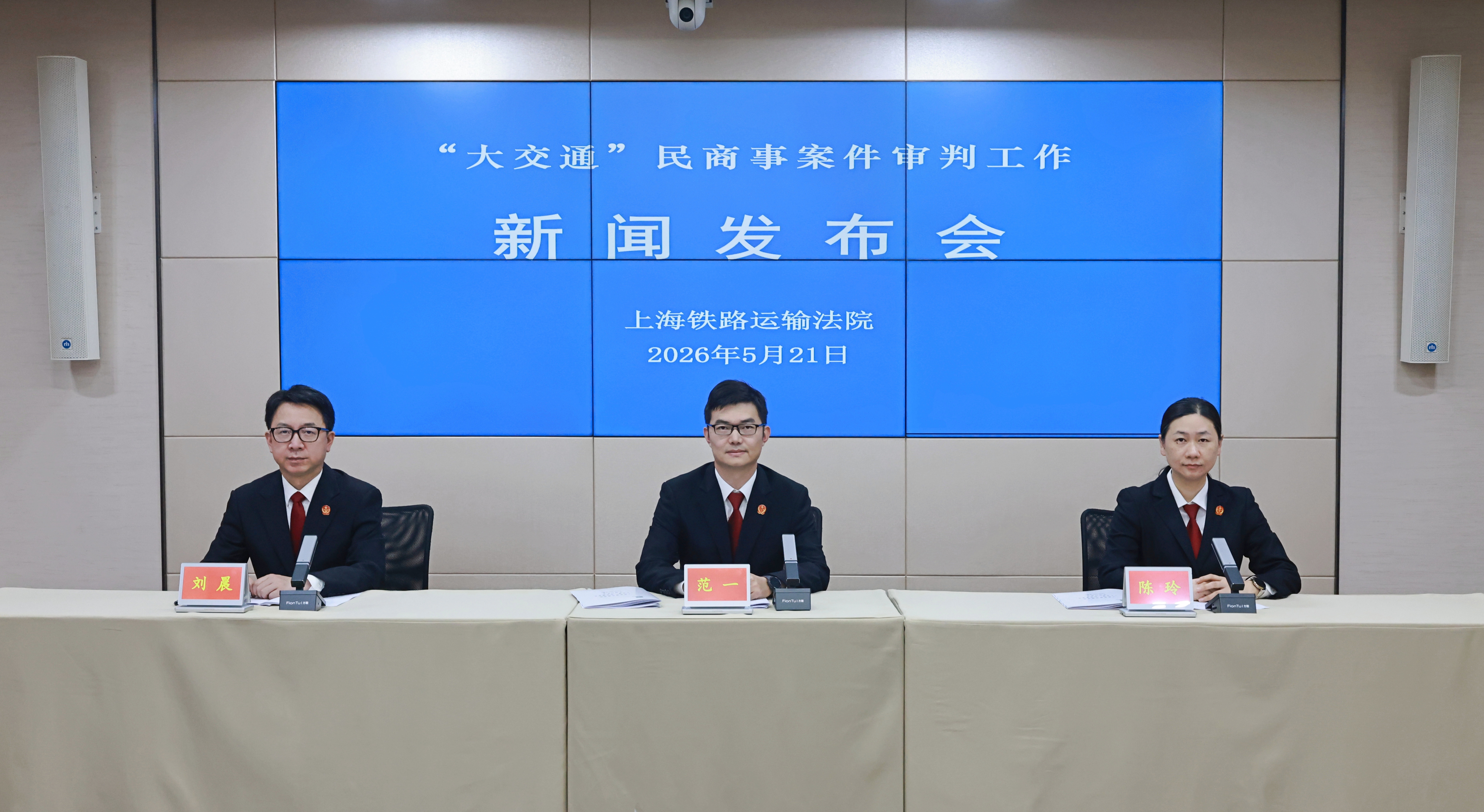
Railway Transportation Court (SRTC) held a press conference on its adjudication
work related to "integrated transportation," announcing the trial
situation of such cases from 2022 to 2025 and releasing typical cases.
At the press conference, Fan Yi, a member
of the Leading Party Members' Group and Vice President of SRTC,
reported on the relevant information of the white paper, and Liu Chen, Chief
Judge of the Civil Division of SRTC, presented typical cases. The press
conference was presided over by Chen Ling, a member of the Leading Party Members'
Group, Director of the General Office, and a press officer of SRTC. Numerous
media outlets attended the press conference.
Releasing the White Paper on
the Adjudication for Civil and Commercial "Integrated Transportation"
Cases
Demonstrating the Effectiveness of Specialized Adjudication
According to the White Paper on the Adjudication for Civil and Commercial
"Integrated Transportation" Cases (hereinafter referred to as the
"White Paper"), from 2022 to 2025, SRTC accepted a total of over
2,000 civil and commercial cases in the "integrated transportation"
field, involving railways, urban rail transit, elevated road traffic, freight
forwarding, etc., and concluded over 1,900 of them.
Out of all civil and commercial
"integrated transportation" cases during the same period, 17.72% are
accepted civil and commercial cases involving railways, 17.47% are those
involving urban rail transit, 27.84% are those involving elevated road traffic,
and 36.97% are those involving freight forwarding.
The White Paper shows that civil and
commercial "integrated transportation" cases exhibit the following
characteristics:
1. A growth trend in the number of
accepted cases
Since 2022, civil and commercial
"integrated transportation" cases have rapidly increased overall,
with an average annual growth rate of 32.8%. Among these, the number of cases
involving rail transit and elevated road traffic has grown significantly.
2. An evident growth trend in the number
of disputes over railway construction project contracts
Overall, the total number of
railway-related cases remains stable. However, disputes over construction
contracts, subcontracting contracts, construction equipment lease contracts,
and sales contracts for railway construction projects accounted for 71% of the
total railway-related cases. And this figure has increased year by year.
3. Personal tort cases, a dominant part of
dispute cases involving rail transit
Since 2022, the cases of dispute over tort
liability for personal injury caused by taking the metro have accounted for
nearly 80% of all cases involving rail transit, becoming the main part of such
cases. In terms of the location of accident, disputes are concentrated within
station spaces, mainly distributed in areas such as metro escalators, carriage
doors, platform screen doors, and staircases. There are mainly two causes of
such disputes: first, conflicts between passengers due to riding behavior; second,
personal injury caused by the neglect of safety factors.
4. The stable mediation and withdrawal
rate for civil and commercial "integrated transportation" cases
For cases involving railways, rail
transit, elevated road traffic, and freight forwarding since 2022, the overall
mediation and withdrawal rate was 47.78%.
Focusing on Innovative Mechanisms in Key Areas
Enhancing the Quality and Efficiency of Rail Transit Adjudication
The White Paper provides SRTC's mechanisms
and practices in trying civil and commercial "integrated
transportation" cases:
First, SRTC performs its specialized
judicial functions to advance the resolution of disputes in railway-related
cases. It boasts a professional adjudication team for railway-related civil and
commercial cases and adopts a professional judge consultation mechanism and a
cross-departmental case consultation mechanism for complex and difficult
railway-related cases, to conduct collective consultations for such cases and
ensure the accurate application of law. The court carries out visits and
investigations to proactively understand the judicial needs of involved
enterprises. And it has established a rapid response mechanism for judicial
services in key cases.
Second, SRTC plays a guiding role in rail
transit adjudication to serve the building of a modern city of the people. The
court vigorously carries forward the core socialist values through providing
value orientation in rail transit adjudication; actively guides the public to
develop a concept of ravel with good manners through maintaining order in rail
transit adjudication; helps enhance the governance level of ultra-large-scale
urban rail transit through improving applicable rules in rail transit adjudication;
and contributes to the building of a law-based and safe Shanghai through
rendering extended services in rail transit adjudication.
Third, SRTC has established a diversified
dispute resolution mechanism to adapt to the characteristics of elevated road
traffic cases. Specifically, it has formed a diversified dispute resolution
pattern to strengthen mediation; optimized the diversion of complex and simple
cases to improve the efficiency of procedural flow; and enhanced its
professional case-handling capabilities to improve the quality and efficiency
of case adjudication. The court emphasizes the publicity of the rule of law,
leveraging the warning and educational role of typical cases.
Implementing Targeted Measures Based on a Problem-Oriented Approach
Promoting the Standardized and Healthy Development of the Industry
In response to the issues identified
during the adjudication of civil and commercial "integrated
transportation" cases, the White Paper proposes the following
countermeasures and suggestions:
(I) To strengthen the prevention and
control of contract risks and enhance the awareness of performance with
integrity
The formulation of unified and
standardized contract templates should be encouraged to regulate contracting
practices. Market entities should enhance their contractual spirit and
integrity awareness, and promptly settle payments in accordance with agreed
conditions. In case of significant capital shortage, it is recommended to
alleviate the repayment pressure through proactive negotiation and mediation
for appropriate extension, phased performance, interest concession, etc.
(II) To enhance metro safety awareness and
promote travel with good manners
Efforts should be made to provide value
orientation in judicial cases, promote social justice through individual case
adjudication, and guide the public to cultivate the awareness of safe travel
with good manners. Relevant metro operators should play a principal role in
metro safety operations and improve the position, method, and frequency of
visual symbols and voice announcements for metro safety prompts, to increase
the effective dissemination rate of safety information. As the primary person
responsible for their own travel safety, every citizen should develop good
habits of safe travel to reduce the occurrence of risks.
(III) To clarify relevant platforms' legal
liabilities and ensure the performance of safety and security obligations
Platform administrators should further
strengthen the qualification review of ride-hailing operators on their
platforms, strengthen supervision of platform users, and regulate their
operational conduct; and fulfill platform safety and security obligations to
ensure the legality and standardization of ride-hailing services. Ride-hailing
operators should enhance their risk prevention awareness and promptly purchase
vehicle insurance.
(IV) To enhance the self-discipline of
industry players and promote healthy competition in the freight forwarding
industry
Industry entities should, first and
foremost, insist on prudent and honest operations, endeavor to avoid layered
entrustment and unfair competition, and maintain a healthy order of industry
development. Freight forwarding enterprises should strengthen the cultivation
of legal compliance awareness among their employees, enhance their awareness of
agency risk prevention, and reasonably assess risks and control risk exposure
before accepting orders. After contract conclusion, it is necessary to
establish a sense of responsibility, strengthen control over all stages of
cargo transportation, and promptly complete the entrusted transportation of
goods, the handover of documents, customs declaration for import and export,
etc. After business risks occur, it is necessary to promptly obtain and grasp
relevant information on transportation, customs declaration, handover, etc.,
and to actively provide feedback to the client and assist relevant units in
recovering losses to prevent their expansion.
Strengthening the Guidance by Rules and Explaining the Law with
Cases
Advancing the Rule of Law in Social Governance
At the press conference, SRTC also
released the Typical Cases from the White Paper on the Adjudication for Civil
and Commercial "Integrated Transportation" Cases. These typical
cases cover multiple legal application issues, including the protection of
personality rights, the responsibility of public space managers, and the
application of valuation clauses. By interpreting the law and promoting
governance through cases, they guide the public to practice the behavioral
norms of goodwill, mutual assistance, honesty, and contract abidance, while
urging operators to strictly adhere to legal boundaries and further perform
their safety and security obligations.
For instance, the "Case of Dispute
over General Personality Rights: Zhu v. Fan" clarifies that in the limited
space on a public vehicle, if forced seating leads to crowding and verbal
conflict between passengers, and this infringes upon others' bodily rights and
causes mental distress, it constitutes an infringement of personality rights
even if no serious physical injury is caused thereby. The court ordered the
defendant to bear civil liability by offering an apology, which demonstrates
the rigid protection and value guidance provided by the judiciary for the
personal dignity of civil subjects and the good order of public spaces.
The "Case of Dispute over a Carriage
Contract: A Certain Industrial Company v. A Certain Logistics Company"
clarifies that during cargo transportation, if the carrier is grossly negligent
for reasons such as vehicle mechanical failure, causing damage to the cargo,
the clause on declared value limit in the contract shall become
inapplicableinapplicable; however, if the shipper fails to truthfully declare
high-value cargo, it shall also bear corresponding fault liability. The court's
judgment precisely balanced the rights and obligations of both parties,
powerfully demonstrating the judiciary's role in regulating and guiding the
transaction order in the logistics and transportation industries.
